 Web
and Book design, Web
and Book design, Copyright, Kellscraft Studio 1999-2005 (Return to Web Text-ures) |
Click Here to return to Book of Boston Content Page Return to the Previous Chapter |
 (HOME) |
|
CHAPTER XX A
TOWN THAT WASHINGTON
WANTED TO SEE  HE ancient Wayside Inn, at
1 Sudbury, dates from the latter years of the 1600’s; it is believed
that at
least a good part of it was built in 1688; and it was a well-known
stopping
place for generations before Longfellow put it into delightful verse.
It stands
on one of the main roads leading from the west to Boston, and
Washington went
past here, and probably halted for a little, and Knox and his
Ticonderoga
cannon went by these doors. It is distant from any town; it has always
been
notable among inns for its isolation; and, when railroads came, the
nearest
one, as if respecting decades of seclusion, remained a mile or more
away, and
thus the ancient inn is as isolated as ever it was, and has kept on
adding to
its aspect of mellow romance. And it is really so very romantic! It is
stately
fronted and very large; I feel sure that I have never seen an old
gambrel-roofed
house as large as this; it is peaceful, it is full of atmosphere, and
its
ancient rooms, its taproom and sitting-rooms and huge dining-room, are
furnished with things of antique time. HE ancient Wayside Inn, at
1 Sudbury, dates from the latter years of the 1600’s; it is believed
that at
least a good part of it was built in 1688; and it was a well-known
stopping
place for generations before Longfellow put it into delightful verse.
It stands
on one of the main roads leading from the west to Boston, and
Washington went
past here, and probably halted for a little, and Knox and his
Ticonderoga
cannon went by these doors. It is distant from any town; it has always
been
notable among inns for its isolation; and, when railroads came, the
nearest
one, as if respecting decades of seclusion, remained a mile or more
away, and
thus the ancient inn is as isolated as ever it was, and has kept on
adding to
its aspect of mellow romance. And it is really so very romantic! It is
stately
fronted and very large; I feel sure that I have never seen an old
gambrel-roofed
house as large as this; it is peaceful, it is full of atmosphere, and
its
ancient rooms, its taproom and sitting-rooms and huge dining-room, are
furnished with things of antique time."As ancient is this
hostelry as any in the land may be; built in the old Colonial day, when
men
lived in a grander way, with ampler hospitality": Longfellow wrote of
it
with glowing appreciation, in those "Tales of a Wayside Inn" in which
he fancied one after another of a group of friends telling stories
there. But,
although the plan of the many poems was fanciful, the friends to whom
he
imaginatively ascribed them were really friends of his. The poet was
Parsons,
the musician was Ole Bull, the Sicilian was Luigi Monti, the
theologian,
Professor Treadwell, the student, Henry Wales, the merchant, Israel
Edrehi – an
interesting group of friends, for a Cambridge poet! – and the landlord
was
Howe, one of a line of Howes who for many years were landlords in
succession. Longfellow, well as
he knew
the surroundings of Boston, knew nothing of the famous inn until told
of it by
that good angel of the Boston authors, James T. Fields! And yet, it is
barely
thirty miles from Boston. The old inn instantly appealed to
Longfellow's fancy,
and without ever seeing it he began his tales, giving them the inn
setting.
Some time after that, on a day in 1862, Fields drove Longfellow out to
the inn;
had it not been for that, Longfellow would have been like most
Bostonians, of
his own day and of the present time, in never seeing the fine old place
at all.
It would not have checked Longfellow's wayside poems, however, not to
have seen
the Wayside! For it was an idiosyncrasy of his, frequently indulged,
not to see
places about which he wrote. It was in 1839 that he wrote of the "Reef
of
Norman's woe," yet as long after as 1878 he wrote to Elizabeth Stuart
Phelps that he had "never seen those fatal rocks," though they are
right at Boston's door! Longfellow was a great traveler, too; it was
not that
he was a stay-at-home. Yet I have seen it stated that he never saw
Acadia, to
which so many thousands pilgrimage to do him honor! One does not quite
like to
inquire whether or not he ever saw the definite localities of Miles
Standish
and John Alden. It is not alone the
houses
and places definitely connected with great events of the past, or with
great
authors, that are of interest. The spirit of the past is often finely
represented by old houses which are without great associations, but are
fascinatingly mellowed by the salt and savor of time. The ancient
wayside Inn,
rich in its associations with Longfellow's admirably told tales, would
have had
great fascination even without them. New England still
possesses
a number of very old houses, delightful in their general presentation
of the
past, without needing much of definitely great associations. There is
the
Royall house at Medford, one of the oldest houses still standing in
this old
country of ours, built, the greater part of it, in the early 1700's,
but with
part of it probably dating back into the previous century. Nothing is
more
difficult, in most cases, than to fix upon the precise building date of
an old
house, and the difficulty is greater if the house has passed through
the hands
of various families, and in addition has been altered or enlarged. In
most
cases, when a house, now old, was built, no one was thinking of
far-distant
future interest in the precise date of construction. Sometimes, when a
house
was built, the date was set up in a corner of the gable; sometimes the
date
seen in a gable represents the date of an addition or is a modern guess
at the
date of the original building. Most often there was no marking
whatever, and
ancient deeds of real-estate seldom throw light on the subject, because
they
mention the land alone or may refer to an earlier house. The Royall house is
one of
the most interesting in appearance of old New England houses. Although
it is a
village house, not a house on an isolated estate, it is more retired
and
exclusive in its situation than was the case with New England village
or town
houses in general, which were mostly set near a main street or road. A
great
open space is still retained about this Royall house, with great old
trees,
with shrubs, with part of an ancient lilac hedge with white and purple
flowers,
with the marks of ancient paths and driveways, with even the ghost of a
garden
still retained within the fragmentary boundary of an ancient wall of
brick. Near the old house
there is
a little ancient building which it is well to look at, for it
represents a
feature of early New England life; for this little building, believed
to be the
only one of its kind still standing in Massachusetts, was the quarters
of the
slaves! – of whom, so records tell, twenty-seven were owned by the
master of
this Royall house, in 1732. The Royall house is a
house
with two fronts: either back or front may almost be termed the front;
and it is
a big house, with fine doorways and windows. And that there is record
of
twenty-one weddings known to have been solemnized within this ancient
home is
quite as important as if it had been a rendezvous for soldiers or had
sheltered
some fleeing patriot or Royalist. As a matter of fact, the owner, when
the
Revolution came, was a Royalist who fled to Halifax and England; he
yearned
deeply to return to the stately house, set in its stately environment
of trees
and garden and grass, but he died an exile, before the war came to an
end. The house is
maintained by
one of the patriotic societies and is furnished throughout with the
furniture
of the past: and in a corner stands a chest, of greenish Chinese
lacquer, an
odd-looking, unexpected thing to be there: and you learn that it is
reputed to
be one of the very chests thrown into the harbor at the Boston Tea
Party, and
picked up, afterwards, floating in the water. There is a staircase
of
delightfulness, with newel-post and balusters exquisitely fine; there
are
notably beautiful interior pilasters in the upper hall; there are
paneling and
window seats and fireplaces and cornicing and a secret stair: there is
abundance
of rambling roominess and everywhere are the belongings and the very
atmosphere
of the past. For such houses are in themselves the very past. It is near the
Mystic: a
quiet stream, sedate and solemn, slowly winding its way in sweeping
bends
through marshy levels to the sea. In this house General Stark early
made his
headquarters; and his wife, pleasantly remembered as "Molly Stark,"
watched from the roof the topmasts of the British ships, in the
distance, as
they moved out of the harbor at the evacuation of Boston. Also on the Mystic,
and not
more than two miles or so from this house of the Royalls, is a house
still
older, the Cradock house. On the way to this house one passes an
ancient-looking little shipyard, whose little ships poke their
bowsprits out
over the very sidewalk. From the foreground
of the
Cradock house and of several oldish houses that neighbor it, the salt
marshes
of the Mystic stretch away into the distance, and far off, above them,
rises
the city of Boston, on its hill. A mist was gently falling, as I
looked, and it
dimmed the stream and the marshes with mystery – all was becoming
literally
Mystic! – and the mist came sweeping softly toward the ancient Cradock
house,
and wrapped it as in the mist that comes with the centuries. The house is of red
brick,
and stands on a low knoll, and is admirable in shape, with its
gambrel-end of
felicitousness, and its many-paned windows, and the little oval windows
at the
side. Vines clamber thickly upon it, and although it is somewhat
spoiled by inferior
immediate surroundings, it is itself fine and sweet, it is itself a
notable
survival, standing so happily on its knoll and looking off toward
Boston. This Cradock house,
in
Medford – easily reachable by trolley – is remindful of another and
still more
fascinating house, of about the same date; a house which, indeed, looks
the
older of the two, and probably is: the Fairbanks house at Dedham: and
this also
may be readily reached by trolley. And I mention this because train
service is
often inconvenient, to many a point, and because not every tourist goes
about
with a motor car. The Fairbanks house is of three periods, all of them, so it is believed, in the 1600's! The middle and oldest portion of the building dates back to before 1650, and it very likely deserves the honor of being the oldest house in New England, although, as has been mentioned, the precise dating of ancient homes is a doubtful matter. 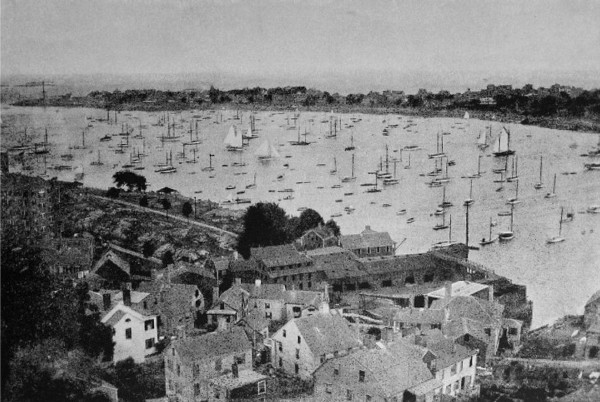 The Harbor of Marblehead The first impression
is of
an entrancing medley of roof lines: literally of roofs; there seems to
be nothing
but roofs! – for the roofs of the center and the wings come, alike,
almost to
the very ground. The general aspect of the house is positively
fascinating: it
is so rambling, so long, so romantic, so fetching, as it stands on its
slight
rise of land, shaded and sheltered by giant hoary trees. There is no
other
house in New England which more
satisfactorily represents very early America. It is not the grandest of
early
houses, but it is thoroughly homelike, thoroughly attractive, a Puritan
homestead. It stands at the junction of two highways, and its approach,
from
Boston, is through an avenue of giant willows that archingly
intermingle their
branches above the road. And the house is forever protected, by having
been
purchased by the Fairbanks Family of the United States, incorporated
for the
purpose. The ancient town of
Marblehead possesses the house, the Lee mansion, the home of Colonel
Jeremiah
Lee, which in costliness of interior finish of a home stands first
among the
pre-Revolutionary mansions of New England. It was built less than ten
years
before the beginning of the Revolution, and is said to have cost the
sum, at
that time deemed enormous for a house, of ten thousand pounds. That
Washington
was received here as an honored guest, that subsequently Lafayette was
received
here, that at a still later date Andrew Jackson was a guest, are but
casual
claims to fame; the chief claim is the house itself, in its stately
beauty and
dignity. But in the first
place one
notices that it stands near the sidewalk, with distinctionless houses
close on
either hand, and that ordinary houses face it from across the narrow
way.
Costly as was this mansion, the home of a merchant who owned a hundred
ships
and was of high social standing, there was never the slightest attempt
at
aristocratic exclusiveness, or to have it one of a number of houses in
joint
aristocratic environment, as with the superb houses of Chestnut Street
in
nearby Salem. A few other rich houses are in the neighborhood, but
they, like
the Lee mansion, are closely surrounded by the homes of the butcher,
the baker,
the candlestick maker. It should be
remembered that
the wealthy colonel, the owner of this house, gave his life for his
country. He
was searched for by the British, at the very beginning of the
Revolutionary
struggle, as he was one of an active committee of safety. The British,
on their
night march to Lexington, passed near a house where the committeemen
were
gathered, and Lee, with one or two others, lay in a field, in hiding,
for some
hours, and he shortly afterwards died from that exposure. Well, he gave
his
life for his country. But what an opportunity he missed! He was a
colonel, a
man of affairs, a leader; he could have won immortal renown had he
headed the
farmers against the British, instead of fleeing and getting his death
from the
chill of a night in early spring; and he let the farmers win
immortality
without any leader of prominence. Like John Hancock and Samuel Adams,
Colonel
Lee, after getting other men to fight, fled from the actual conflict;
even
though, also as with Adams and Hancock, on that night before Lexington
and
Concord, the British soldiers were so close upon him that it was with
difficulty he got away. Had he accepted the opportunity that Fate was
trying to
force upon him he might not only have won splendid fame, but might have
lived
after the war, for years, in his splendid home. The mansion, now
maintained
by the Marblehead Historical Society, is entered through a superb
portico and a
superb ten-paneled door. The hall is noble in proportions and size,
being
forty-two feet long and sixteen feet in width. The stairway is of the
noble
width of six feet and eleven inches, and rises in stately ease, with
beautifully twirled banisters of mahogany. The stair turns, at a
landing, where
there is a wonderful beehive window and a felicitous window-seat, with
a pair
of beautiful pilasters at either side. I do not remember any staircase
and
landing to equal the beauty, the serenity, the nobility of this, in
any, even
of the grandest, of other Colonial houses, South or North. The house is
rich in
paneling, and one of the finest rooms is paneled in solid mahogany. And
a
strikingly distinguished feature is the wallpaper of the ball; huge
pictured
paper, still in perfect preservation, showing great classical
landscapes, in
black on cream-colored ground, with temples and arches and streams.
This
magnificent paper antedates the Revolution and is supposed to have been
made by
an Italian in London. Within sight of the
Lee
mansion is that of Lee's brother-in-law, "King" Hooper, as he was
called from his wealth and magnificence; he was another merchant
prince, and
the house is especially notable from the fine banquet hall, still
preserved, in
the upper story of the big building. And not far away is another Lee
mansion,
the home of a brother of Colonel Lee. Marblehead is a town
of old
houses, although most of them are of a far more modest kind than these
great
mansions. And it is an interesting town in its general aspect of the
olden-time. "The strange, old-fashioned, silent town – the wooden
houses,
quaint and brown"; and indeed it is a study in browns! And in its older
portion, beside the shore, it is still little more than a maze of paths
and
byways, of narrow streets incredibly twisting. Houses are set down at
all sorts
of angles, shouldering one another into or away from the roadways. Many
of
these houses are ancient, and there is still in use a fascinating,
ancient-looking shipyard, with high-perched ships under construction,
directly
on the line of one of the streets, as with the one at Medford; it is a
yard
full of ships and chips. And there are black rocks, with black pools
among
them, and a rocky shore; and there is a broad stretch of harbor,
thick-dotted
with fishing boats. The people who live in this most old-fashioned
portion of
the town are still full of old-fashioned ways and beliefs, and many of
them
have actually heard the shrieking woman: the ghost of a woman who was
put to
death by Spanish pirates at what is now called Oakum Bay, and who
shrilly
shrieks on the yearly night of her murder, just as she shrieked in
actuality,
dismally rousing the town from its slumber, so long ago. George Washington was
especially desirous of seeing Marblehead, on the journey that he made
to
Massachusetts in 1789; I say "especially," not that he gave any
reason, but because in his diary he singled the place out for mention
as one to
which he wished to go; and it was an extremely unusual thing for him
thus to
write of any place. Going to Salem, he detoured to Marblehead, "which
is
four miles out of the way, but I wanted to see it." It is rather
tantalizing that, after so writing, he kept his impressions of the
place to
himself! Perhaps he went to
Marblehead because it was the home town of the gallant General Glover,
who did
so much at Long Island and the Delaware. And the home of Glover is
still
preserved. It is up one of the crookedest and narrowest of the lanes, a
stone's
throw from the water's edge, in the heart of an ancient nautical
neighborhood;
it is a white house, with fine doorway and gambrel roof, and has a fine
aspect
of dignity. Here in Marblehead
still
stands the house in which lived Captain Blackler, one of General
Glover's men,
who was intrusted by Glover with the command of the very boat in which
Washington
crossed the Delaware! And compared with such a memory, how little does
it
matter that this house of Blackler's was also the birthplace of
Elbridge Gerry! Marblehead is mainly
known,
to many people, from the stirring lines depicting Skipper Ireson,
Whittier
having lived in the town for a time and having become saturated with
the
legends and spirit of the place. But Marblehead does not relish the
lines,
picturing, as they do, the supposed cowardice of one of its captains,
and has
striven hard to throw off the odium by claiming that it was not Skipper
Ireson's wish to desert the ship that asked for aid, but that he
followed the
united demand of his crew; an amusing defense of the honor of the town,
to put
the blame on many rather than on one! It has seemed to me that the
endeavor to
reject the story has really been more on account of the desire to throw
aside
the odium of Marblehead's women engaging in the pastime of tarring and
feathering, a sport supposed to have been left to men. But New England
women did
early do tarring and feathering on occasion, as in a case mentioned by
Baroness
Riedesel, in her memoirs, as having occurred in Boston, a case in which
a party
of Boston women seized the wife and daughter of a self-exiled loyalist
and
tarred and feathered them and led them through the city. I am afraid
that a
good many things that were not very pretty took place in the good old
days. So far as bravery is
concerned, Marblehead needs no defender; Ireson was an exception – or
his men
were exceptions, if the town prefers to put it that way. Marblehead is
said to
have given more men to the Revolutionary army, in proportion to the
population,
than any other town in America; and it was not only quantity of men but
quality; Marblehead men were famed for bravery. It was to a Marblehead
man, in
his armed schooner, that, in 1775, the first British flag was struck.
And some
Marblehead men sailed into the St. Lawrence, also before 1775 was over,
and not
only captured English boats, but actually landed on Prince Edward's
Island and
made the governor a prisoner. But the list of the Marblehead brave is
too long
to name. The old Town House of
Marblehead still stands, full of years and memories. And there still
stands the
home of a certain Moses Pickett who, reputed a miser and dying in 1853,
left
his house and his entire little fortune for the poor widows of the
town, thus
with his thirteen thousand dollars doing far more good in the world
than many a
wealthy man has done by blindly throwing away millions. And here is
still
standing the home of that Captain Creesy who, with the Flying
Cloud, won the reputation of being the best skipper, with
the fleetest sailing ship, in the world. And here is the house in which
the
famous jurist, Judge Story, was born. A church is still standing, St. Michael's, which is over two hundred years old, but it has been considerably altered from its original appearance. And there is a delightful association connected with it. For an early rector of this church left it to take, instead, a church in Virginia, and while in Virginia he was called upon to marry two people who came to be a very prominent couple in the eyes of the world-for they were George Washington and the Widow Custis! 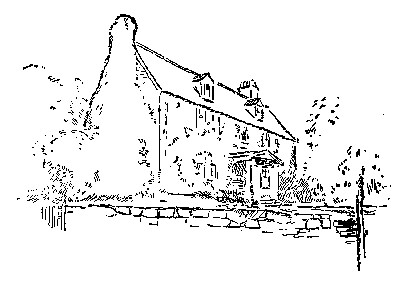 |
 Click the book image to turn to the next Chapter.