 Web
and Book design, Web
and Book design, Copyright, Kellscraft Studio 1999-2005 (Return to Web Text-ures) |
Click Here to return to Book of Boston Content Page Return to the Previous Chapter |
 (HOME) |
|
CHAPTER
XXI THE
FAMOUS OLD SEAPORT OF
SALEM  N the minds of many, Salem
is chiefly notable on account of Hawthorne; in the minds of others the
city is
equally notable on account of the witches; yet most of the Salem people
themselves do not relish any talk of witches; in their treatment of
which
unfortunates after all, this city only
followed the example set by Boston; and as to Hawthorne, he for his
part
frankly disliked pretty much everything connected with the place even
though he
was born in Salem and achieved his greatest triumph while he lived
there. N the minds of many, Salem
is chiefly notable on account of Hawthorne; in the minds of others the
city is
equally notable on account of the witches; yet most of the Salem people
themselves do not relish any talk of witches; in their treatment of
which
unfortunates after all, this city only
followed the example set by Boston; and as to Hawthorne, he for his
part
frankly disliked pretty much everything connected with the place even
though he
was born in Salem and achieved his greatest triumph while he lived
there.The ancient house
where
Hawthorne was born on the patriotic day of July 4th, 1804, at 27 Union
Street,
is still preserved, and it is a house that could never have been very
attractive, and is situated in a faded quarter of the town which was
never of
the best. Salem was settled at about the same time as Boston, but a
little
earlier than the big neighbor that was to outgrow it; it was settled
almost ten
years after the landing of the Pilgrims at Plymouth; and among the
various and
notable things in the long history of Salem there has been nothing
finer than
its standing undauntedly by Boston when Boston's port was closed in
punishment
for unrest and outspokenness shortly before the beginning of the
Revolution;
Salem might have profited by a rival's misfortune, but would not, and
nobly set
forth, in formally phrased declaration, that "We must be dead to every
idea of justice, lost to all feelings of humanity, could we indulge a
thought
to raise our fortunes on the ruin of our suffering neighbors." Hawthorne lived in
Salem an
several different houses in turn, and in one of these houses, the house
on
Herbert Street where he lived as a boy and as a young man, and twice at
different periods afterwards, he wrote, in 1840, "If ever I should have
a
biographer he ought to make great mention of this chamber in my
memoirs,
because here my mind and character were formed. By and by, the world
found me
out in my lonely chamber"; and it was of this Herbert Street house that
he
wrote, "In this dismal chamber Fame was won." Future fame, in the
person of another, had certainly found him out as far back as when he
was a
boy, when he lived in this Herbert Street house, for at one time, when
he was
kept from school through having hurt his foot, his kindly
school-teacher came
here to call upon him, this quiet school-teacher being a man of the
name of
Worcester, himself to be famous as the author of a dictionary honored
on both
sides of the Atlantic! In his earlier years
and
well into middle life Hawthorne had no doubt of his claims to high
literary fame,
but, as with many another author, doubts came to him with lack of
financial
returns, and when, at the age of forty-five, he wrote his masterpiece,
he was
so afraid that it was a failure that he actually feared to show it; he
had had
so little of practical success that he could not believe that he had
really
written a book that was even worth looking at; he was utterly
downhearted; and
this brought about the most interesting happening in the entire history
of this
town of Salem, the discovery of the "Scarlet Letter." And I do not
mean the supposititious discovery, by the author, of the letter itself,
but the
actual discovery of the novel by the publisher. James T. Fields came
out
here to Salem to see Hawthorne one day in 1849, when Hawthorne was
living at 14
Mall Street, and encouragingly asked for material for a book, to which
Hawthorne only replied, gloomily, that he had been doing nothing. "And
who
would publish a book by such an unpopular author as I am?" he demanded.
Whereupon, "I would," promptly responded Fields. His publishing
instinct told him that Hawthorne had really been at work and had
something
ready. "You have a book already completed," he insisted, in spite of
the author's demurs; and at length Hawthorne reluctantly admitted that
he had
really been writing something and that it was enough for a book. And he
reluctantly took from a drawer the manuscript of the greatest of all
American
stories. Fields took it with
joy,
hurried with it back to Boston, sat up that night to read it, realized
its
greatness, and hurried back next day, aglow with enthusiasm. He found Hawthorne
still
discouraged, awaiting his report on the story, but the discouragement
swiftly
vanished when he found that Fields was bubbling over with energy and
happiness,
and eager to make a contract for the book's publication. And that was
how the
"Scarlet Letter" saw the light. Previous to this
inspiration
and encouragement on the part of Hawthorne's publisher there had been
the
encouragement and inspiration of Hawthorne's wife. For when,
downhearted,
thinking that without a salary he could not live, he had gone home to
her with
the news that he had lost the place in the Salem Custom House that had
come to
him from the friendship of his old-time college-mate, President Pierce,
his wife
neither joined him in repining nor urged him to seek some other
salaried place,
but, instead, put down before him money that she had been saving,
unknown to
him, from the domestic allowance, and said cheerfully, "Now, you can
write
your novel." It was under that inspiration that he wrote it, and when,
the
work done, fear came upon him that it was not good, it was from his
publisher's
inspiration that it saw the light. In all, a strange story of
literature and of
Salem! Near the waterside,
in the
older part of the city, looking out at a lovely view across the water
of the
harbor and off toward the broad Atlantic, is an ancient, nestled,
low-set
house, with ancient stack-chimney of brick; a house overhung by great
trees and
pleasantly surrounded with grass, and reached by a little
private-looking lane
known as Turner Street, which leads down from a main thoroughfare.
Hawthorne
wrote of this house, which even when he wrote was about a century and
three
quarters old, and he gave it fame as the "House of the Seven Gables."
Within my own memory this house had only five gables, in spite of its
fame –
given seven and its actual present seven, for it has not only been
restored and
kept in repair on account of its association with Hawthorne, but an
architect discovered,
or thought he discovered, that it originally had seven gables, just as
Hawthorne described it, and so the necessary two were built out again!
And a
wonderful roof-line the house has, with its clustered gables and that
old
central chimney, "stacked" stacked" like those of Tudor days.
Perhaps it was not altogether desirable to put on the two gables;
Hawthorne had
no desire to have the house precisely match his description; he
pictured it in
his imagination and that was quite enough. Hepzibah's "cent shop" has
also been given to the building, and its interesting old rooms are open
to the
public for a small fee. Hawthorne began to
write the
"Scarlet Letter" at a high desk in the Custom House, a satisfactory,
good-looking, old square building down near the waterfront, while he
held the
appointment of surveyor for the port of Salem, and it was after he lost
that
official position that he finished the story. Hawthorne felt very
critical
toward the people of Salem, not having found precisely congenial
surroundings
there, even though it was in Salem that fame came to him, with some of
his
early work, and even though his wife was a young woman of Salem. He
kept very
much to himself while he lived in that town, at least in his maturer
years, and
his attitude is expressed by a letter in which he comments on an
invitation
which he has just received, for his unsocial expression is, "Why will
not
people let poor persecuted me alone?" It need not be thought that he
was a
recluse, but at no time in his life did he care to spend time with
people who
did not interest him. Hawthorne has somehow
managed to offer for future generations such an atmosphere and detail
of the
past of old Salem, and thereby of all of old New England, as shows us
the very
life and feeling of the ancient time. He could see and feel the fine
old
romance of the past, the charm of it, the beauty of it, and he could
also see
the vivid human nature of it. And Salem could never quite forgive him
that he
recognized also the impermanence of much that was so good in it, and
that in
that very town he discerned what he termed "worm-eaten aristocracy."
It was his ability to see and to feel the past not only in its romantic
colors
but in its entirety that made it possible for him to write his greatest
works,
"The Scarlet Letter" and "The House of the Seven Gables." One's first
impression of
Salem is that it is rather an uninteresting place, for the entire
central
district near the railway station has been made unattractively
brick-red and
modern; but by getting away from this central region, one finds that
there is
still left very much of the interesting. Gallows Hill, on
which the
witches were hanged, is a hill that seems to be a solid rock, at the
edge of
the town, bare of trees but covered with grass and dwarf sumac. The
actual
place where the gallows stood has been forgotten, but the general
position is
remembered and avoided, and the city itself owns the land. Not far
away,
however, quite a settlement has grown up and the people who live there
have
formed themselves, with cheerful bravado, into a Gallows Hill
Association, and
when the children of Salem not long ago paraded in a pageant, those
from this
part of the city dressed themselves proudly as little witches. At the court house in
Salem,
some ancient witchcraft mementoes are preserved, including some of the
"witch pins" that figured in the evidence, and the curious death
warrant that directed the sheriff to hang one of the witches until
"dead
and buried" – which was an unintentional order to carry vengeance
beyond
the grave. Under the old English
Common
Law, which was in force in America until modified by local laws,
conviction for
felony involved confiscation of property, but there was no provision
for procuring
conviction in case the accused refused to plead. Nowadays, in case of
such
refusal the court enters "Not Guilty," but formerly there was nothing
to do but try to force a plea by the frightfully painful method known
as peine forte et dure, which was the
heaping of stones and weights upon a man's chest until he yielded or
died. If a
man was brave enough to bear the torture to the bitter end, he could
not be
convicted, and there could be no forfeiture, whereupon his heirs
inherited his
property; and now and then a man actually bore the pain to win that result. In all
American history there
has been but one example of peine forte
et dure. Giles Corey, accused at Salem of witchcraft, and knowing
that if
he stood trial he was certain, in those days of blind excitement, to be
convicted, refused to plead and heroically bore the punishment of
pressing to
death. There can be no
possible
appreciation of Salem without going from end to end of Chestnut Street.
Yet
even a mention of this street is likely to be omitted in Salem
guide-books,
merely because no incident ever happened there. But no greater mistake
can be
made by any one who wishes to understand the past than to look only at
places
connected with definite occurrences, for the history of the past and
the
interest of the past often lie even more deeply in houses and
localities that
only represent the past with indirectness. And Chestnut Street is in
itself a
remarkable American street. Among the most interesting streets in America are Chestnut Street of Salem, Chestnut Street of Boston, and Chestnut Street of Philadelphia, and each of these has justly been deemed a street with much of the old American charm of architecture, each has been a stronghold of aristocratic living, each has still much of the flavor of the past, each is a street of houses of beauty and good taste, and all these three Chestnut Streets still preserve a great degree of their original felicitousness, even though the greater part of the Chestnut Street of Philadelphia has lapsed into business. 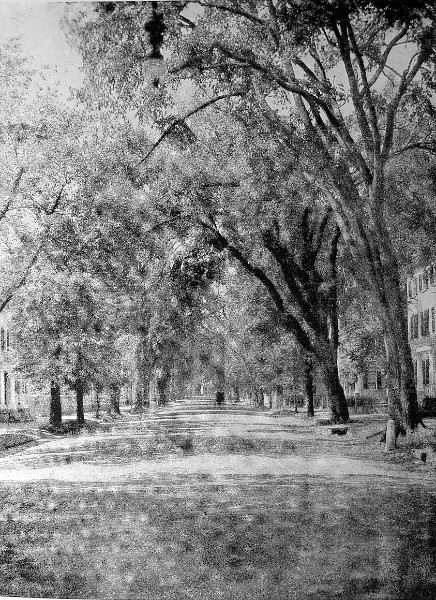 Romantic Chestnut Street, in Salem Salem is proud in the
belief
that of the three Chestnut Streets its own has always been the best;
and it
really has been, and that is a great deal to say of even the best
street of a
little city like Salem. These Salem houses on Chestnut Street were
built in the
first quarter of the 1800's by the rich merchants of that period, and
there is
not only a superb line of mansions, well kept up, but also even more
superb
lines of huge trees, glorious trees, trees that splendidly overarch the
entire
length of the street, the houses themselves being just far enough back
from the
sidewalk line to permit of the complete rounding of the shapes of the
trees.
One cannot well be too enthusiastic, too appreciative, of this street
of
mansions, fine American in style as they are, and designed, most of
them, by
the Salem architect, McIntire, or at least built under his influence.
It is the
finest street, taken in all, of any of the streets of old-time mansions
in
America, and the double line of old mansions is remarkably unbroken. Toward the other end
of the
city, with staid old homes built about it, is Washington Square, with
its
iron-railed and elm-bordered training-green. The houses of wealth and
dignity
that front this green are of the same general period as those of
Chestnut
Street, and both of these sections show the fine and even magnificent
living of
the period of Salem's highest prosperity, when her great shipping
fortunes were
made; and, indeed, by far the greater part of the fortunes of New
England had
their origin in the glorious days of American shipping. As one goes about
Salem, the
first impression that there is little of interest here entirely
disappears; one
forgets entirely the portions that at first jarred expectation; and
there comes
the full understanding that the city is remarkably rich in interesting
houses of
the past. And it is one of the chief charms of the place that upon
these houses
of the past the hand of the restorer has been but lightly laid, and
that they
remain as their builders intended them to remain. One of the most
interesting
of the many old houses is the Pickering house on Broad Street, a
particularly
attractive home that has stood there for two and a half centuries; it
has
actually stood, right here in Salem, since the later years of the time
of
Cromwell, or at least since 1660, the year of the restoration of the
Stuarts!
How unexpectedly far away this seems, for America, even after one has
come to a
realization that this is not a new country! For it is hard to realize
that
actual living was so fixed and comfortable here so long, long ago. This
Pickering
house is still preserved and cared for by Pickering descendants, and
the
building serves to keep in mind not only the general charm and interest
of the
charming and interesting past, but the career of a particular Pickering
who was
born in this house and who won unique honors – that Timothy Pickering
who, as a
right brave fighter, was an officer at the battles of Germantown and
Brandywine, who, as a legislator, was successively representative and
senator,
and who, in Washington's Cabinet, was given the successively high
distinctions
of being postmaster-general, secretary of war and secretary of state. The best parts of
Salem are
interesting not only because of the admirable buildings but because of
the not
infrequent fine and planned harmony of mansion and carriage-house and
garden,
arranged and designed as a complete whole. There is a house at 80
Federal
Street which, with its surroundings, is a particularly good example, a
house
built in 1782, a house which ought to be seen by any visitor; it is of
fine New
England architecture, and I remember its doorway as a work of special
beauty;
and it has carved urns of most admirable classic design on its
gateposts,
showing how very beautiful may be a plain gateway with posts and
ornaments of
wood; and this house, with its garden and adjuncts, is one of the
excellent
examples of harmonized planning. More than most other
Eastern
cities Salem offers direct inspiration for visitors from the West,
because from
the first it has been built with detached homes, each with grass plot
and
garden, instead of with houses ranged closely, shoulder to shoulder, as
in
Boston, New York and Philadelphia. One of the most
famous of
naval fights, that between the Chesapeake and Shannon, the gallant
"Don't give up the ship!" action, was fought so near Salem, just off
its harbor, that the heights along the shore were thronged with Salem
people
who watched the progress of the battle with eager suspense. Always a
brave
city, this; a city ready to encourage others in bravery and to do brave
things
itself. It is said that in the War of 1812 forty armored vessels of the
two
hundred and fifty furnished by the entire country were from Salem. And
the
mettle of Salem was shown in the brave way in which it faced the
devastation of
the fire of 1914, that swept away hundreds of houses; for instead of
helplessly
yielding to what might well have seemed an irreparable disaster, the
city began
at once, and on a broad scale, the task of rebuilding. A fortunate thing
with that
fire was that with few exceptions it did not take away the old-time
buildings
of the city. They still remain. In fact, there is no better place, and
there is
probably no place even as good except a remote town like Guilford in
Connecticut, where the various styles and periods of American buildings
may be
seen. Salem still has houses of the 1600's, with their overhanging
stories and
stack chimneys; it has houses of the 1700's, with their gambrel roofs
or roofs
of double pitch; it has the great square-fronted stately houses of the
period
from 1790 to 1825. Those who would study the old houses of America
should go to
Salem. And there is many a
little
detail here, too, that is noticeable, as well as the houses themselves;
for
example, all over Salem there is the opportunity to see excellent
designs in
old-time door-knockers. The Ropes mansion, a
house
of the 1700's, is interesting both in itself and in the way in which it
has
been preserved, for it is an endowed memorial of the past, left by its
late
owner to be kept, with all of its old furniture and with its garden
planned as
an old-fashioned garden of finest type, not as a museum held by one of
the
patriotic societies, but as a possession of the public into which the
public
may freely go. The house, with its belongings, is forever to be shown
to one
generation after another, with no chance of being sold or torn down at
the whim
of some tasteless heir. Yet, if all these old
houses, with their wealth of old belongings, should be destroyed, the
Salem of
the past would still be represented if it should still retain the
treasures of
its Essex Institute. The building that holds these treasures is a
three-story
structure of generous proportions, standing near the center of the
city, on
Essex Street; and that where this house now stands there once stood the
house
of a man named Downing, is remindful of one of the romantic facts in
regard to
early America. For the son of this Downing went over from here to
London and
became so strong a friend of Cromwell as to be made Minister to The
Hague, and
then by a swift transfer of allegiance, in order to retain his
ambassadorship,
he swung over to the cause of Charles the Second; and eventually he
gave name
to Downing Street; that street of all streets that is most typical of
the
English, the street whose name typifies the English government itself! The Essex Institute
holds,
in itself, Old Salem. Enter the door – and the building is freely open
to
entrance by any one who is interested – and instantly you are
generations away
from the present, for there is nothing that does not tell of the past,
and the
past is shown with infinite picturesqueness and particularity. There is
a great
central portion, and there are little alcoved rooms full-furnished as
rooms of
the olden time, all in immaculate ship-shape order. There are paintings
of the
men and women of the past; there are the very costumes that they wore,
the
gowns, the bonnets, the coats, the waistcoats; there are wedding gowns
and
there are uniforms and there are the very looking-glasses in which
those old-timers
saw the reflection of their faces. Here are the very glasses from which
they
drank and the very dishes from which they ate; and these are preserved
in
amazingly great quantity and in amazingly good condition; and glass
collectors
would like to know that one item alone is of some one hundred and fifty
cup-plates of glass of Sandwich make! Here in Essex
Institute is
the furniture of our forefathers, tables and sideboards and chairs, and
among
them is a black, heavy three-slat chair with high-turned posts which
was the
favorite chair of that beloved Mary English, who, with her husband, the
richest
ship-owner of Salem, had to flee from Massachusetts for very life under
the
shadow of witchcraft accusation; and this excellent old chair seems to
stand as
a reminder that neither wealth nor high character nor charm of manner
nor
social position can be relied upon to check a popular, delusion. On the whole, the
relics are
remindful of a cheerful past, a happy, bright, refreshing, pleasant
past; and
the surprising number of spinets that have been preserved would alone
show that
the early days were far from being days of mere gloom and severity. But not only the
personal
belongings of the past, and the furnishings of the old buildings, are
preserved, here at the Essex Institute, and not only is there a
delightful old
house of the seventeenth century, with overhanging second-story and
peaked
roof-windows, actually within the grounds of the Institute, but
fascinatingly
among the possessions of the museum are portions of old houses that
have been
destroyed: for here are pilasters and balusters, pillars and
window-tops, here
are the very cornices of rooms, here are the essential fragments of
buildings
that have gone. It would seem as if not only in cases of demolition of
old
houses, but in the fewer cases of restoration and "improvement," the
Institute has been on the watch for treasure. Some time ago the old
house in
which Hawthorne was born had some of its window sash replaced by larger
panes –
and the little window through which the eyes of Hawthorne first looked
forth to
the sky and the great world is preserved at the Essex Institute. A few miles from
Salem, out
beyond Danvers, is the old Putnam homestead; a sturdy old house,
gambrel-roofed, and built around a great central chimney. Spacious
rooms, great
fireplaces, old sideboard, sofa and chairs, old-time portraits and
silhouettes,
all tell of the long-past time. Here many a Putnam was born, including
the
famous General Israel Putnam, "Old Put," who so bravely galloped down
the stone steps in Connecticut and who left a general impression of
going
gallantly galloping through the entire Revolution. Putnams still live
in the
old house, and the present small-boy Putnam has the big, frank, blue
eyes of
the distinguished Israel. There is an inclosing
tall
thorn hedge, and the house is shaded by great elms and by a monster
willow tree
that was anciently planted by a Putnam slave. The house is away from
the center
of Danvers, in a charming region of hills and dales and stone walls and
apple
orchards; it is a countryside not greatly changed since the Revolution
– except
that the State has set a monstrous ugly asylum on a hilltop near by; a
poor
return for the loyalty of the Putnams. And what a wonderful family these New England Putnams – who changed their name from the English form of Puttenham – were! It is believed that they gave more men to the Union army, in the Civil War, than did any other single family; it seems even more sure that they gave more men to the Revolutionary army than did any other family; and on the great day of Lexington and Concord there were more Putnams than men of any other name who eagerly hurried to take part in the conflict. Seventy-five Putnams, all supposed to be connections, from various Putnam homes, responded to the call that day; the more distant could not come up till the British were back within the Boston lines, but many arrived before that – and the family toll for that very first day was one wounded and two killed.  |
 Click the book image to turn to the next Chapter.