
Web
and Book design,
Copyright, Kellscraft Studio 1999-2007 (Return to Web Text-ures) |
 (HOME)
|
|
FORTUNATUS  N the city of
Famagosta, in the island of Cyprus, there lived a very rich gentleman.
His name
was Theodorus: he married a lady who was the greatest beauty in Cyprus,
and she
was as rich as himself; she was called Graciana. They both had every
pleasure
that wealth could buy, and lived in the highest style. Besides all
this, the
lady Graciana brought her husband a fine little son, who was named
Fortunatus;
so that one would think nothing could have kept Theodorus from being
the most
happy person in the world. But this was not long the case; for when he
had
enjoyed all these pleasures for some time, he grew tired of them, and
began to
keep company with young noblemen of the court, with whom he sat up all
night,
drinking, and playing cards, so that in a few years he spent all his
fortune.
He was now very sorry for what he had done, but it was too late; and
there was
nothing he could do, but to work at some trade to support Ms wife and
child.
For all this, the lady Graciana never found fault with him, but still
loved her
husband the same as before; saying, ‘Dear Theodorus, to be sure, I do
not know
how to work at any trade; but, if I cannot help you in getting money, I
will
help you to save it.’ So Theodorus set to work, and though the lady
Graciana
had always been used only to ring her bell for everything that she
wanted, she
now scoured the kettles and washed the clothes with her own hands. N the city of
Famagosta, in the island of Cyprus, there lived a very rich gentleman.
His name
was Theodorus: he married a lady who was the greatest beauty in Cyprus,
and she
was as rich as himself; she was called Graciana. They both had every
pleasure
that wealth could buy, and lived in the highest style. Besides all
this, the
lady Graciana brought her husband a fine little son, who was named
Fortunatus;
so that one would think nothing could have kept Theodorus from being
the most
happy person in the world. But this was not long the case; for when he
had
enjoyed all these pleasures for some time, he grew tired of them, and
began to
keep company with young noblemen of the court, with whom he sat up all
night,
drinking, and playing cards, so that in a few years he spent all his
fortune.
He was now very sorry for what he had done, but it was too late; and
there was
nothing he could do, but to work at some trade to support Ms wife and
child.
For all this, the lady Graciana never found fault with him, but still
loved her
husband the same as before; saying, ‘Dear Theodorus, to be sure, I do
not know
how to work at any trade; but, if I cannot help you in getting money, I
will
help you to save it.’ So Theodorus set to work, and though the lady
Graciana
had always been used only to ring her bell for everything that she
wanted, she
now scoured the kettles and washed the clothes with her own hands. They went
on in
this manner till Fortunatus was sixteen-years of age. When that time
came, one
day as they were all sitting at dinner, Theodorus fixed his eyes on his
son,
and sighed deeply. ‘What is the matter with you, father?’ said
Fortunatus. ‘Ah!
my child,’ said Theodorus, ‘I have reason enough to be sorry, when I
think of
the noble fortune which I have spent, and that my folly will force you
to
labour for your living.’ — ‘Father,’ replied Fortunatus, ‘do not grieve
about
it. I have often thought that it was time I should do something for
myself; and
though I have not been brought up to any trade, yet I hope I can
contrive to
support myself somehow.’ When Fortunatus had done his dinner, he took
his hat
and walked to the sea-side, thinking of what he could do, so as to be
no longer
a burden to his parents. Just as he reached the sea-shore, the Earl of
Flanders, who had been to Jerusalem, was embarking on board his ship
with all
his servants, to set sail for Flanders. Fortunatus now thought he would
offer
himself to be the Earl’s page. When the Earl saw that he was a
smart-looking
lad, and heard the quick replies which he made to his questions, he
took him
into his service; so at once they all went on board. On their way the
ship
stopped a short time at the port of Venice; where Fortunatus saw many
strange
things, which made him wish still more to travel, and taught him much
that he
did not know before. Soon after
this
they came to Flanders; and they had not been long on shore, before the
Earl his
master was married to the daughter of the Duke of Cleves. The wedding
was kept with
all sorts of public feasting, and games on horseback, called tilts,
which
lasted many days: and among the rest, the Earl’s lady gave two jewels
as prizes
to be played for, each of them the value of a hundred crowns. One of
these was
won by Fortunatus, and the other by Timothy, a servant of the Duke of
Burgundy;
who after ran another tilt with Fortunatus, so that the winner was to
have both
the jewels. So they tilted, and at the fourth course, Fortunatus
hoisted
Timothy a full spear’s length from his horse, and thus won both the
jewels:
which pleased the Earl and countess so much, that they praised
Fortunatus, and
thought better of him than ever. At this time, also, Fortunatus had
many rich
presents given him by the lords and ladies of the court. But the high
favour
which was showed to him made his fellow-servants jealous; and one of
them,
named Robert, who had always been used to pretend that he had a great
friendship for Fortunatus, made him believe that, for all his seeming
kindness,
the Earl in secret envied Fortunatus for his great skill at tilting.
Robert
said too, that he had heard the Earl give private orders to one of his
servants
to find some way of killing Fortunatus next day while they should all
be out
hunting. Fortunatus
thanked
the wicked Robert for what he thought a great kindness; and the next
day at
daybreak, he took the swiftest horse in the Earl’s stables, and left
his
country. When the Earl heard that Fortunatus had gone away in a hurry,
he was
much surprised, and asked all his servants what they knew about the
matter: but
they all denied knowing any thing of it, or why he had left them. The
Earl then
said, ‘Fortunatus was a lad for whom he had a great esteem, and that he
was
sure some of them must have given him an affront; but if he found it
out to be
so, he would not fail to punish any person who had been guilty of doing
this.’
In the meantime Fortunatus, when he found himself out of the Earl’s
country,
stopped at an inn to refresh himself: here he began to reckon how much
he had
about him. He took out all his fine clothes and jewels, and could not
help
putting them on.; he then looked at himself in the glass, and thought
that to
be sure he was quite a fine smart fellow. Next he took out his purse
and
counted the money that had been given him by the lords and ladies of
the Earl’s
court. He found that in all, he had five hundred crowns; so he bought a
horse,
and took care to send back the one that he had taken from the Earl’s
stables. He then
set off for
Calais, crossed the channel, landed safely at Dover, and went on to
London;
where he soon made his way into genteel company, and had once the
honour to
dance with the daughter of a duke at the lord-mayor’s ball: this sort
of life,
as any one may well think, soon made away with his little stock of
money. When
Fortunatus found he had not a penny left, he began to think of going
back again
to France, and soon after went on board a ship bound to Picardy. He
landed in
that country; but finding no employment for himself, he set off for
Brittany,
when he lost his way in crossing a wood, and was forced to stay in it
all
night. The next morning he was but little better off than before, for
he could
find no path. So he walked about from one part of the wood to another;
till at
last, on the evening of the second day, he met with a spring, at which
he drank
very heartily; but still he had nothing to eat, and was ready to die
with
hunger. When night came on, he heard the growling of wild beasts; so he
climbed
up a high tree for safety; and he had hardly seated himself in it,
before a
lion walked fiercely up to the spring to drink. This made him very much
afraid.
When the lion had gone away, a bear came to drink also; and as the moon
shone
very bright, he looked up and saw Fortunatus, and straight began to
climb up
the tree to get at him.
Fortunatus
now did
not know what to do with himself for joy, and began to thank the lady
very
much; but she told him that he had better think of making the best of
his way
out of the wood. She then directed him which path to take, and bade him
farewell. He walked by the light of the moon as fast as his weakness
and
fatigue would let him, till he came near an inn. But before he went
into it, he
thought it would be best to see whether the lady Fortune had been as
good as
her word; so he put his hand into his purse, and to his great joy he
counted
ten pieces of gold. Having nothing to fear, Fortunatus walked boldly
into the
inn, and called for the best supper they could get ready in a minute,
‘for,’
said he, ‘I must wait till to-morrow before I am very nice. I am so
hungry now,
that almost anything will do.’ Fortunatus very soon ate his belly full,
and
then called for every sort of wine in the house; and after supper, he
began to
think what sort of life he should lead. ‘For,’ said he to himself, ‘I
shall now
have money enough for every thing I can desire.’ He slept that night in
the
very best bed in the house, and the next day he ordered the finest
victuals of
all kinds. When he rang his bell, all the waiters tried who should run
fastest
to ask him what he pleased to want; and the landlord himself, hearing
what a
noble guest was come to his house, took care to be standing at the door
to bow
to him when he should be passing out. Fortunatus
asked
the landlord whether any fine horses could be got near at hand; also,
if he
knew of some smart-looking clever men servants who wanted places. By
chance the
landlord was able to provide him with both, to his great liking. As he
had now
got everything that he wanted, he set out on the finest horse that was
ever
seen, with two servants, for the nearest town. There he bought some
grand suits
of clothes, and put his two servants in liveries laced with gold; and
then he
went on to Paris. Here he took the best house that was to be got, and
lived in
great pomp. He invited the nobility, and gave grand balls to all the
most beautiful
ladies of the court. He went to all public places of amusement, and the
first
lords in the country invited him to their houses. He had lived in this
manner
for about a year, when he began to think of going to Famagosta to visit
his
parents, whom he had left very poor. ‘But,’ thought Fortunatus, ‘as I
am young
and have not seen much of the world, I should like to meet with some
person of
more knowledge than I have, who would make my journey both useful and
pleasing
to me.’ Soon after this, he met with an old gentleman called Loch
Fitty; who
was a native of Scotland, and had left a wife and ten children a great
many
years ago in hopes to better his fortune; but now, owing to many
accidents, was
poorer than ever, and had not money enough to take him back to his
family. When Loch
Fitty
found how much Fortunatus wished to obtain knowledge, he told him many
of the
strange adventures he had met with; and gave him an account of all the
countries he had been in, as well as of the customs, dress, and manners
of the
people. Fortunatus thought to himself, ‘this is the very man I stand in
need
of:’ so at once he made him a good offer, which the old gentleman
agreed to,
but made the bargain that he might first go and visit his family.
Fortunatus
told him that he should. ‘And,’ said he, ‘as I am a little tired of
being
always in the midst of such noisy pleasures as we find at Paris, I
will, with
your leave go with you to Scotland, and see your wife and children.’
They set
out the very next day, and came safe to the house of Loch Fitty; and in
all the
journey, Fortunatus did not once wish to change his kind companion for
all the
pleasures and grandeur that he had left behind. Loch Fitty kissed his
wife and
children; five of whom were daughters, and the most beautiful creatures
that
were ever beheld. When they were seated, his wife said to him, ‘Ah!
dear Lord
Loch Fitty, how happy I am to see you once again! now I hope we shall
enjoy
each other’s company for the rest of our lives. What though we are
poor? we
will be content if you will but promise not to think of leaving us
again to get
riches only because we have a noble title.’ Fortunatus
heard
this with great surprise. ‘What,’ said he, ‘are you a lord? Then you
shall be a
rich lord too. And that you may not think I lay you under any burden in
the
fortune I shall give you, I will put it into your power to make me your
debtor
instead. Give me your youngest daughter, Cassandra, for a wife, and
accompany
us as far as to Famagosta; and take all your family with you, that you
may have
pleasant company on your way back, when you have rested in that place
from your
fatigue.’ Lord Loch Fitty shed some tears of joy to think he should at
last see
his family again raised to all the honours which it had once enjoyed.
He gladly
agreed to Fortunatus being the husband of his daughter Cassandra, and
then told
him the reasons that had forced him to drop his title and live poor at
Paris.
When Lord Loch Fitty had ended his story, they agreed that the very
next
morning the lady Cassandra should be asked to accept the hand of
Fortunatus;
and that if she should consent, they would set sail in a few days for
Famagosta. The next morning the offer was made to her, as had been
agreed on,
and Fortunatus had the pleasure of hearing from the lips of the
beautiful
Cassandra, that the very first time she cast her eyes on him, she
thought him
the most handsome gentleman in the world. Every
thing was
soon ready for them to set out on the journey. Fortunatus, Lord Loch
Fifty, his
lady, and their ten children, then set sail in a large ship; they had a
good
voyage, and landed safe at the port of Famagosta. They spent a few days
after
this in making ready for the wedding, and it then took place with all
the
grandeur and joy that could be. As Fortunatus found that his father and
mother
were both dead, he begged that Lord Loch Fitty would be so kind as to
stay and
keep him and his lady company; so they lived all together in Famagosta,
and in
very great style. By the end of the first year, the lady Cassandra had
a little
son, who was christened Ampedo; and the next year another, who was
christened
Andolocia. For twelve years Fortunatus lived a very happy life with his
wife
and children, and his wife’s kindred; and as each of her sisters had a
fortune
given her from the purse of Fortunatus, they soon married very well.
But by
this time he began to long to travel again; and he thought, as he was
now so
much older and wiser than when he was at Paris, he might go by himself,
for
Lord Loch Fitty was at this time too old to bear fatigue. After he had
with
great trouble got the consent of the Lady Cassandra, and made her a
promise to
stay away only two years, he made all things ready for his journey; and
taking
his lady into one of his private rooms, he showed her three chests of
gold. He
told her to keep one of these for herself, and take charge of the other
two for
their sons, in case anything bad should happen to him. He then led her
back to
the room where the whole family were sitting, embraced them all
tenderly one by
one, and set sail with a fair wind for Alexandria. When
Fortunatus
came to this place, he was told it was the custom to make a handsome
present to
the sultan; so he sent him a piece of plate that cost five thousand
pounds. The
sultan was so mush pleased at this, that he ordered a hundred casks of
spices
to be given to Fortunatus in return. Fortunatus sent these straight to
the Lady
Cassandra, with the kindest letters, by the same ship that brought him,
which
was then going back to Famagosta. Fortunatus soon told the sultan that
he
wished to travel through his country by land; so the sultan gave him
such
passports and letters as he might stand in need of to the other princes
in
those parts. He then bought a camel, hired proper servants, and set off
on his
travels. He went through Turkey, Persia, and from thence to Carthage;
he next
went into the country of Prester John, who rides upon a white elephant,
and has
kings to wait on him. Fortunatus made him some rich presents, and went
on to
Calcutta; and in coming back he took Jerusalem in his way, and so came
again to
Alexandria, where he had the good fortune to find the same ship that
had
brought him, and to learn from the captain that his wife and family
were all in
perfect health. The first thing that he did was to pay a visit to his
old
friend the sultan. He again made a handsome present to him, and was
invited to
dine at his palace. After dinner the sultan said, ‘It must be
vastly amusing,
Fortunatus, to hear an account of all the places you have seen; pray
favour me
with a history of your travels.’ Fortunatus did as he was
desired, and pleased
the sultan very much, by telling him the many odd adventures he had met
with;
and above all, the manner of his first becoming known to the Lord Loch
Fitty,
and the desire of that lord to maintain the honours of his family. When
he had
ended, the sultan said he was greatly pleased with what he had heard;
but that
he had a more curious thing than any that Fortunatus had told him. He
then led
him into a room almost filled with jewels, opened a large closet, and
took out
a cap, which he told Fortunatus was of greater value than all the rest.
Fortunatus thought the sultan was joking, and told him he had seen many
a
better cap than that. ‘Ah!’ said the sultan,
‘that is because you do not know
its value. Whoever puts this cap on his head, and wishes to be in any
part of
the world, will find himself there in a moment.’ —
‘Indeed!’ said Fortunatus;
‘and pray is the man living who made it?’
— ‘I know nothing about that,’ said
the sultan. — ‘One would hardly believe
it,’ said Fortunatus. ‘Pray, sir, is it
very heavy?’ — ‘Not at all,’
replied the sultan; ‘you may feel it.’ Fortunatus
took up the cap, put it on his head, and could not help wishing himself
on
board the ship that was going back to Famagosta. In less than a moment
he was
carried through the winds on board of her, just as she was ready to
sail; and
there being a brisk gale, they were out of sight in half-an-hour; while
the
sultan all the time began to repent of his folly for letting Fortunatus
try the
cap on his head. The ship came safe to Famagosta, after a happy
passage, and
Fortunatus found his wife and children well; but Lord Loch Fitty and
his lady
had died of old age, and were buried in the same grave. Fortunatus now began to take great pleasure in teaching his two boys all sorts of useful learning, and also such manly sports as wrestling and tilting. Now and then he thought about the curious cap which had brought him home, and then he would wish he could just take a peep at what was passing in other countries; but at those times he always made himself content with staying only an hour or two, so that the Lady Cassandra never missed him, and was not uneasy any more about his love of travelling. At last, Fortunatus began to get old, and the Lady Cassandra fell sick and died. The loss of her caused him so much grief, that soon after he fell sick too. As he thought he had not long to live, he called his two sons to his bedside, and told them the secrets of the purse and the cap, which he begged they would not, on any account, make known to others. ‘Follow my example,’ said Fortunatus, ‘I have had the purse these forty years, and no living person knew from what source I obtained my riches.’ He then told them to make use of the purse between them, and to live together in friendship; and, embracing them, died soon after. Fortunatus was buried with great pomp by the side of Lady Cassandra, in his own chapel, and was for a long time mourned by the people of Famagosta.  |
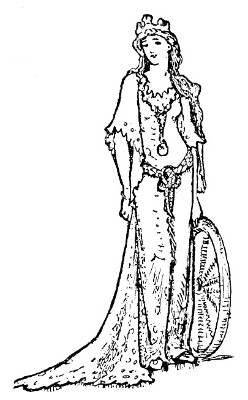 Fortunatus drew his
sword, and sat quiet till the bear was come within arm’s length; and
then he
ran him through the body with it several times. This drove the bear so
very
savage, that he made a great spring to get at him; but the bough broke,
and
down he fell, and lay sprawling and making a shocking yell on the
ground.
Fortunatus now looked round on all sides; and as he saw no more wild
beasts
near, he thought this would be a good time to get rid of the bear at
once; so
down he came, and killed him at a single blow. Being almost starved for
want of
food, he stooped down, and was going to suck the blood of the bear; but
looking
round once more, to see if any wild beast was coming, he on a sudden
beheld a
beautiful lady standing by his side, with a bandage over her eyes,
leaning upon
a wheel and looking as if she was going to speak. The lady did not make
him
wait long before she said these words: ‘Know, young man, that my name
is
Fortune; I have the power to bestow wisdom, strength, riches, health,
beauty,
and long life; one of these I am willing to bestow on you, choose for
yourself
which it shall be.’ Fortunatus was not a moment before he answered,
‘Good lady,
I wish to have riches in such plenty that I may never again know what
it is to
be so hungry as I now find myself.’ The lady then gave him a purse, and
told
him that in all the countries where he might happen to be, he need only
put his
hand into the purse as often as he pleased, and he would be sure to
find in it
ten pieces of gold; that the purse should never fail of yielding the
same sum
as long as it was kept by him and his children; but that when he and
his
children should be dead, then the purse would lose its power.
Fortunatus drew his
sword, and sat quiet till the bear was come within arm’s length; and
then he
ran him through the body with it several times. This drove the bear so
very
savage, that he made a great spring to get at him; but the bough broke,
and
down he fell, and lay sprawling and making a shocking yell on the
ground.
Fortunatus now looked round on all sides; and as he saw no more wild
beasts
near, he thought this would be a good time to get rid of the bear at
once; so
down he came, and killed him at a single blow. Being almost starved for
want of
food, he stooped down, and was going to suck the blood of the bear; but
looking
round once more, to see if any wild beast was coming, he on a sudden
beheld a
beautiful lady standing by his side, with a bandage over her eyes,
leaning upon
a wheel and looking as if she was going to speak. The lady did not make
him
wait long before she said these words: ‘Know, young man, that my name
is
Fortune; I have the power to bestow wisdom, strength, riches, health,
beauty,
and long life; one of these I am willing to bestow on you, choose for
yourself
which it shall be.’ Fortunatus was not a moment before he answered,
‘Good lady,
I wish to have riches in such plenty that I may never again know what
it is to
be so hungry as I now find myself.’ The lady then gave him a purse, and
told
him that in all the countries where he might happen to be, he need only
put his
hand into the purse as often as he pleased, and he would be sure to
find in it
ten pieces of gold; that the purse should never fail of yielding the
same sum
as long as it was kept by him and his children; but that when he and
his
children should be dead, then the purse would lose its power.  Click the book image to turn
to the next Chapter.
Click the book image to turn
to the next Chapter.