 Web
and Book design,
Web
and Book design, Copyright, Kellscraft Studio 1999-2006 (Return to Web Text-ures) |
Click
Here to return to Castles of England and Wales Content Page Return to the Previous Chapter |
 (HOME) |
 CARISBROOKE, CORFE, AND PORCHESTER THE famous
saying,
“They little know of England who only England know,” is less an epigram
than a
platitude. It may be true that England’s greatest achievements are to
be found
on seven seas and five continents, but it is even more obvious that the
ordinary Englishman knows less than a little about his own country. Its
castles
are a case in point. The names of some are household words, others are
hardly
known at all; and those that are forgotten are often the most ancient
or the
most impressive, whether in ruins or in repair. To the thousands who
will boast
that their country possesses Warwick, the names of Warkworth,
Hurstmonceaux,
Raglan, and Bodiam, may be empty sounds. The
castles which
are so little known, however, are often enough those that have played
small
part in English history. Their towers may be majestic, their ruins
striking,
but any historic importance they possess is due to one spectacular
incident or
qualification. Porchester, for instance, in the later years of Roman
Britain,
protected the vast harbour at the end of Stane Street; Carisbrooke was
the
“narrow chase” of Charles Stuart’s captivity; and Corfe is spoken of as
the
place where the young Saxon King Edward was murdered. None the
less,
throughout the Middle Ages the harbour now called Portsmouth was of
vital
importance and necessarily well defended. The Roman system of roads
connected
it with London by way of Chichester and the Weald as well as through
Southampton and Winchester. The Norman invasion magnified tenfold every
motive
that existed in the time of the Saxon isolation for communication with
the
Continent, and no harbour to which a Roman road still led could remain
unprotected or unused. The Norman rulers also made such effective
defensive
measures that we can imagine the Danish pirates spirited, rather than
frightened away, from the scene of English history. That is the raison d’être of Colchester keep, and partly of the Tower of London. Nearer to our subject, Farnham Castle had some of its yearly dues remitted on account of its duty of defence against the Vikings; and Porchester also protected its harbour from these attacks. Besides, as a royal castle, it was a resting-place for kings on their continental journeys, particularly when Winchester rather than London was the capital of the Angevin Empire, and later during the intermittent French wars. 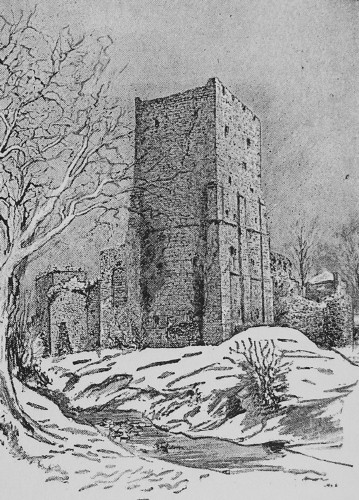 PORCHESTER CASTLE. Obviously
the
Normans did not adapt the walls of Porchester to their uses because
they found
them standing; for Richborough, without the harbour it once guarded,
was
neglected by them. But Porchester was in a splendid military position
on a
tongue of land projecting into the harbour, so that two of the walls of
the
square Roman fort were washed by the sea, and at a short distance from
the
landward walls a broad ditch — perhaps the remains of an earlier
fortification
— cut across the approaches. Allowing for necessary repairs and a few
mediæval
alterations the walls enclosing the outer ward to-day are of the
original Roman
workmanship in flint concrete, with occasional projecting bastions. On
the
eastern curtain two bastions flank the mediæval water-gate (for it was
part of
the strength of Porchester that it could easily be relieved or
provisioned from
the harbour), but the south-east corner bastion has been undermined by
sea-water, and the north-western corner is occupied by the keep. In this
angle of
the Roman fort a castle grew up in the twelfth century, and it was kept
in
repair as a protection for Portsmouth Harbour until the end of the
Hundred
Years’ War. After that it lapsed to private tenants, who occasionally
leased it
back to the Crown, when it was wanted as a place of internment for
prisoners of
war. So the history of Porchester is less glorious than instructive. The first
documentary mention of a castle at Porchester occurs in a grant of
1153, but as
the royal treasure was removed there for a time in 1163, we can imagine
that it
was already of some strength. The keep, of which the lower part appears
to be
of the early twelfth century, confirms this documentary evidence of its
strength. It has none of the domestic graces that make the White Tower
at
London as much a palace as a citadel, and military requirements weighed
more
heavily with its builders. The keep dominated the castle and the plain
in which
it stood. It consisted of a basement and two floors to which (as at
Corfe) two
further stories were added at a later period. It had a fore building
leading
to the second story, from which a spiral staircase gave the only access
to the
basement; and while there are some good windows in the upper part of
the
present keep, the original building must have been remarkable for its
dark and
musty interior. The only
other
remaining Norman work is the curtain wall of the inner ward, forming a
square
bailey in the corner of the original enclosure. The domestic buildings
ranged
along the western and southern walls of the inner ward include a hall
built by
Richard II, the royal living rooms, and a building which may have been
used for
the Exchequer; but the buildings on the eastern side of the ward were
erected
in seventeenth-century Gothic by Sir Thomas Cornwallis. In the
south-eastern corner of the outer ward is a Norman church built in the
time of
Henry I for a royal foundation as the priory church of a new house of
Austin
Canons. For some reason or other the site was found to be inconvenient
by the
Canons, who abandoned it, but the church was kept well enough repaired.
In a
petition to Queen Anne it is stated that in the reign of Charles II the
church,
having been used to keep prisoners of war, “was by their means set on
fire and
for the greater part ruined,” but however great the damage, it has
since been
made good. Porchester
Castle
was a silent eyewitness of the conflict between Church and State in the
twelfth
and thirteenth centuries. It was there that the Bishop of Evreux met
Henry II
to mediate between him and St. Thomas à Becket over the constitutions
of
Clarendon, and eight years later Henry found himself again at
Porchester,
publicly declaring his innocence in the matter of the Archbishop’s
murder, in
the presence of the Papal Legates. King John, that much-travelled
monarch, was
often at Porchester. He was there when the Pope’s interdict was
promulgated in
England. But John must be chiefly remembered by his missive to the
barons of
the Exchequer, “that we lent our brother, the Earl of Salisbury, at
Porchester,
ten shillings to play.” After the
reign of
Elizabeth the castle was used chiefly as a prison. Norden, in 1609,
said the
castle was then ruined “by reason the leade hathe been cutt and
imbezeled.” The
hall he described as “verye fayer and spacious,” the other rooms being
“maine
spacious but dark and malincolie,” and he wanted one tower lowered
“because it
annoyeth the reste of the howse by reflexe of the chimneye smoake,”
which
appears to be a simple method of curing the smoke evil, though it would
hardly
commend itself to Londoners to-day. But Porchester was not to
degenerate
quietly into a useless ruin. It was filled with Dutchmen after Blake’s
sea
victories, and with Frenchmen during the Napoleonic wars. It is almost
incredible that about five thousand Frenchmen were stowed away there at
one
time. The
suggestion that
Porchester should then be used as a naval hospital produced a protest,
which
was a curious comment upon the lot of the French prisoners, but perhaps
the
report of 1855 was a slightly jaundiced view. “A building ruinous and
falling
to pieces,” it ran, “badly ventilated . . . badly lighted, the site
low, bleak,
with miles of exposed mud before it, difficult of access, and
containing within
its walls the parish church and churchyard, there could scarcely be
chosen a
less desirable place for the proposed hospital.” The
writers of that
report on Roman walls and Norman keep were practical but surely very
unimaginative people. Carisbrooke
also
goes back to very early beginnings, and it has been brought to a more
picturesque decline. The site of the castle was anciently the chief
stronghold
on the Isle of Wight, and fortified in all probability by the Jutes.
Some, who
place their simple faith in the most disputed passages of the
Anglo-Saxon
Chronicle, identify Carisbrooke as the “Wihtgarasburh,” where Cynric
and Cerdic
defeated the islanders in 530, and where Wihtgar himself was buried. Certainly
the chalk
spur on which Carisbrooke stands is a natural position for defence, and
the
castle buildings cut right across well-defined earthworks of an earlier
date.
This was the form of the Conqueror’s castle, which was probably
surrounded by
wooden stockades with some stone buildings. After the
Conquest
the lordship of the island with the castle of Carisbrooke was
alternately
vested in short-lived or rebellious families and resumed by the Crown.
The Fitz
Osborns, for instance, were enfeoffed at the Conquest and deprived in
1078 for
complicity in the conspiracy of Ralph Guader. The de Redvers, to whom
the grant
was made by Henry I, built most of the stone part of the castle.
Baldwin de
Redvers, an adherent of Matilda, raised “a castle stately, built of
hewn stone
and strengthened by great fortifications,” against Stephen; but the
wells ran
dry, and he submitted without putting his work to the test of war. In
1293 the
line ended in a woman, Isabel de Fortibus — a very capable woman,
herself an
active builder, who left her mark on the castle. After her death the
castle was
held by the monarchy for long periods, and its military works were kept
in
repair until late in the seventeenth century. The early
works
were probably begun by William Fitz Osborn and carried on by the
Conqueror.
They dictated the form of the present castle by constructing an
artificial
mound of chalk rubble at the north-east corner of an oblong bailey
enclosed by
high chalk banks. The chapel of St. Nicholas, near the centre of the
enclosure
(restored in 1904 in memory of King Charles) was in existence at the
time of
the Domesday survey. The domestic buildings were ranged along the north
bank,
and the defences were probably wooden stockades until the de Redvers
replaced
them by stone walls. It was in this early castle that William the
Conqueror
personally arrested his half-brother, Odo of Bayeux, Earl of Kent, and
sent him
prisoner to Rouen, with the successful quibble that he laid hands, not
on the
consecrated Bishop, but on the rebellious Earl. History,
however,
moved slowly on this small island, dwelling apart from the larger world
of
mediæval England. Carisbrooke only endured one siege, and that in the
late fourteenth
century, so that the improvement in its fortifications went on
undisturbed. The
de Redvers built the polygonal shell keep on the mound, approached by a
flight
of seventy-one steps from the bailey, and constructed stone curtain
walls
around the bailey. The original Norman entrance on the west side was
considerably altered and strengthened by subsequent lords and governors
of the
castle, being ultimately defended by a narrow passage containing three
archways
with portcullises, fronted by a gatehouse with towers. The fourteenth
century
is a late period in the history of English castellation, but these and
other
improvements (such as the fore building added to the keep) were begun
in 1334
“by command of the King for fear of invasion of the island,” and the
King’s
fears were not ungrounded. In 1377 the French landed in force,
destroyed the
town of Francheville (where Newtown now stands) and besieged
Carisbrooke. They
were beaten off, some say the invaders were annihilated; but at least
the brief
military history of the castle was not inglorious. The next
scare was
the Armada. Carisbrooke was hastily prepared for defence by a levy en
masse of
the islanders, but the danger passed by. It was after the defeat of the
Armada
that Elizabeth called on the engineer Gianibelli, who made a long outer
line of
defence with bastions and ravelines according to the latest methods of
warfare,
to protect the castle. Jerome,
Earl of
Portland, was dismissed from the Governor ship of Carisbrooke as a
Royalist
and Papist, in 1642, to be replaced by one Colonel Hammond, and
Parliament
spent £246 in repairs to its walls and gatehouses in 1658. It was to
this
castle, so favoured by Parliament, and to its rebel governor, that
Charles was
persuaded to entrust himself, rather unwillingly, when he fled from
Hampton
Court. He was held at first in the Constable’s lodgings, but, on his
attempting
to escape, when he found hospitality a disguised captivity, his
quarters were
removed to a small chamber between the hall and the north curtain. He
again
attempted to escape, but he desisted just in time, for there is a
suspicion
that the good Hammond, having got wind of the venture, was waiting
outside to
shoot him in the very act of escaping. Despite these associations with
their
father, the Council of State, in 1650, sent the young Duke of
Gloucester and
the Princess Elizabeth to Carisbrooke, where they were housed in the
chambers
Charles had occupied; and there the tragic little Princess declined and
died,
being found with her head pillowed on her Bible, a gift from the
unfortunate
King. The history of Carisbrooke has not been stirring, but the fortification of the castle was long maintained. Edward I found it sufficiently valuable to negotiate with Isabel de Fortibus for the transfer of it while she lay on her deathbed, and, whether royal or baronial, the possessors of the castle have taken care to preserve it. So its domestic architecture is in every style; it em bodies towers and bastions of the Elizabethan period with a keep of the twelfth century. Its most tragic and most famous associations are at the close of its history, for its decline has taken place only in the last two hundred years. 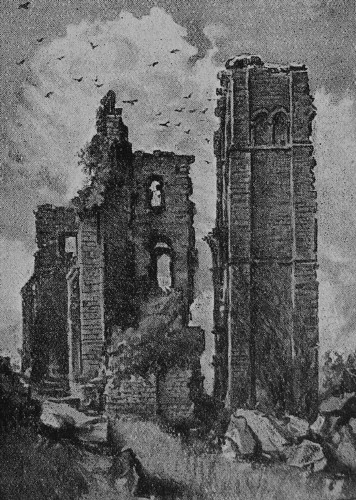 CORFE CASTLE. Corfe, in
Dorset, a
third castle on this short strip of coast, is also a striking reminder
of the
Civil Wars. Corfe commanded the promontory known as the Isle of
Purbeck, but
until the Conquest there was no fortification on the spot, for William
the
Conqueror negotiated for its possession with the Abbess of Shaftesbury.
Consequently the Corfe Geat, where, according to the Chronicle, the
young King
Edward the Martyr was murdered in 987, must be identified with another
spot. The site
was ideal
for a castle, protected on three sides by the natural steepness of a
chalk
down, at the base of which two rivers forked on their way to Poole
Harbour. The
castle was Norman and Edwardian in three wards crowned by a keep. The
keep,
probably erected by Henry I, was massive, its walls not weakened by
interior
galleries or chambers; but only one of its walls re mains. Its wards
were
surrounded by admirably constructed curtain walls with projecting round
towers,
and the gatehouse was protected by drum towers and portcullis; but the
towers
are now crooked and breached, and the gatehouse is gutted. Here
Baldwin de
Redvers held out for Matilda before he re tired to the Wight, but its
military
importance was never great. To many monarchs, to John especially, it
was more
valuable as a prison. Duke Robert was brought here after Tenchebrai,
and Edward
II before he was removed to Berkeley Castle. But John starved to death
twenty-four French knights at Corfe at one time; his executions were
massacres.
In one case he put a mother and her son together in one dungeon to die
of
starvation. The account of their end is one of the most revolting
stories in
the mediæval chronicles. In another case, a prophet, one Peter de
Wakefield,
who foretold the end of John’s reign, was kept at Corfe to see the
outcome of
his prophecy. In the predestined year John gave England in fief to the
Pope, and
the prophet, who had scored a technical victory undoubtedly, was
dragged to
death at the heels of wild horses. Such were
the
incidents in the history of Corfe. It was a place of great strength,
unlikely
ever to be tested seriously in local warfare, and it was geographically
remote
from the strategic centres of the country. By Elizabeth it was granted
to Sir
Christopher Hatton, and in 1635 it was sold to Sir John Bankes. Its
future
might have been equally uneventful, and Corfe might have been an
admired
show-place to-day, but that Dorset suddenly acquired an accidental
strategic
importance in the Civil Wars. It lay between Oxford and the Royalist
stronghold
of the South-west. Sherborne and Corfe were the keys to the northern
and
southern communications with the Cornish peninsula. Twice an inglorious
Roundhead army attacked Corfe, which was defended by Lady Bankes. The
best
accounts of the siege are Royalist, and they tell of the
Parliamentarians
“filling their men with strong waters even to madnesse,” and of their
“cowardly
leader who had, like Cæsar, been the only man that came sober to the
assault,
lest he should be valiant against his will.” But they did not prevail
until one
of the garrison turned traitor, and, pretending to introduce
newly-recruited defenders,
placed all the important posts of the castle in the hands of the enemy.
The House
of
Commons ordered £10 to be given to the Captain who gave the news of the
taking
of Corfe, and £10 to the messenger who brought it. Corfe was ordered to
be
“slighted” or dismantled; an order which was carried out very
thoroughly, as we
see by the disordered ruins. Heavy charges of gunpowder were used, and
also the
older device of burning props beneath the undermined towers. The
Buttavant
Tower has been half blown away, the drum tower of the gatehouse thrown
forward,
and the encircling walls and bastions thrown down or turned askew. |
 Click the book image to turn
to the next Chapter.
Click the book image to turn
to the next Chapter.