|
(Return
to Web
Text-ures)
|
Content Page
|
 (HOME) |

|
WINDSOR AS it
appears from
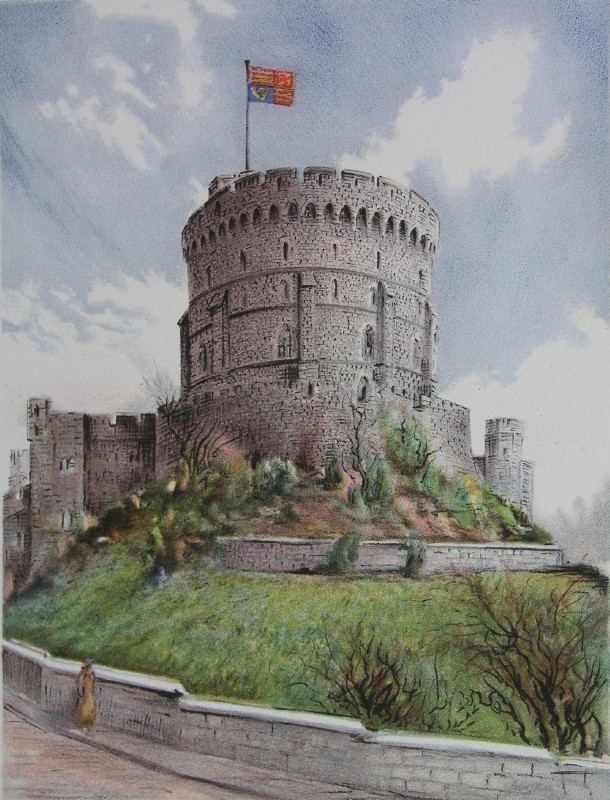
the railway train, Windsor’s round tower rising above the trees behind
Slough
becomes too familiar for comment. Straining our eyes, perhaps, to see
if the
standard hangs above it as a sign that the royal family is in
residence, we
think vaguely of the castle as a palace; a place like Hampton Court,
that
should be worth visiting some day. We are not like the French, who have
to
regard Belfort, or Toul, or Verdun, as forts commanding a pass, a
river, or a
road. For nearly five centuries England has been an unfortified
country, and, theoretically
at least, the Government would surrender at once to an enemy who
succeeded in
crushing the naval defence. So we have no reason to think of Windsor as
“commanding “the railway; and if we approach London from the west,
crossing the
river at Staines, there is no thought in our minds of the garrison at
Windsor
giving us protection. But anyone
who
undertakes the tedious journey to London by river receives another
impression.
By the time Oxford, Wallingford, and Reading have been passed, the
Thames has
become no longer the scene for a day’s leisurely outing, but a highway,
with
Windsor towering above the river, the key to London at the end of the
road. William
the
Conqueror, the first ruler since the Romans to subordinate the whole of
England
to a unified strategic plan, was faced with the problem of safeguarding
the two
great approaches to London from the west — the one, that system of
Roman roads
that ends in Oxford Street, and the other the Thames. In his blockade
of
London, William himself went as far north as Wallingford before
crossing the
river. Subsequently, as the defender of London, he could find neither
at the
Goring Gap nor at Staines a position within easy reach of London which
offered
a natural defence in command of both road and river. But Windsor had
these
advantages: its site commanded the Thames, and was within two hours’
march of
Staines and Maidenhead, and a long day’s march of his capital. There
was a
bluff overlooking a bend in the river and surmounted by a mound, which
had possibly
been already fortified by the Romans and under the Heptarchy. And at
Old
Windsor, not far away, was the royal “vill” of the Saxon kings.
By the
time of
Edward the Confessor the military value of the riverside manor was so
little
appreciated that he had granted it “to Christ and the Abbey of St.
Peter at
Westminster.” William at once resumed possession, giving the monks in
ex
change various manors, including “St. Patrick’s Isle,” which we know as
Battersea. Nominally, perhaps, he intended it as a hunting-lodge, but,
in fact,
he threw up earthworks there which made the place as strong as any of
the
period. The
present shape
of Windsor is an oblong enclosure forming three wards, of which the
mound in
the middle crowned by the keep and a ditch with a small enclosure
around it
makes the centre ward. Some have said that the Conqueror merely
palisaded the
mound and the eastern ward after the usual pattern of a Norman
mound-and-bailey
castle. More probably he gave it at once its present form; in fact,
both
Nottingham and Arundel are examples that the early Norman builders did
not
always limit themselves to one ward. At first, however, there were
probably no
stone defences, but ditch, earthen rampart, and a continuous stockade
made
these for a time unnecessary. In the eastern, or upper ward, were the
royal
lodgings. For a time
the
Norman kings continued to use the Confessor’s “vill” at Old Windsor as
a royal
residence. There is no mention in the chronicles of New Windsor until
Henry of
Huntingdon tells us that Henry I in 1110 held his court in that
place “which he
himself had built,” and in 1121 he married in the castle chapel his
second
Queen, Adela of Louvain. In other words, Henry probably did something
to make
Windsor particularly his own. He began, most likely, to replace the
wooden
defences with stone, although it is curious that the rebel Robert de
Mowbray
should have been imprisoned there by Rufus after the siege of Bamburgh,
if
there were no permanent buildings already erected. Under
Henry II a
casual reference here and there in the chronicles is replaced by
definite
entries in the royal accounts. He was a great builder at Windsor, for
he raised
the Great Tower in stone, constructed four towers on the eastern
curtain, and
four on the south side which he connected with curtain walls; and, in
addition
to this, he rebuilt the royal lodgings in the upper ward, which he
enclosed
with a wall. Henry III brought the work of fortification to its highest
point,
but he also erected more magnificent buildings within the wards, so
that if
to-day we find Windsor a palace, we feel that it has become so without
violation of its early military traditions. Matthew of Westminster,
describing
how Prince Edward, son of Henry III, filled Windsor with troops, spoke
of the
fortress-palace appropriately as “that very flourishing castle than
which, at
that time, there was not another more splendid within the bounds of
Europe.” The only
serious
siege suffered by Windsor was at the hands of the Count de Nevers and
the
Barons in opposition to John after the signing of the Charter. For
three months
a large and well-equipped army assaulted the castle, but petraria and
battering
ram were used in vain until the attempt had to be abandoned. But if its
strength was never seriously tried, this was merely a sign of its high
reputation. By the situation which it commanded, Windsor exerted a
predominant,
though passive, influence upon all mediæval campaigns centring around
London,
and it is significant that Edward I, the greatest of English castle
builders,
made no improvement in its fortifications. Edward
III, who was
born at Windsor, often stayed there, and added much to its tradition as
a
palace. Influenced by the chivalry of his age, he conceived the idea of
gathering a body of knights to his Round Table “in the same manner and
condition as the Lord Arthur, formerly King of England, appointed it .
. . and
he would cherish it according to his power.” For this purpose he
proceeded to
build a tower in the upper ward to house a great table, and at one time
he was
spending £100 a week on the work. It was never finished, however, and
to-day
not a trace remains, for by 1348 Edward’s ideas had undergone a change.
He
founded instead the Order of the Garter, an order of which the
insignia, a
garter, and the motto, Honi soit qui mal y pense, inevitably
produced a crop of
legends. It was the
foundation of the Garter Order which made Edward remodel Henry III’s
chapel of
St. Edward as a chapel for his knights. This chapel has had a curious
history.
When Edward IV built the larger and more glorious St. George’s Chapel
at its
western end, it became a Lady Chapel which Henry VII re-edified,
proposing to
use it as a shrine for Henry VI and a burial-place for English kings.
Instead,
he raised the beautiful building bearing his name at Westminster, and
in course
of time Cardinal Wolsey, once canon of Windsor, was to be found
supervising the
erection of his own sarcophagus in the chapel, a sarcophagus which
to-day
covers the body of Nelson in the crypt of St. Paul’s Cathedral. Henry
VIII
again resumed possession of the Lady Chapel, which seemed to be of
ill-omen to
those who desired it for a burial-place. His plans for a royal tomb
were never
completed, and it was left for Queen Victoria to convert it into a
Memorial
Chapel to the Prince Consort, whose body lies at Frogmore. Beautiful as
the
exterior of the Albert Memorial Chapel is, it is quite eclipsed by St.
George’s
Chapel, the glory of Windsor, a master piece in the Perpendicular
style, which
ranks second only to Westminster Abbey as a treasure-house of English
art and
architecture. In the stalls and stall plates of the Knights of the
Garter it
possesses a unique glory, yet it is known hardly to one in every ten of
those
who love to visit the Abbey. It contains also the bodies of Edward IV,
Henry
VI, Henry VIII, and Charles I, while the best craftsmen of the late
Middle Ages
have left, as a legacy, a noble series of screens in wood, iron, stone,
and
even bronze work which reaches its perfection in the iron gates built
for
Edward IV’s chantry chapel. The Kings
of
England had a tradition to keep up in a palace which was connected with
William
of Wykeham, who there began his architectural career, and the
courtier-poet
Geoffrey Chaucer, who was Clerk of the Works, a sinecure which he
probably
enjoyed more as a courtier than as a poet. The Tudors and Stuarts
deserve well
enough of the critics, but William and Mary allowed Wren to exercise
his taste
in surroundings not altogether suited to the architect of the City
churches. It
is rather surprising that we have to thank George IV for the
improvements
carried out under the supervision of Sir Jeffrey Wyattville. Not many
visitors
realize that the Great Tower, originally built in two stories, was
carried
successfully to its present height only at the beginning of the last
century,
and we owe to Wyattville the tactful removal of some eighteenth-century
incongruities. Windsor
should draw
many visitors because it awakens such different interests. Some are
drawn by
the romance of battlements, some by the ecclesiastical glories of St.
George’s
Chapel, and some by the splendid furniture, the carvings of Grinling
Gibbons,
the many paintings of Van Dyck, Rubens, and the great English artists
in the
State Apartments. However, as the attendance at the National Gallery
falls
below the attendance at the Zoo, it is not surprising that Windsor’s
short
distance from London should further discourage our contemporaries, who
can
amuse themselves at home by all the usual methods which do not call for
an
appreciation of history, art, or architecture. There
should be,
nevertheless, a new interest for Englishmen in a castle whose walls are
so
largely the work of the Norman kings, now that it has been made the caput
honoris of the reigning house. Throughout English history Windsor
has been the
castle par excellence; and it is in recognition of this that it
has become the
family seat of the House of Windsor. 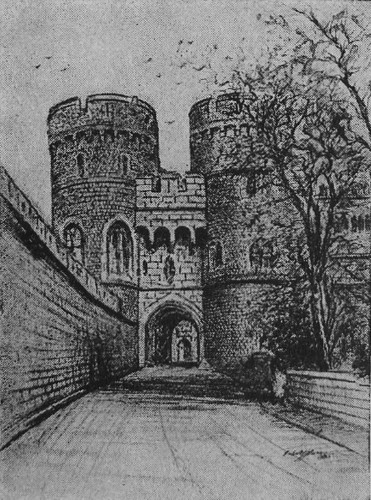 WINDSOR CASTLE (THE NORMAN GATE) |
 Click the book image to turn
to
the next Chapter.
Click the book image to turn
to
the next Chapter.