 Web
and Book design, Web
and Book design, Copyright, Kellscraft Studio 1999-2005 (Return to Web Text-ures) |
Click Here to return to Book of Boston Content Page Return to the Previous Chapter |
 (HOME) |
|
CHAPTER
IX THE
DISTINCTIVE PARK STREET
CORNER  HE unusual prominence of
monuments to ministers in Boston might at first thought, be ascribed by
some to
the fact of this being a woman's city;
but of course, as any Bostonian would at once tell you, it is really
because of
the unusual prominence of ministers in the development and life of the
city.
There is the memorial to Phillips Brooks beside his church, at a busy
edge of
Copley Square, he being set within a canopied marble niche, garbed in
his
bishop's robes, with an angelic figure behind him: and not far away, at
the
nearest corner of the Public Garden, there is niched, like a
cinque-cento
saint, the long-gowned figure of William Ellery Channing. Entirely
unlike both
of these, in its exceedingly un-saint-like appearance, is the monument
to
another minister, Edward Everett Hale, at a Charles Street entrance to
the
Public Garden, for he stands in wait in the shrubs, just inside the
gate, in
every-day clothes and long loose overcoat, stooping, as if pausing for
a moment
in his walk, with his old-fashioned beaver hat in one hand and his cane
in the
other; a man honorably known to all Americans for his "Man without a
Country." HE unusual prominence of
monuments to ministers in Boston might at first thought, be ascribed by
some to
the fact of this being a woman's city;
but of course, as any Bostonian would at once tell you, it is really
because of
the unusual prominence of ministers in the development and life of the
city.
There is the memorial to Phillips Brooks beside his church, at a busy
edge of
Copley Square, he being set within a canopied marble niche, garbed in
his
bishop's robes, with an angelic figure behind him: and not far away, at
the
nearest corner of the Public Garden, there is niched, like a
cinque-cento
saint, the long-gowned figure of William Ellery Channing. Entirely
unlike both
of these, in its exceedingly un-saint-like appearance, is the monument
to
another minister, Edward Everett Hale, at a Charles Street entrance to
the
Public Garden, for he stands in wait in the shrubs, just inside the
gate, in
every-day clothes and long loose overcoat, stooping, as if pausing for
a moment
in his walk, with his old-fashioned beaver hat in one hand and his cane
in the
other; a man honorably known to all Americans for his "Man without a
Country."To commemorate not
only the
clerical profession but the medical, there is within the Public Garden
a
monument that gave Holmes the inspiration for a brilliant bit of wit.
The
monument was designed to commemorate the discovery of Ether, the
mastering of
the whole problem of consciousness of pain in surgery, but while it was
under
construction a fierce and never-to-be-settled controversy arose as to
which of
two claimant physicians was really the discoverer, and so the monument
was
completed with the name of the man omitted, which led Holmes promptly
to
suggest, with that obviousness which marks all great wit, that it was
not so
much a monument to Ether as to Either. There is an
exceedingly
prominent monument, the big equestrian of General Hooker, set up in
front of
the State House, which is also interesting on account of what is left
off, for
there is nothing but the single word "Hooker"; as if, one may fairly
suppose, when they came to the matter of inscription, it was remembered
that the
only battle of consequence in which General Hooker commanded was the
terrible
defeat of Chancellorsville. It is sometimes delightfully wise to have
brief
inscriptions on statues. After all, New England was not fortunate in
developing
great military leaders in the Civil war, in spite of her prominence in
the
events and discussions preceding the struggle and in spite of the vast
number
of her men who gallantly went to the front; she developed no Grant or
Thomas or
Sherman; and already she has practically hidden, off on one side of the
State
House, statues of the never-prominent General Banks and General Devens.
But
monumenting in haste and repenting at leisure is something far older
than
America. And it is a favorite Boston belief, long held and often
expressed,
that if she should set up statues to all her distinguished sons there
would be
no room left in which people could move about. Diagonally across
from the
Hooker monument, just away from the corner of Park and Beacon Streets,
close to
the altered Ticknor homestead, is a little house, tucked in among
towering
business buildings and faced by a great hotel: and this house, still a
home, is
filled with paintings collected years ago in Europe. It stood before
the
Revolution (its front has been changed), and about 1830 was the home of
Chester
Harding, the New England-born, backwoods artist who, after making his
success
in Paris – but it was a Paris in Kentucky – painted the great ones of
America
and of England, including judges and senators and some half dozen of
the dukes,
and then came back to Boston. For some time while in Boston he so
eclipsed
Gilbert Stuart that that great painter was wont to ask, looking at his
own
empty studio and knowing that Harding's was thronged, "How rages the
Harding fever?" Close by is the
Athenaeum,
most charming and delightful of libraries, full of serenity and repose
and rich
in its great collection of books. Not only does it possess the workable
and
readable books of recent years, but precious prints and books and
manuscripts
of the past, and such treasure as the greater part of the library of
George
Washington, each book, with his signature and bookplate, deposited here
after
its purchase in 1849 by "seventy gentlemen of Boston, Cambridge and
Salem," who contributed fifty dollars each to obtain it. To the
Bostonian
of tradition, the Athenaeum still proudly represents the essence of the
city;
the building is admirably impressive outwardly, it is attractive and
full of
atmosphere within, and it is rich in the very spirit of the best of
Boston. Its
main entrance has a replica of Houdon's life-size statue of Washington,
a
replica, modeled by Houdon himself, of the original, which was made for
the
State of Virginia and is preserved at Richmond; Houdon having come to
America
to make a statue of Washington, at the request of Franklin, who knew
him in
Paris. The main
reading-room, occupying the great upper
floor, is of unusual architectural beauty, with its vaulted roof, its
pillars
and alcoves, its general fineness and comfort. The library is
peculiarly fitted
to the needs of the scholar, and membership in it, to be a
"proprietor," as is the term, is highly esteemed. The great rear
windows of
the Athenaeum look down into the ancient deep-shaded Granary Burying
Ground,
and off at one side, also looking down into the burying-ground, are the
windows
of that monthly, the Atlantic, which is itself
another of the treasured belongings of Boston: and
especially is the bowed window noticeable when one learns that it is
the window
of the oval room in which James Russell Lowell reigned as editor, and
where he
still looks down benignantly from the wall, like a patron saint: and
although
one may do full honor to his memory and to his fine influence, the
profuse and
double-pointed whiskers do rouse the recollection of the little girl
who asked:
"But what are the points for?" There are few more
impressive burying-grounds in the
world than the Granary, fronting out on busy Tremont Street and hemmed
in on
its other sides by towering business structures, by the phalanxed
windows of
the quiet Athenaeum, by the publishing buildings, and by the old Park
Street
Church. The Granary has impressiveness, it even has beauty, and it has
an
aloofness that comes from its being some three feet or so above the
level of
the thronging sidewalk that it adjoins. Anciently a granary
actually
stood here, but the place long since came to be a crowded human granary
instead; and what a roll of fascinating old-time names might be called
here!
Hancock, Sewall, Bellingham, Faneuil, Samuel Adams, Franklin (the
parents of
Benjamin Franklin are buried here), Cushing, Phillips, Otis, Revere!
There are
royal governors, patriot governors, signers of the Declaration,
orators,
leaders among the citizens – it would be a long, long roll! And there
would be
a strange unexpectedness if responses should come, for many of the
stones in
this graveyard were long ago indiscriminately changed about. At one
time they
were even tidied and set in rows to meet the landscape-gardening and
grass-mowing proclivities of a city official! There was some mild
objection to
this, but nothing was done to check or correct the changing, and when,
long
afterwards, people began to speak strongly about it, it was too late,
for
records had not been kept. Although Boston
thinks a
great deal of the people of the past, they would seem to have acquired
somewhat
careless habits of caring for their remains. Gilbert Stuart was
mislaid. Major
Pitcairn was lost, and it was probably a substitute body that was sent
back to
England as his, to rest in Westminster. The stones on Copp's Hill were
changed
about or used for doorsteps. And here in the Granary the municipal
idiosyncrasy
has been even more striking. It was Oliver Wendell Holmes who remarked
of this
graveyard, that the stones really tell the truth when they say "Here
lies." But although this
carelessness of the past needs to be known it does not affect the
dignity, the
solemnity, the impressiveness of the place. It merely means that the
visitor
must be content to honor these worthies of the past in mass rather than
in
detail. They are all there. They all lie somewhere within the broad
enclosure.
Upon their confused resting-places the tall office buildings look down,
and
beside them the public go hurrying along the crowded sidewalk. They are
somewhere
here, beneath the shade of the thickly clustered horse-chestnuts and
honey
locusts, and it really is not worth while to try and pick out the still
properly marked graves from the mistaken ones. One of the two young
duellists of whom Holmes wrote, who fought to the death on the Common,
is
buried here, and it is curious that this seems to be better remembered,
by most
people, than does the fact that here were buried so many great and
famous folk,
although that young duellist has no claim to fame except that of dying
in a
duel which seized upon the imagination of the man whose personality
permeates
all Boston. A high, open, iron
fence
standing on a low, dark retaining wall, separates the burying-ground
from the
street, and the entrance is through a black and gloomy stone arch, with
a
suggestion of the Egyptian in style, flanked at either end of the wall
by a
black stone pillar. It is pleasant to notice that with such a great
area of
office buildings looking down into this resting place of American dead,
there
is scarcely a business sign to be seen, although the opportunity and
temptation
are so great. It is a fine example of business restraint. Indeed, one
at first
thinks that there is absolutely no sign at all, for it is only by
carefully
looking for them that two or three very little ones are found. From the Athenaeum
itself,
from a little high-perched coign of vantage there, a little outside
summer
reading-place which fairly overhangs the back of the Granary graveyard,
the
most striking of all views of the inclosure may be had, for from this
point one
looks down through the treetops on curving lines of little dull-colored
headstones, standing shoulder to shoulder on the green dark grass,
under the
gloomy trees, like gloomy spirits of New England consciences forever
looking
out, with drooping shoulders, through the great iron fence, upon the
passing of
their descendants and successors. The Granary
burying-ground
antedates the church beside it, the fine old building, with Christopher
Wren-like steeple, known as the Park Street Church. And one is tempted
to think
of this church as, on the whole, the most typically Bostonian building
of
Boston. On its prominent corner at the foot of the slope leading up to
the
State House, and with its windows looking out on one side over the
Common, and
on the other one the Granary ground, it seems as if it had grown there,
so
natural it is, so easy, so graceful, so felicitous, standing there in
so sweet
a pride. The delightful spire
is
notable, not only for the perfection of its upper proportions but also
in not
rising from the building itself but, instead, forming the extension of
a tower
that itself rises from the ground, church and tower being connected by
pillared
curves, quadrant-like, which architecturally unite them into an
indivisible
whole, with no sign of separation. There could not be a more charmingly
picturesque corner, for the Common, than is made by this so charming
and
picturesque a church. For many years the
building
was painted, and even in its dull drab was attractive, but it has
recently been
vastly improved, as a number of other old Boston buildings have
similarly been
improved, by the cleaning of all the paint from the brick and by the
painting
anew of all the wood; thus restored to its original design the church
now
positively sparkles in its white paint and mellow red brick. Park Street Church is
not so
old as are several others in Boston, for it dates back only to a little
more
than a century ago, but in its short life it has not been without
claims to
distinction; the first public address of William Lloyd Garrison was
delivered
in this building, and here for the first time the hymn "America" was
publicly sung. Beneath the church
are a
gay-looking flower-shop and picturesque tea-rooms, and they seem
pleasantly
Bostonian in their churchly location, for until recent years a
bookstore was
quartered in the basement of the Old South Church, and I have noticed a
furniture-packing shop beneath a church at the foot of Beacon Hill, and
it used
to be, when the Hollis Street Church was standing, that its pastor, a
powerful
advocate of prohibition, used to deliver attacks on drink at the same
time that
the vaults beneath his feet were rented by three pillars of his church,
distillers, for the storage of casks, giving rise to the
still-remembered
epigram: "Above, the spirit
Divine,
Below, the spirits of wine." The corner where stands so felicitously the altogether attractive Park Street Church has itself given rise to a flash of real wit, especially notable as showing that Holmes did not utter every witty Boston saying. For this came from a certain long-ago Appleton, brother-in-law of Longfellow, famed as a humorist and bon vivant, a man of wealth and family but whose humor, still remembered reiteratively, usually – took some such form as sailing for Europe, without telling any one, on the very day that he was expected to be host or guest at a dinner. However, the corner beside Park Street Church really inspired him to one excellent jest. For it is a very windy corner, one of the windiest in all Boston, and Appleton dryly remarked one day that there really ought to be a, shorn lamb tethered there! 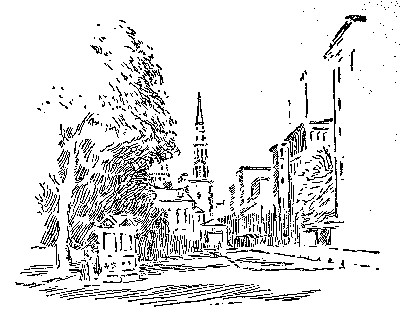 |
 Click the book image to turn to the next Chapter.