 Web
and Book design, Web
and Book design, Copyright, Kellscraft Studio 1999-2005 (Return to Web Text-ures) |
Click Here to return to Book of Boston Content Page Return to the Previous Chapter |
 (HOME) |
|
CHAPTER
VIII A
WOMAN'S CITY  HE Sunday observance
law which John Hancock found, to his
annoyance could be invoked even against a man of power, provided that
"all
persons profaning the Lord's
Day by walking, standing in the streets or
any other way breaking the laws made for the due observance of the
Lord's Day,
may expect the execution of the law upon them for all disorders of this
kind"; and the city still gives a general impression of respect for the
Sabbath. As long ago as 1711 Increase Mather told the Bostonians that a
great
fire of that year had come as a punishment for not observing the
Sabbath with
sufficient strictness, and his admonition was promptly heeded and, so
it would
seem from appearances, has been heeded ever since – although, one
regrets to
observe, without noticeable results in the way of fire prevention. HE Sunday observance
law which John Hancock found, to his
annoyance could be invoked even against a man of power, provided that
"all
persons profaning the Lord's
Day by walking, standing in the streets or
any other way breaking the laws made for the due observance of the
Lord's Day,
may expect the execution of the law upon them for all disorders of this
kind"; and the city still gives a general impression of respect for the
Sabbath. As long ago as 1711 Increase Mather told the Bostonians that a
great
fire of that year had come as a punishment for not observing the
Sabbath with
sufficient strictness, and his admonition was promptly heeded and, so
it would
seem from appearances, has been heeded ever since – although, one
regrets to
observe, without noticeable results in the way of fire prevention.The city does not,
however,
give the impression of being particularly religious. It religiously
celebrates
Sunday with fish-cakes and brown bread, but it is without the general
tramp-tramp-tramp of church-going feet that is heard on the Sabbath day
in that
city with which it is most often compared, Edinburgh. There is
considerable
church-going: it should not be forgotten that Boston has long been the
center
of Unitarianism and that it has become the stronghold of Christian
Science; but
the general impression of the city and its streets on Sunday is of a
sleepy
quietude with comparatively few people stirring about. But not all
Boston is at
church or at home, for in pleasant weather the principal roads leading
back
into the city are, at night, aflame with motor lights. It used to be
that the
Sabbath began on Saturday at sunset, and "upon no pretense whatsoever
was
any man on horseback or with a wagon to pass into or out of the town"
till
the time of Sabbath observance was over. Well, at least the horses had
a day of
rest. But on the entire subject of Puritanism, with its varied
inhibitions, one
cannot but think of that illustrative antithesis of Macaulay, perhaps
quite
unfair but at least quite unforgettable, that the Puritans hated
bear-baiting,
not because it gave pain to the bear but because it gave pleasure to
the
spectators. The difficulty of
even now
getting food on Sunday in Boston is really amusing: of course, the
hotels are
open, but many restaurants, even such as cater to three-meals-a-day
custom,
close tight during all of Sunday! – and this, not merely in the
business
section, where closing would be justified, but in localities where
hosts of
people, students of the myriad educational institutions, and temporary
dwellers, without home ties or home facilities, are wholly dependent
upon these
local restaurants. Restaurant-closing is a survival of Sunday
observance;
Boston, except as to its own individual appetite, would fain remember
the
Sabbath day to keep it hungry. Restaurants, by the
way,
average better and cheaper in Boston than in other great American
cities. In no
respect, indeed, is the city more admirable than in being a place where
people
of limited means but excellent tastes and desires may live economically
and at
the same time with self-respect: and this comes largely from the
influence of
the innumerable army of students, and visitors of the student class,
and
unmarried and self-supporting women. The general atmosphere of Boston
is one of
a pleasant economy which need not at all be associated with poverty. The shopping
districts have
a number of attractive little restaurants and tea-rooms, managed by
women or by
philanthropic societies of women, where a type of food is offered which
may,
perhaps, be described as hygienic health food. There are also
"laboratories" and "kitchens" and "food-shops";
not names that would attract one, I think, except in New England.
Apparently,
the next generation of New Englanders are not to be "sons of pie and
daughters of doughnut." Also, one notices
that there
are very few restaurants open after the generally announced closing
hour of
eight, and one is inclined to say that the fingers of one hand, and
perhaps
even the thumbs alone, would number the places where after-theater
suppers are
openly offered. One restaurant freely advertises, without arousing
comment or
protest, that it is the "one bright spot in Boston" after theater
closing. There are two or three hotels that cater to late comers, but
there is
little to attract those who would drop naturally into a cheerful
restaurant but
who balk at going formally to a hotel. As soon as the theater is over,
the
audiences scurry into the subway. Those who do not go to the theater
are
supposed to be in bed by ten o'clock or so. It gets late very early in
Boston. A curious effect of Sabbath
observance that lasted until far into the 1800's was the omission by
the
theaters of Saturday night performances. The first breaking from the
old ideals
came in 1843, when the Tremont Theater of that time reluctantly gave a
Saturday
night performance to please the many visitors who had come to the city
for the
Webster oration at the dedication of Bunker Hill Monument. (It was in
this
theater, three years earlier, that Margaret Fuller and Ralph Waldo
Emerson
together watched the dancing of Fanny Ellsler, when, so the tale runs,
Margaret
whispered ecstatically, "Ralph, this is poetry!" to which came the
philosopher's fervent response, "Margaret, it is religion!") It is curious, with
Boston's
theaters, to find that several of the best-constructed or most popular
– the
terms are not necessarily synonymous – are on streets that amaze the
visitor
with the impression of being shabby or narrow or hard to find, such as
Eliot
Street or Hollis Street, or Tremont Street in a section where it
suddenly loses
its excellent appearance; naturally, this sort of thing does not strike
a
Bostonian, because he is used to it: it is like a man knowing his way
familiarly about in his own backyard, although it would merely mean
unattractive exploration for a stranger. The theater which, more than
any
other, appeals to the "best families" and for which it is the
tradition,
though by no means the general practice, to "dress," is on a narrow,
back, out-of-the-way street. The venerable Boston
Theater
– soon, so it is understood, to be torn down, after a long, long
existence –
has its main entrance on Washington Street; but a secondary and highly
interesting entrance, from the best part of Tremont Street, is through
a long
tunnel-like foot-passage, and then an actual underground passage
beneath a
building; and another theater, close by, has an entrance even more
interesting,
this being a hundred yards or so of subterranean passage, lined with
mirrors,
not only under buildings but underneath a narrow street; although one
is so apt
to associate underground passages, at least in an old city, with sieges
or
escapes or romance. The old Boston
Theater was
opened in 1852, and the first words delivered from the stage were those
of a
poem written for the occasion, that had won a prize of one hundred
dollars; one
of the actors reading the poem, and the author of the lines being
Parsons, Longfellow's
Poet of the Wayside Inn. Even as late as that, the Saturday night
closing
tradition was still so generally adhered to that for quite a while no
Saturday
night performances were given in this theater; there were just five
evening
performances a week. This city was
particularly
associated with the life of Edwin Booth. His very first appearance on
any stage
was at the old Boston Museum (now destroyed), in 1849, when he played
Tressel
to the Richard the Third of his father, Junius Brutus Booth. In the
good old
days, although there was no rivalry with the busy "movies," the
theaters had a way of giving satisfyingly crowded evenings, and that
particular
performance of "Richard the Third" was accompanied by a farce of the
decidedly un-Shakespearean name of "Slasher and Crasher." Another
evening of two performances, "The Iron Chest" and "Bon Caesar de
Bazan," this time in 1865 and at the Boston Theater, was to Booth
tragically notable, for it was on that evening that his brother shot
President
Lincoln. Those who, in the
course of
the many years of its existence, have come to know the Boston Theater,
with its
circling Auditorium and big steep galleries, and to love it on account
of its
boasted acoustic qualities, would have been incredibly amazed had they
been told
long ago, that the. time was to come, in its theatrical career, when
acoustics
would not count: yet that time has really come, for it has been turned
over to
the "movies," pending destruction. Among the many
memories
associated with the theater is that of the great ball given here in
honor of
the Prince of Wales, afterwards Edward the Seventh, in 1860, when the
wealth
and fashion of Boston came here to do him honor. I have somewhere seen
it noted
that some fifteen hundred tickets were subscribed for, for that
literally
princely ball at the Boston Theater; one thousand for couples and the
other
five hundred for additional ladies accompanying them, thus making two
women for
each man, which would seem to point out that even long ago Boston was a
woman's
city. At any rate, Boston
is a
woman's city now; not that women are collectively of more importance
than men,
but that they are of much more than usual importance: there is no other
city in
which women are relatively of such consequence. Yet it is not
distinctively a
suffragist city, and, surprisingly for a woman's stronghold, the women
anti-suffragists are very active. More than in any
other city,
women go unescorted and without question to theaters and restaurants.
So many
women are independent, so many women are employed in stores and in
offices,
that, more than in other cities, respectable women alone on the streets
at
night are a common sight, and they attract neither comment nor
attention. They
have what Barrie calls The fact that so many women are so eminently capable of taking care of themselves brings about the natural consequence that they are freely permitted to take care of themselves; for example, in other cities one of the rarest sights is to see a woman carrying a heavy traveling-bag, but here in Boston it is a sight so common as to attract no notice whatever. In the daytime or at night-time you will frequently see a well-dressed woman, an independent feme sole, walking briskly along, heavy bag in hand; and I do not mean carrying the pleasant little Boston shopping bags but literal valises, and I have not infrequently seen a woman carrying not only one big valise but one in each hand. 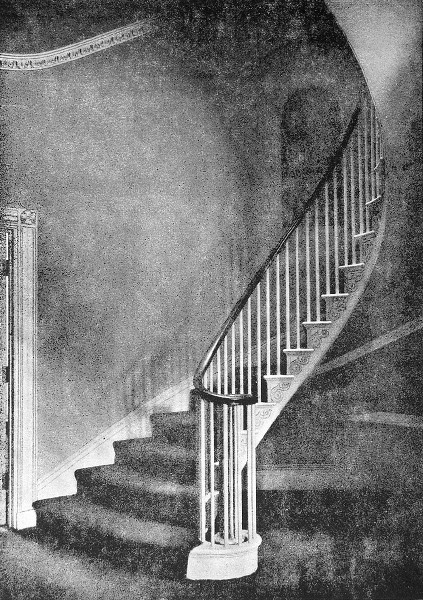 A Spiral Stairway by Bulfinch, on Beacon Hill. On the average, too,
this
being a woman's city has had a not unnatural result upon woman's
dressing, it
being, on the average, not quite so merely attractive or charming as it
is in
most cities. There is a great deal of highly excellent dressing on the
part of
the women, but it is excellent and good in the sense in which a man's
dressing
would be deemed good: it is not quite so much a matter of following the
fashion
as of wearing good clothes of good material; and, as with the men, the
women
are likely to keep their excellent clothes until they begin to show
wear,
instead of being quite so subject as are the women of other cities to
what
would be termed the whims of fashion. Boston has an extraordinary
number of
well-tailored women, but perhaps it may be said that it is mostly a
matter of
excellent grooming. There is a smaller proportion of women in Boston
than in
other cities who dress merely to flutter along a fashionable promenade
to
please the eyes of observers. I noticed at the
street door
of a fashionable shop where they sell nothing more intimate than hats
and
millinery, a sign such as I never saw in any other city, for it bluntly
reads,
"No admission for men"! And it is not an emergency sign, for a
crowded season, but is permanently lettered on brass. Imagine such a
sign on a
hat shop on Bond Street or the Rue de la Paix, or in Berlin, let us
say, where
the Emperor William loves to go out and buy his wife's hats and
surprise her
with them, and then expects her to simulate joy! A marked result of
the
unusual consequence of women here is the unusual importance, both
relatively
and in themselves, of women's clubs; and the women show that they can
excellently equip and excellently manage their clubs. One, the Women's
City
Club, has had the excellent taste to acquire for its club-house a
building that
is one of the finest examples of American town-house architecture; it
is a
house built by Bulfinch, and is one of a pair of balanced mansions,
each with
the distinguished bow-front of Boston and each with a beautifully
pillared and
fan-lighted doorway. This club-house is at 40 Beacon Street, and looks
down on
the pool and the elms of the Common, and it is worth becoming familiar
with not
only to see how excellently the women chose a headquarters but also to
see what
was the kind of house that Bulfinch won his fame in building. The front hall is
broad,
with a small reception room at one side, and from it there starts
upward, with
a charming curl to the top of its newel-post, a most graceful, aerial,
spiral
stair which mounts up and up, a thing of ease and lightness and grace,
toward
the great round cupola or lantern that throws down its light from the
roof for
the entire stair. The rail is mahogany, the balusters are white, and
the steps
are white, with a crimson carpet. What was originally
the
dining-room is the large room at the front on the main floor, and it
swells
finely into the swell of the great window-bow. The rear wall of this
room
curves backward in exact balance with the curve of the front, and its
two
mahogany doors are set into the curve, thus producing the effect of an
oval room
even though the side-walls are straight. A fireplace, in staid setting
of white
and green marble, faces the door. The windows are large and mahogany
sashed,
with dark heavy curtains hanging straight down from up above the
window-tops
and caught aside with rosetted holders of brass; these club women
aiming
constantly to keep up, in adjuncts, with the excellent effect that
Bulfinch
with his architecture began. The doors, six-paneled and broad, are of
mahogany,
and those that are in the curve at the back of the room are themselves
curved
to fit it, such being the designer's completeness of detail. The door
in the
hall opens in two flaps and is broad enough to permit the guests to
walk in to
dinner two by two, in the old-fashioned formal way. Behind the
dining-room is
the great old kitchen, with its open fire-place, its ovens, and its
queerly
built-in iron-domed concavities. Ascending the main stair, whose tread
and rise
are a delight, we enter an ante-room with a lovely, mellow marble
mantel, and
from this room pass through an opening with fluted pillars into what
was the
great drawing-room, this being an oval room, rich in fine Greek detail,
with
exquisite mantel, exquisitely molded cornice and exquisitely designed
oval
ceiling; a room by an American architect of which an American may be
proud! The house was built
to be
heated by wood fires, and a niche in the hall marks where an iron urn
originally stood, which received its heat from a fire in the cellar for
the
heating of the hall, such being the method in use before the days of
modern
furnaces and furnace pipes; and it is interesting to remember that
almost all
of the houses we now see on Beacon Hill were built back in the days of
wood
fires, when the wood was sawed on the sidewalk and stored in the
cellars, or in
wood-houses in the yards; and that not only were there primitive
methods of
heating, and also of lighting, but that there was even no public water
supply
until less than three quarters of a century ago, and that almost all of
these
old houses still have wells in their cellars, even though the wells may
in the
course of time have been filled up. In a sense Bulfinch,
the
architect of the house of the women's Club, made Boston. He gave the
city a
high standard of architectural distinction. He gave it architectural
individuality. He gave it the type of dwelling of which this club-house
is such
an admirable example. And not only did he admirably design dwellings
and set a
high standard which other architects were glad to follow, but he also
gave to
America its general type of State House. As the honored architect of
the State
House of Massachusetts he was called to Washington to take charge of
the
Capitol there, and his ideas as to public buildings have been followed
throughout America. Any city would have the right to be proud of this
great
man, and so it is particularly pleasant to remember that not only was
he an
American but that he was so much so that as a small boy he watched the
battle
of Bunker Hill from the roof of his father's house. It is interesting
that when,
toward the close of his life, Bulfinch was asked if he would train any
of his
children in his own profession, he naively replied that he did not
think there
would really be enough left for any architect to do! The different
cities, he,
went on, and the principal States, were already supplied with their
principal
buildings, and he hardly thought there could be enough building to do
in the
future for a young man to make his living as an architect. Perhaps it was from
remembering that Boston is a woman's city that I thought of its being
the
home of Alice Brown, and there came the
further thought that not only are the
homes of writers of the past worth noticing, but also the homes of
writers of
the present day, especially when, as in the case of Miss Brown, the
present day
writer is one whose work is of grace and distinction. Naturally, I did
not much
expect to find the name of Alice Brown in the telephone directory;
there would
be "John Brown" and "James Brown" and other Browns, but not
likely the one as to whose home I had become interested. Still, the
telephone
book was handy, and I might as well look. – And I realized as never
before that
Boston is a woman's city, for, each with her separate telephone number,
there
were nine Alice Browns looking up at me, so to speak, from the page!
Nine
Alices with name so Brown, as the old song almost has it! Fascinated,
my eyes
wandered up and down the columns, and I noted telephones for women
Browns
innumerable: three Annas, three Berthas, four Lauras, no fewer than
twelve
Marys, and an ever-lengthening list leading to Katharine and Sarah and
Alice
and Inez and Corah and Daisy and Lillia and Lilliah, up to one hundred
and
nineteen in all, and many a Browne more with an "e" to follow! And as other names of
the
directory would be like Brown, I thought of how thin a telephone book
would be
Boston's if all the women's names were taken out 1 And even with the
nine Alice
Browns, the name of Alice Brown the writer is not to be found. But her
house is
on Beacon Hill, at 11 Pinckney Street; a brick house, prim, pleasant
and
precise, with iron-railed steps leading up to a curve-topped
entranceway. That Boston is a
woman's
city came to me, just a few days ago, in still another way, for a
Bostonian
friend handed me a letter, just received, and said that I really ought
to use
it because it was so typical of old Boston and she knew that the sender
would
not be displeased if she should ever know it had been published. The
writer of
the letter is one of two elderly maiden sisters, who always dress in
heavy
black silk, and whose hair is still done in the prim, old-fashioned way
of
Civil war times, and who still live in the old house, in its still
aristocratic
neighborhood, in which they were born. "I walked home," thus part of the typical letter runs, "doing several errands on the way, and most of the evening I was reading to my sister, and this morning I awoke early, lighted my candle and read until I had to get ready for breakfast!" She read by candlelight! What a picture in these modern days! "Then settled down comfortably to tackle a tableful of monthly bills waiting for the checks to pay them, stopping long enough to look over a list of kitchen furnishings that the cook had ordered and to write a Christmas poem which my sister had been composing, from her dictation!" What charming old-fashioned sisterly sympathy – and a Christmas poem! "Now it is one o'clock, and I haven't begun my bills, and there are the dinner chimes. We dine at one" (old-fashioned again!), "myself, my sister's attendant and her secretary, and sometimes " – what a touch! – "our stately black cat."  |
