 Web
and Book design,
Web
and Book design, Copyright, Kellscraft Studio 1999-2006 (Return to Web Text-ures) |
Click
Here to return to Golden Fleece Content Page Return to the Previous Chapter |
 (HOME) |
|
VIII. THE
CARRYING OF THE ARGO
 ITH the
terrible weight of the ship upon their shoulders the Argonauts made
their way
across the desert, following the tracks of Poseidon’s golden-maned
horse. Like
a wounded serpent that drags with pain its length along, they went day
after
day across that limitless land. ITH the
terrible weight of the ship upon their shoulders the Argonauts made
their way
across the desert, following the tracks of Poseidon’s golden-maned
horse. Like
a wounded serpent that drags with pain its length along, they went day
after
day across that limitless land. A day came when they saw the great tracks of the horse no more. A wind had come up and had covered them with sand. With the mighty weight of the ship upon their shoulders, with the sun beating upon their heads, and with no marks on the desert to guide them, the heroes stood there, and it seemed to them that the blood must gush up and out of their hearts. 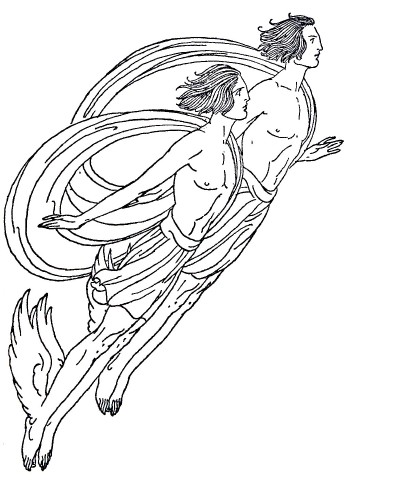 Then Zetes
and Calais, sons of the North Wind, rose up upon their wings to strive
to get
sight of the sea. Up, up, they soared. And then as a man sees, or
thinks he
sees, at the month’s beginning, the moon through a bank of clouds,
Zetes and Calais,
looking over the measureless land, saw the gleam of water. They shouted
to the
Argonauts; they marked the way for them, and wearily, but with good
hearts, the
heroes went upon the way. They came
at last to the shore of what seemed to be a wide inland sea. They set Argo
down
from off their over-wearied shoulders and they let her keel take water
once
more. All salt
and brackish was that water; they dipped their hands into and tasted
the salt.
Orpheus was able to name the water they had come to; it was that lake
that was
called after Triton, the son of Nereus, the ancient one of the sea.
They set up
an altar and they made sacrifices in thanksgiving to the gods. They had
come to water at last, but now they had to seek for other water — for
the sweet
water that they could drink. All around them they looked, but they saw
no sign
of a spring. And then they felt a wind blow upon them — a wind that had
in it
not the dust of the desert but the fragrance of growing things. Toward
where
that wind blew from they went. As they
went on they saw a great shape against the sky; they saw mountainous
shoulders
bowed. Orpheus bade them halt and turn their faces with reverence
toward that
great shape: for this was Atlas the Titan, the brother of Prometheus,
who stood
there to hold up the sky on his shoulders. Then they
were near the place that the fragrance had blown from: there was a
garden
there; the only fence that ran around it was a lattice of silver.
“Surely there
are springs in the garden,” the Argonauts said. “We will enter this
fair garden
now and slake our thirst.” Orpheus
bade them walk reverently, for all around them, he said, was sacred
ground.
This garden was the Garden of the Hesperides that was watched over by
the
Daughters of the Evening Land. The Argonauts looked through the silver
lattice;
they saw trees with lovely fruit, and they saw three maidens moving
through the
garden with watchful eyes. In this garden grew the tree that had the
golden
apples that Zeus gave to Hera as a wedding gift. They saw
the tree on which the golden apples grew. The maidens went to it and
then
looked watchfully all around them. They saw the faces of the Argonauts
looking
through the silver lattice and they cried out, one to the other, and
they
joined their hands around the tree. But
Orpheus called to them, and the maidens understood the divine speech of
Orpheus. He made the Daughters of the Evening Land know that they who
stood
before the lattice were men who reverenced the gods, who would not
strive to
enter the forbidden garden. The maidens came toward them. Beautiful as
the
singing of Orpheus was their utterance, but what they said was a
complaint and
a lament. Their
lament was for the dragon Ladon, that dragon with a hundred heads that
guarded
sleeplessly the tree that had the golden apples. Now that dragon was
slain.
With arrows that had been clipped in the poison of the Hydra’s blood
their
dragon, Ladon, had been slain. The
Daughters of the Evening Land sang of how a mortal had come into the
garden
that they watched over. He had a great bow, and with his arrow he slew
the
dragon that guarded the golden apples. The golden apples he had taken
away;
they had come back to the tree they had been plucked from, for no
mortal might
keep them in his possession. So the maidens sang — Hespere, Eretheis,
and Ægle
— and they complained that now, unhelped by the hundred-headed dragon,
they had
to keep guard over the tree. The
Argonauts knew of whom they told the tale — Heracles, their comrade.
Would that
Heracles were with them now! The
Hesperides told them of Heracles — of how the springs in the garden
dried up
because of his plucking the golden apples. He came out of the garden
thirsting.
Nowhere could he find a spring of water. To yonder great rock he went.
He smote
it with his foot and water came out in full flow. Then he, leaning on
his hands
and with his chest upon the ground, drank and drank from the water that
flowed
from the rifted rock. The
Argonauts looked to where the rock stood. They caught the sound of
water. They
carried Medea over. And then, company after company, all huddled
together, they
stooped down and drank their fill of the clear good water. With lips
wet with
the water they cried to each other, “Heracles! Although he is not with
us, in
very truth Heracles has saved his comrades from deadly thirst!” They saw
his footsteps printed upon the rocks, and they followed them until they
led to
the sand where no footsteps stay. Heracles! How glad his comrades would
have
been if they could have had sight of him then! But it was long ago —
before he
had sailed with them — that Heracles had been here. Still
hearing their complaint they turned back to the lattice, to where the
Daughters
of the Evening Land stood. The Daughters of the Evening Land bent their
heads
to listen to what the Argonauts told one another, and, seeing them bent
to
listen, Orpheus told a story about one who had gone across the Libyan
desert,
about one who was a hero like unto Heracles. Beyond
where Atlas stands there is a cave where the strange women, the ancient
daughters of Phorcys, live. They have been gray from their birth. They
have but
one eye and one tooth between them, and they pass the eye and the
tooth, one to
the other, when they would see or eat. They are called the Graiai,
these two
sisters. Up to the
cave where they lived a youth once came. He was beardless, and the garb
he wore
was torn and travel-stained, but he had shapeliness and beauty. In his
leathern
belt there was an exceedingly bright sword; this sword was not straight
like
the swords we carry, but it was hooked like a sickle. The strange youth
with
the bright, strange sword came very quickly and very silently up to the
cave
where the Graiai lived and looked over a high boulder into it. One was
sitting munching acorns with the single tooth. The other had the eye in
her
hand. She was holding it to her forehead and looking into the back of
the cave.
These two ancient women, with their gray hair falling over them like
thick
fleeces, and with faces that were only forehead and cheeks and nose and
mouth,
were strange creatures truly. Very silently the youth stood looking at
them. “Sister,
sister,” cried the one who was munching acorns, “sister, turn your eye
this
way. I heard the stir of something.” The other
turned, and with the eye placed against her forehead looked out to the
opening
of the cave. The youth drew back behind the boulder. “Sister, sister,
there is
nothing there,” said the one with the eye. Then she
said: “Sister, give me the tooth for I would eat my acorns. Take the
eye and
keep watch.” The one
who was eating held out the tooth, and the one who was watching held
out the
eye. The youth darted into the cave. Standing between the eyeless
sisters, he
took with one hand the tooth and with the other the eye. “Sister,
sister, have you taken the eye?” “I have
not taken the eye. Have you taken the tooth?” “I have
not taken the tooth.” “Some one
has taken the eye, and some one has taken the tooth.” They stood
together, and the youth watched their blinking faces as they tried to
discover
who had come into the cave, and who had taken the eye and the tooth. Then they
said, screaming together: “Who ever has taken the eye and the tooth
from the
Graiai, the ancient daughters of Phorcys, may Mother Night smother
him.” The youth
spoke. “Ancient daughters of Phorcys,” he said, “Graiai, I would not
rob from
you. I have come to your cave only to ask the way to a place.” “Ah, it is
a mortal, a mortal,” screamed the sisters. “Well, mortal, what would
you have
from the Graiai?” “Ancient
Graiai,” said the youth, “I would have you tell me, for you alone know,
where
the nymphs dwell who guard the three magic treasures — the cap of
darkness, the
shoes of flight, and the magic pouch.” “We will
not tell you, we will not tell you that,” screamed the two ancient
sisters. “I will keep the eye and the tooth,” said the youth, “and I will give them to one who will help me.” 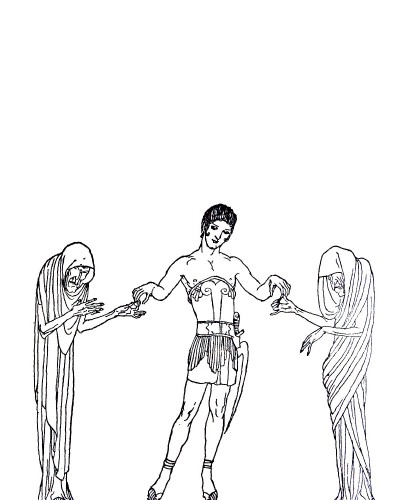 “Give me
the eye and I will tell you,” said one. “Give me the tooth and I will
tell
you,” said the other. The youth put the eye in the hand of one and the
tooth in
the hand of the other, but he held their skinny hands in his strong
hands until
they should tell him where the nymphs dwelt who guarded the magic
treasures.
The Gray Ones told him. Then the youth with the bright sword left the
cave. As
he went out he saw on the ground a shield of bronze, and he took it
with him. To the
other side of where Atlas stands he went. There he came upon the nymphs
in
their valley. They had long dwelt there, hidden from gods and men, and
they
were startled to see a stranger youth come into their hidden valley.
They fled
away. Then the youth sat on the ground, his head bent like a man who is
very
sorrowful. The
youngest and the fairest of the nymphs came to him at last. “Why have
you come,
and why do you sit here in such great trouble, youth?” said she. And
then she
said: “What is this strange sickle-sword that you wear? Who told you
the way to
our dwelling place? What name have you?” “I have
come here,” said the youth, and he took the bronze shield upon his
knees and
began to polish it, “I have come here because I want you, the nymphs
who guard
them, to give to me the cap of darkness and the shoes of flight and the
magic
pouch. I must gain these things; without them I must go to my death.
Why I must
gain them you will know from my story.” When he
said that he had come for the three magic treasures that they guarded,
the kind
nymph was more startled than she and her sisters had been startled by
the
appearance of the strange youth in their hidden valley. She turned away
from
him. But she looked again and she saw that he was beautiful and brave
looking.
He had spoken of his death. The nymph stood looking at him pitifully,
and the
youth, with the bronze shield laid beside his knees and the strange
hooked
sword lying across it, told her his story. “I am
Perseus,” he said, “and my grandfather, men say, is king in Argos. His
name is
Acrisius. Before I was born a prophecy was made to him that the son of
Danaë,
his daughter, would slay him. Acrisius was frightened by the prophecy,
and when
I was born he put my mother and myself into a chest, and he sent us
adrift upon
the waves of the sea. “I did not
know what a terrible peril I was in, for I was an infant newly born. My
mother
was so hopeless that she came near to death. But the wind and the waves
did not
destroy us: they brought us to a shore; a shepherd found the chest, and
he
opened it and brought my mother and myself out of it alive. The land we
had
come to was Seriphus. The shepherd who found the chest and who rescued
my
mother and myself was the brother of the king. His name was Dictys. “In the
shepherd’s wattled house my mother stayed with me, a little infant, and
in that
house I grew from babyhood to childhood, and from childhood to boyhood.
He was
a kind man, this shepherd Dictys. His brother Polydectes had put him
away from
the palace, but Dictys did not grieve for that, for he was happy
minding his
sheep upon the hillside, and he was happy in his little hut of wattles
and clay.
“Polydectes,
the king, was seldom spoken to about his brother, and it was years
before he
knew of the mother and child who had been brought to live in Dictys’s
hut. But
at last he heard of us, for strange things began to be said about my
mother —
how she was beautiful, and how she looked like one who had been favored
by the
gods. Then one day when he was hunting, Polydectes the king came to the
hut of
Dictys the shepherd. “He saw
Danaë, my mother, there. By her looks he knew that she was a king’s
daughter
and one who had been favored by the gods. He wanted her for his wife.
But my
mother hated this harsh and overbearing king, and she would not wed
with him.
Often he came storming around the shepherd’s hut, and at last my mother
had to
take refuge from him in a temple. There she became the priestess of the
goddess. “I was
taken to the palace of Polydectes, and there I was brought up. The king
still
stormed around where my mother was, more and more bent on making her
marry him.
If she had not been in the temple where she was under the protection of
the
goddess he would have wed her against her will. “But I was
growing up now, and I was able to give some protection to my mother. My
arm was
a strong one, and Polydectes knew that if he wronged my mother in any
way, I
had the will and the power to be deadly to him. One day I heard him say
before
his princes and his lords that he would wed, and would wed one who was
not
Danaë. I was overjoyed to hear him say this. He asked the lords and the
princes
to come to the wedding feast; they declared they would, and they told
him of
the presents they would bring. “Then King
Polydectes turned to me and he asked me to come to the wedding feast. I
said I
would come. And then, because I was young and full of the boast of
youth, and
because the king was now ceasing to be a terror to me, I said that I
would
bring to his wedding feast the head of the Gorgon. “The king
smiled when he heard me say this, but he smiled not as a good man
smiles when
he hears the boast of youth. He smiled, and he turned to the princes
and lords,
and he said: ‘Perseus will come, and he will bring a greater gift than
any of
you, for he will bring the head of her whose gaze turns living
creatures into
stone.’ “When I
heard the king speak so grimly about my boast the fearfulness of the
thing I
had spoken of doing came over me. I thought for an instant that the
Gorgon’s
head appeared before me, and that I was then and there turned into
stone. “The day
of the wedding feast came. I came and I brought no gift. I stood with
my head
hanging for shame. Then the princes and the lords came forward, and
they showed
the great gifts of horses that they had brought. I thought that the
king would
forget about me and about my boast. And then I heard him call my name.
‘Perseus,’
he said, ‘Perseus, bring before us now the Gorgon’s head that, as you
told us,
you would bring for the wedding gift.’ “The
princes and lords and people looked toward me, and I was filled with a
deeper
shame. I had to say that I had failed to bring a present. Then that
harsh and
overbearing king shouted at me. ‘Go forth,’ he said, ‘go forth and
fetch the
present that you spoke of. If you do not bring it remain forever out of
my
country, for in Seriphus we will have no empty boasters.’ The lords and
the
princes applauded what the king said; the people were sad for me and
sad for my
mother, but they might not do anything to help me, so just and so due
to me did
the words of the king seem. There was no help for it, and I had to go
from the
country of Seriphus, leaving my mother at the mercy of Polydectes. “I bade
good-by to my sorrowful mother and I went from Seriphus — from that
land that I
might not return to without the Gorgon’s head. I traveled far from that
country. One day I sat down in a lonely place and prayed to the gods
that my
strength might be equal to the will that now moved in me — the will to
take the
Gorgon’s head, and take from my name the shame of a broken promise, and
win
back to Seriphus to save my mother from the harshness of the king. “When I
looked up I saw one standing before me. He was a youth, too, but I knew
by the
way he moved, and I knew by the brightness of his face and eyes, that
he was of
the immortals. I raised my hands in homage to him, and he came near me.
‘Perseus,’ he said, ‘if you have the courage to strive, the way to win
the
Gorgon’s head will be shown you.’ I said that I had the courage to
strive, and
he knew that I was making no boast. “He gave
me this bright sickle-sword that I carry. He told me by what ways I
might come
near enough to the Gorgons without being turned into stone by their
gaze. He
told me how I might slay the one of the three Gorgons who was not
immortal, and
how, having slain her, I might take her head and flee without being
torn to
pieces by her sister Gorgons. “Then I
knew that I should have to come on the Gorgons from the air. I knew
that having
slain the one that could be slain I should have to fly with the speed
of the
wind. And I knew that that speed even would not save me — I should have
to be
hidden in my flight. To win the head and save myself I would need three
magic
things — the shoes of flight and the magic pouch, and the dogskin cap
of Hades
that makes its wearer invisible. “The youth
said: ‘The magic pouch and the shoes of flight and the dogskin cap of
Hades are
in the keeping of the nymphs whose dwelling place no mortal knows. I
may not
tell you where their dwelling place is. But from the Gray Ones, from
the
ancient daughters of Phorcys who live in a cave near where Atlas
stands, you
may learn where their dwelling place is.’ “Thereupon
he told me how I might come to the Graiai, and how I might get them to
tell me
where you, the nymphs, had your dwelling. The one who spoke to me was
Hermes,
whose dwelling is on Olympus. By this sickle-sword that he gave me you
will
know that I speak the truth.” Perseus
ceased speaking, and she who was the youngest and fairest of the nymphs
came
nearer to him. She knew that he spoke truthfully, and besides she had
pity for
the youth. “But we are the keepers of the magic treasures,” she said,
“and some
one whose need is greater even than yours may some time require them
from us.
But will you swear that you will bring the magic treasures back to us
when you
have slain the Gorgon and have taken her head?” Perseus
declared that he would bring the magic treasures back to the nymphs and
leave
them once more in their keeping. Then the nymph who had compassion for
him
called to the others. They spoke together while Perseus stayed far away
from
them, polishing his shield of bronze. At last the nymph who had
listened to him
came back, the others following her. They brought to Perseus and they
put into
his hands the things they had guarded — the cap made from dogskin that
had been
brought up out of Hades, a pair of winged shoes, and a long pouch that
he could
hang across his shoulder. And so
with the shoes of flight and the cap of darkness and the magic pouch,
Perseus
went to seek the Gorgons. The sickle-sword that Hermes gave him was at
his
side, and on his arm he held the bronze shield that was now well
polished. He went
through the air, taking a way that the nymphs had shown him. He came to
Oceanus
that was the rim around the world. He saw forms that were of living
creatures
all in stone, and he knew that he was near the place where the Gorgons
had
their lair. Then,
looking upon the surface of his polished shield, he saw the Gorgons
below him.
Two were covered with hard serpent scales; they had tusks that were
long and
were like the tusks of boars, and they had hands of gleaming brass and
wings of
shining gold. Still looking upon the shining surface of his shield
Perseus went
down and down. He saw the third sister — she who was not immortal. She
had a
woman’s face and form, and her countenance was beautiful, although
there was
something deadly in its fairness. The two scaled and winged sisters
were
asleep, but the third, Medusa, was awake, and she was tearing with her
hands a
lizard that had come near her. Upon her
head was a tangle of serpents all with heads raised as though they were
hissing. Still looking into the mirror of his shield Perseus came down
and over
Medusa. He turned his head away from her. Then, with a sweep of the
sickle-sword he took her head off. There was no scream from the Gorgon,
but the
serpents upon her head hissed loudly. Still with
his face turned from it he lifted up the head by its tangle of
serpents. He put
it into the magic pouch. He rose up in the air. But now the Gorgon
sisters were
awake. They had heard the hiss of Medusa’s serpents, and now they
looked upon
her headless body. They rose up on their golden wings, and their brazen
hands
were stretched out to tear the one who had slain Medusa. As they flew
after him
they screamed aloud. Although
he flew like the wind the Gorgon sisters would have overtaken him if he
had
been plain to their eyes. But the dogskin cap of Hades saved him, for
the
Gorgon sisters did not know whether he was above or below them, behind
or
before them. On Perseus went, flying toward where Atlas stood. He flew
over
this place, over Libya. Drops of blood from Medusa’s head fell down
upon the
desert. They were changed and became the deadly serpents that are on
these
sands and around these rocks. On and on Perseus flew toward Atlas and
toward
the hidden valley where the nymphs who were again to guard the magic
treasures
had their dwelling place. But before he came to the nymphs Perseus had
another
adventure. In
Ethopia, which is at the other side of Libya, there ruled a king whose
name was
Cepheus. This king had permitted his queen to boast that she was more
beautiful
than the nymphs of the sea. In punishment for the queen’s impiety and
for the
king’s folly Poseidon sent a monster out of the sea to waste that
country.
Every year the monster came, destroying more and more of the country of
Ethopia. Then the king asked of an oracle what he should do to save his
land
and his people. The oracle spoke of a dreadful thing that he would have
to do —
he would have to sacrifice his daughter, the beautiful Princess
Andromeda. The king
was forced by his savage people to take the maiden Andromeda and chain
her to a
rock on the seashore, leaving her there for the monster to devour her,
satisfying himself with that prey. Perseus,
flying near, heard the maiden’s laments. He saw her lovely body bound
with
chains to the rock. He came near her, taking the cap of darkness off
his head.
She saw him, and she bent her head in shame, for she thought that he
would
think that it was for some dreadful fault of her own that she had been
left
chained in that place. Her father
had stayed near. Perseus saw him, and called to him, and bade him tell
why the
maiden was chained to the rock. The king told Perseus of the sacrifice
that he
had been forced to make. Then Perseus came near the maiden, and he saw
how she
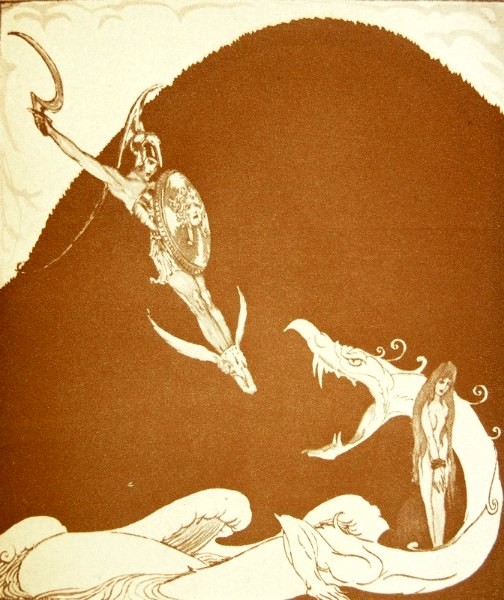
looked at him with pleading eyes. Then Perseus made her father promise that he would give Andromeda to him for his wife if he should slay the sea monster. Gladly Cepheus promised this. Then Perseus once again drew his sickle-sword; by the rock to which Andromeda was still chained he waited for sight of the sea monster. It came
rolling in from the open sea, a shapeless and unsightly thing. With the
shoes
of flight upon his feet Perseus rose above it. The monster saw his
shadow upon
the water, and savagely it went to attack the shadow. Perseus swooped
down as
an eagle swoops down; with his sickle-sword he attacked it, and he
struck the
hook through the monster’s shoulder. Terribly it reared up from the
sea.
Perseus rose over it, escaping its wide-opened mouth with its treble
rows of
fangs. Again he swooped and struck at it. Its hide was covered all over
with
hard scales and with the shells of sea things, but Perseus’s sword
struck
through it. It reared up again, spouting water mixed with blood. On a
rock near
the rock that Andromeda was chained to Perseus alighted. The monster,
seeing
him, bellowed and rushed swiftly through the water to overwhelm him. As
it
reared up he plunged the sword again and again into its body. Down into
the
water the monster sank, and water mixed with blood was spouted up from
the
depths into which it sank. Then was
Andromeda loosed from her chains. Perseus, the conqueror, lifted up the
fainting maiden and carried her back to the king’s palace. And Cepheus
there
renewed his promise to give her in marriage to her deliverer. Perseus
went on his way. He came to the hidden valley where the nymphs had
their
dwelling place, and he restored to them the three magic treasures that
they had
given him — the cap of darkness, the shoes of flight, and the magic
pouch. And
these treasures are still there, and the hero who can win his way to
the nymphs
may have them as Perseus had them. Again he
returned to the place where he had found Andromeda chained. With face
averted
he drew forth the Gorgon’s head from where he had hidden it between the
rocks.
He made a bag for it out of the horny skin of the monster he had slain.
Then,
carrying his tremendous trophy, he went to the palace of King Cepheus
to claim
his bride. Now before
her father had thought of sacrificing her to the sea monster he had
offered
Andromeda in marriage to a prince of Ethopia — to a prince whose name
was
Phineus. Phineus did not strive to save Andromeda. But, hearing that
she had
been delivered from the monster, he came to take her for his wife; he
came to
Cepheus’s palace, and he brought with him a thousand armed men. The palace
of Cepheus was filled with armed men when Perseus entered it. He saw
Andromeda
on a raised place in the hall. She was pale as when she was chained to
the
rock, and when she saw him in the palace she uttered a cry of gladness.
Cepheus,
the craven king, would have let him who had come with the armed bands
take the
maiden. Perseus came beside Andromeda and he made his claim. Phineus
spoke insolently
to him, and then he urged one of his captains to strike Perseus down.
Many
sprang forward to attack him. Out of the bag Perseus drew Medusa’s
head. He
held it before those who were bringing strife into the hall. They were
turned
to stone. One of Cepheus’s men wished to defend Perseus: he struck at
the
captain who had come near; his sword made a clanging sound as it struck
this
one who had looked upon Medusa’s head. Perseus
went from the land of Ethopia taking fair Andromeda with him. They went
into
Greece, for he had thought of going to Argos, to the country that his
grandfather ruled over. At this very time Acrisius got tidings of Danaë
and her
son, and he knew that they had not perished on the waves of the sea.
Fearful of
the prophecy that told he would be slain by his grandson and fearing
that he
would come to Argos to seek him, Acrisius fled out of his country. He came
into Thessaly. Perseus and Andromeda were there. Now, one day the old
king was
brought to games that were being celebrated in honor of a dead hero. He
was
leaning on his staff, watching a youth throw a metal disk, when
something in
that youth’s appearance made him want to watch him more closely. About
him
there was something of a being of the upper air; it made Acrisius think
of a brazen
tower and of a daughter whom he had shut up there. He moved
so that he might come nearer to the disk-thrower. But as he left where
he had
been standing he came into the line of the thrown disk. It struck the
old man
on the temple. He fell down dead, and as he fell the people cried out
his name
— “Acrisius, King Acrisius!” Then Perseus knew whom the disk, thrown by
his
hand, had slain. And
because he had slain the king by chance Perseus would not go to Argos,
nor take
over the kingdom that his grandfather had reigned over. With Andromeda
he went
to Seriphus where his mother was. And in Seriphus there still reigned
Polydectes, who had put upon him the terrible task of winning the
Gorgon’s
head. He came to
Seriphus and he left Andromeda in the hut of Dictys the shepherd. No
one knew
him; he heard his name spoken of as that of a youth who had gone on a
foolish
quest and who would never again be heard of. To the temple where his
mother was
a priestess he came. Guards were placed all around it. He heard his
mother’s
voice and it was raised in lament: “Walled up here and given over to
hunger I
shall be made go to Polydectes’s house and become his wife. O ye gods,
have ye
no pity for Danaë, the mother of Perseus?” Perseus
cried aloud, and his mother heard his voice and her moans ceased. He
turned
around and he went to the palace of Polydectes, the king. The king
received him with mockeries. “I will let you stay in Seriphus for a
day,” he
said, “because I would have you at a marriage feast. I have vowed that
Danaë,
taken from the temple where she sulks, will be my wife by to-morrow’s
sunset.” So Polydectes said, and the lords and princes who were around him mocked at Perseus and flattered the king. Perseus went from them then. The next day he came back to the palace. But in his hands now there was a dread thing — the bag made from the hide of the sea monster that had in it the Gorgon’s head. 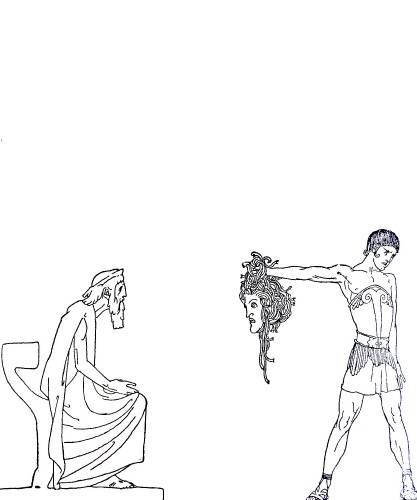 He saw his
mother. She was brought in white and fainting, thinking that she would
now have
to wed the harsh and overbearing king. Then she saw her son, and hope
came into
her face. The king
seeing Perseus, said: “Step forward, O youngling, and see your mother
wed to a
mighty man. Step forward to witness a marriage, and then depart, for it
is not
right that a youth that makes promises and does not keep them should
stay in a
land that I rule over. Step forward now, you with the empty hands.” But not
with empty hands did Perseus step forward. He shouted out: “I have
brought
something to you at last, O king — a present to you and your mocking
friends.
But you, O my mother, and you, O my friends, avert your faces from what
I have
brought.” Saying this Perseus drew out the Gorgon’s head. Holding it by
the
snaky locks he stood before the company. His mother and his friends
averted
their faces. But Polydectes and his insolent friends looked full upon
what
Perseus showed. “This youth would strive to frighten us with some
conjuror’s
trick,” they said. They said no more, for they became as stones, and as
stone
images they still stand in that hall in Seriphus. He went to
the shepherd’s hut, and he brought Dictys from it with Andromeda.
Dictys he
made king in Polydectes’s stead. Then with Danae and Andromeda, his
mother and
his wife, he went from Seriphus. He did not
go to Argos, the country that his grandfather had ruled over, although
the
people there wanted Perseus to come to them, and be king over them. He
took the
kingdom of Tiryns in exchange for that of Argos, and there he lived
with
Andromeda, his lovely wife out of Ethopia. They had a son named Perses
who
became the parent of the Persian people. The
sickle-sword that had slain the Gorgon went back to Hermes, and Hermes
took
Medusa’s head also. That head Hermes’s divine sister set upon her
shield —
Medusa’s head upon the shield of Pallas Athene. O may Pallas Athene
guard us
all, and bring us out of this land of sands and stone where are the
deadly
serpents that have come from the drops of blood that fell from the
Gorgon’s
head! They
turned away from the Garden of the Daughters of the Evening Land. The
Argonauts
turned from where the giant shape of Atlas stood against the sky and
they went
toward the Tritonian Lake. But not all of them reached the Argo. On his
way
back to the ship, Nauplius, the helmsman, met his death. A sluggish
serpent was in his way — it was not a serpent that would strike at one
who
turned from it. Nauplius trod upon it, and the serpent lifted its head
up and
bit his foot. They raised him on their shoulders and they hurried back
with
him. But his limbs became numb, and when they laid him down on the
shore of the
lake he stayed moveless. Soon he grew cold. They dug a grave for
Nauplius
beside the lake, and in that desert land they set up his helmsman’s oar
in the
middle of his tomb of heaped stones. And now like
a snake that goes writhing this way and that way and that cannot find
the cleft
in the rock that leads to its lair, the Argo went hither and
thither striving
to find an outlet from that lake. No outlet could they find and the way
of
their homegoing seemed lost to them again. Then Orpheus prayed to the
son of
Nereus, to Triton, whose name was on that lake, to aid them. Then
Triton appeared. He stretched out his hand and showed them the outlet
to the
sea. And Triton spoke in friendly wise to the heroes, bidding them go
upon
their way in joy. “And as for labor,” he said, “let there be no
grieving
because of that, for limbs that have youthful vigor should still toil.”
They took
up the oars and they pulled toward the sea, and Triton, the friendly
immortal, helped
them on. He laid hold upon Argo’s keel and he guided her through the
water. The
Argonauts saw him beneath the water; his body, from his head down to
his waist,
was fair and great and like to the body of one of the other immortals.
But
below his body was like a great fish’s, forking this way and that. He
moved
with fins that were like the horns of the new moon. Triton helped Argo
along
until they came into the open sea. Then he plunged down into the abyss.
The
heroes shouted their thanks to him. Then they looked at each other and
embraced
each other with joy, for the sea that touched upon the land of Greece
was open
before them. |
 Click the book image to turn
to the next Chapter.
Click the book image to turn
to the next Chapter.