
Web
and Book
design,
Copyright, Kellscraft Studio 1999-2006 (Return to Web Text-ures) |
Click
Here to return to Golden Fleece Content Page |
 (HOME) |
|
PART
I. THE VOYAGE TO COLCHIS
I. THE YOUTH JASON  MAN
in the garb of a slave went up the side of that mountain that is all
covered
with forest, the Mountain Felon. He carried in his arms a little child. MAN
in the garb of a slave went up the side of that mountain that is all
covered
with forest, the Mountain Felon. He carried in his arms a little child.
When
it was full noon the slave came into a clearing of the forest so silent
that it
seemed empty of all life. He laid the child down on the soft moss, and
then,
trembling with the fear of what might come before him, he raised a horn
to his
lips and blew three blasts upon it. Then he waited. The blue sky was above him, the great trees stood away from him, and the, little child lay at his feet. He waited, and then he heard the thud-thud of great hooves. And then from between the trees he saw coming toward him the strangest of all beings, one who was half man and half horse; this was Chiron the centaur. Chiron
came toward the trembling slave. Greater than any horse was Chiron,
taller than
any man. The hair of his head flowed back into his horse’s mane, his
great
beard flowed Over his horse’s chest; in his man’s hand he held a great
spear. Not
swiftly he came, but the slave could see that in those great limbs of
his there
was speed like to the wind’s. The slave fell upon his knees. And with
eyes that
were full of majesty and wisdom and limbs that were full of strength
and speed,
the king-centaur stood above him. “O my lord,” the slave said, “I have
come
before thee sent by Æson, my master, who told me where to come and what
blasts
to blow upon the horn. And Æson, once King of Iolcus, bade me say to
thee that
if thou dost remember his ancient friendship with thee thou wilt,
perchance,
take this child and guard and foster him, and, as he grows, instruct
him with
thy wisdom.” “For
Æson’s sake I will rear and foster this child,” said Chiron the
king-centaur in
a deep voice. The
child lying on the moss had been looking up at the four-footed and
two-handed
centaur. Now the slave lifted him up and placed him in the centaur’s
arms. He
said: “Æson bade me tell thee that the child’s name is Jason. He bade me give thee this ring with the great ruby in it that thou mayst give it to the child when he is grown. By this ring with its ruby and the images engraved on it son may know his son when they meet after many years and many changes. And another thing son bade me say to thee, O my lord Chiron: not presumptuous is he, but he knows that this child has the regard of the immortal Goddess Hera, the wife of Zeus.” 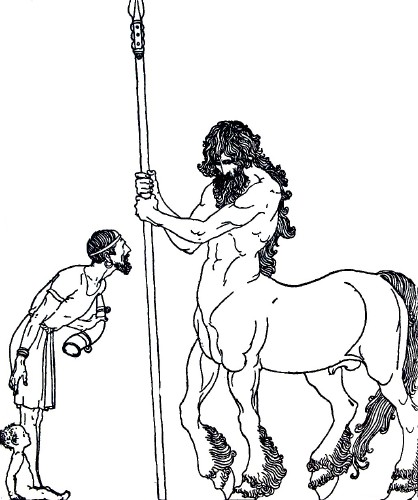 Chiron
held Æson’s son in his arms, and the little child put hands into his
great
beard. Then the centaur said, “Let Æson know that his son will be
reared and
fostered by me, and that, when they meet again, there will be ways by
which
they will be known to each other.” Saying
this Chiron the centaur, holding the child in his arms, went swiftly
toward the
forest arches; then the slave took up the horn and went down the side
of the
Mountain Pelion. He came to where a horse was hidden, and he mounted
and rode,
first to a city, and then to a village that was beyond the city. All
this was before the famous walls of Troy were built; before King Priam
had come
to the throne of his father and while he was still known, not as Priam,
but as
Podarces. And the beginning of all these happenings was in Iolcus, a
city in
Thessaly. Cretheus
founded the city and had ruled over it in days before King Priam was
born. He
left two sons, Æson and Pelias. Æson
succeeded his father. And because he was a mild and gentle man the men
of war
did not love Æson; they wanted a hard king who would lead them to
conquests. Pelias,
the brother of Æson, was ever with the men of war; he knew what mind
they had
toward son and he plotted with them to overthrow his brother. This they
did,
and they brought Pelias to reign as king in Iolcus. The
people loved Æson and they feared Pelias. And because the people loved
him and
would be maddened by his slaying, Pelias and the men of war left him
living.
With his wife, Alcimide, and his infant son, Æson went from the city,
and in a
village that was at a distance from Iolcus he found a hidden house and
went to
dwell in it. Æson
would have lived content there were it not that he was fearful for
Jason, his
infant son. Jason, he knew, would grow into a strong and a bold youth,
and
Pelias, the king, would be made uneasy on his account. Pelias would
slay the
son, and perhaps would slay the father for the son’s sake when his
memory would
come to be less loved by the people. Æson thought of such things in his
hidden
house, and he pondered on ways to have his son reared away from Iolcus
and the
dread and the power of King Pelias. He
had for a friend one who was the wisest of all creatures — Chiron the
centaur;
Chiron who was half man and half horse; Chiron who had lived and was
yet to
live measureless years. Chiron had fostered Heracles, and it might be
that he
would not refuse to foster Jason, Æson’s child. Away
in the fastnesses of Mount Pelion Chiron dwelt; once Æson had been with
him and
had seen the centaur hunt with his great bow and his great spears. And
Æson
knew a way that one might come to him; Chiron himself had told him of
the way. Now
there was a slave in his house who had been a huntsman and who knew
all the
ways of the Mountain Pelion. Æson talked with this slave one day, and
after he
had talked with him he sat for a long time over the cradle of his
sleeping
infant. And then he spoke to Alcimide, his wife, telling her of a
parting that
made her weep. That evening the slave came in and Æson took the child
from the
arms of the mournful-eyed mother and put him in the slave’s arms. Also
he gave
him a horn and a ring with a great ruby in it and mystic images
engraved on its
gold. Then when the ways were dark the slave mounted a horse, and, with
the
child in his arms, rode through the city that King Pelias ruled over.
In the
morning he came to that mountain that is all covered with forest, the
Mountain
Pelion. And that evening he came back to the village and to Æson’s
hidden house,
and he told his master how he had prospered. Æson
was content thereafter although he was lonely and although his wife
was lonely
in their childlessness. But the time came when they rejoiced that their
child
had been sent into an unreachable place. For messengers from King
Pelias came
inquiring about the boy. They told the king’s messengers that the
child had
strayed off from his nurse, and that whether he had been slain by a
wild beast
or had been drowned in the swift River Anaurus they did not know. The
years went by and Pelias felt secure upon the throne he had taken from
his
brother. Once he sent to the oracle of the gods to ask of it whether he
should
be fearful of anything. What the oracle answered was this: that King
Pelias had
but one thing to dread — the coming of a half-shod man. The
centaur nourished the child Jason on roots and fruits and honey; for
shelter
they had a great cave that Chiron had lived in for numberless years.
When he
had grown big enough to leave the cave Chiron would let Jason mount on
his
back; with the child holding on to his great mane he would trot gently
through
the ways of the forest. Jason
began to know the creatures of the forest and their haunts. Sometimes
Chiron
would bring his great bow with him; then Jason, on his back, would hold
the
quiver and would hand him the arrows. The centaur would let the boy see
him
kill with a single arrow the bear, the boar, or the deer. And soon
Jason,
running beside him, hunted too. No
heroes were ever better trained than those whose childhood and youth
had been
spent with Chiron the king-centaur. He made them more swift of foot
than any
other of the children of men. He made them stronger and more ready
with the
spear and bow. Jason was trained by Chiron as Heracles just before him
had been
trained, and as Achilles was to be trained afterward. Moreover,
Chiron taught him the knowledge of the stars and the wisdom that had to
do with
the ways of the gods. Once,
when they were hunting together, Jason saw a form at the end of an
alley of
trees — the form of a woman it was — of a woman who had on her head a
shining
crown. Never had Jason dreamt of seeing a form so wondrous. Not very
near did
he come, but he thought he knew that the woman smiled upon him. She was
seen no
more, and Jason knew that he had looked upon one of the immortal
goddesses. All
day Jason was filled with thought of her whom he had seen. At night,
when the
stars were out, and when they were seated outside the cave, Chiron and
Jason
talked together, and Chiron told the youth that she whom he had seen
was none
other than Hera, the wife of Zeus, who had for his father son and for
himself
an especial friendliness. So
Jason grew up upon the mountain and in the forest fastnesses. When he
had
reached his full height and had shown himself swift in the hunt and
strong
with the spear and bow, Chiron told him that the time had come when he
should
go back to the world of men and make his name famous by the doing of
great
deeds. And
when Chiron told him about his father Æson — about how he had been
thrust out
of the kingship by Pelias, his uncle — a great longing came upon Jason
to see
his father and a fierce anger grew up in his heart against Pelias. Then
the time came when he bade good-by to Chiron his great instructor; the
time
came when he went from the centaur’s cave for the last time, and went
through
the wooded ways and down the side of the Mountain Pelion. He came to
the river,
to the swift Anaurus, and he found it high in flood. The stones by
which one
might cross were almost all washed over; far apart did they seem in the
flood. Now
as he stood there pondering on what he might do there came up to him an
old
woman who had on her back a load of brushwood. “Wouldst
thou cross?” asked the old woman. “Wouldst thou cross and get thee to
the city
of Iolcus, Jason, where so many things await thee?” Greatly was the youth astonished to hear his name spoken by this old woman, and to hear her give the name of the city he was bound for. “Wouldst thou cross the Anaurus?” she asked again. “Then mount upon my back, holding on to the wood I carry, and I will bear thee over the river.” 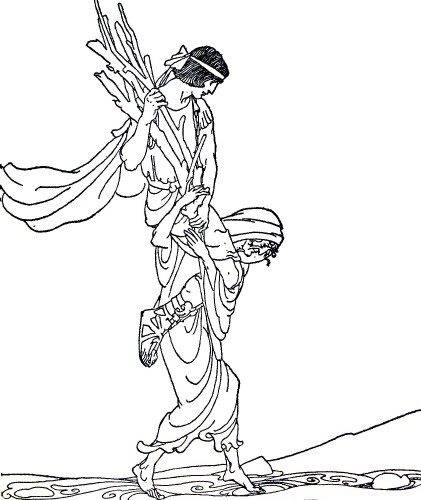 Jason
smiled. How foolish this old woman was to think that she could bear him
across
the flooded river! She came near him and she took him in her arms and
lifted
him up on her shoulders. Then, before he knew what she was about to do,
she had
stepped into the water. From
stone to stepping-stone she went, Jason holding on to the wood that she
had
drawn to her shoulders. She left him down upon the bank. As she was
lifting him
down one of his feet touched the water; the swift current swept away a
sandal. He
stood on the bank knowing that she who had carried him across the
flooded river
had strength from the gods. He looked upon her, and behold! she was
transformed.
Instead of an old woman there stood before him one who had on a golden
robe and
a shining crown. Around her was a wondrous light — the light of the sun
when it
is most golden. Then Jason knew that she who had carried him across the
broad
Anaurus was the goddess whom he had seen in the ways of the forest —
Hera,
great Zeus’s wife. “Go
into Iolcus, Jason,” said great Hera to him, “go into Iolcus, and in
whatever
chance doth befall thee act as one who has the eyes of the immortals
upon him.” She
spoke and she was seen no more. Then Jason went on his way to the city
that
Cretheus, his grandfather, had founded and that his father Æson had
once ruled
over. He came into that city, a tall, great-limbed, unknown youth,
dressed in a
strange fashion, and having but one sandal on. |
 Click the book image to turn
to
the next Chapter.
Click the book image to turn
to
the next Chapter.