
Web
and Book design,
Copyright, Kellscraft Studio 1999-2007 (Return to Web Text-ures) |
Click
Here to return to
Autobiography of Benjamin Franklin Content Page Return to the Previous Chapter |
 (HOME)
|
|
XI INTEREST IN PUBLIC
AFFAIRS I BEGAN
now to turn
my thoughts a little to public affairs, beginning, however, with small
matters.
Thecity watch was one of the first things that I conceiv’d to want
regulation.
It was managed by the constables of the respective wards in turn; the
constable
warned a number of housekeepers to attend him for the night. Those who
chose
never to attend, paid him six shillings a year to be excus’d, which was
suppos’d to be for hiring substitutes, but was, in reality, much more
than was
necessary for that purpose, and made the constableship a place of
profit; and
the constable, for a little drink, often got such ragamuffins about him
as a
watch, that respectable housekeepers did not choose to mix with.
Walking the
rounds, too, was often neglected, and most of the nights spent in
tippling. I
thereupon wrote a paper to be read in Junto, representing these
irregularities,
but insisting more particularly on the inequality of this six-shilling
tax of
the constables, respecting the circumstances of those who paid it,
since a poor
widow housekeeper, all whose property to be guarded by the watch did
not
perhaps exceed the value of fifty pounds, paid as much as the
wealthiest
merchant, who had thousands of pounds’ worth of goods in his stores. On the
whole, I
proposed as a more effectual watch, the hiring of proper men to serve
constantly in that business; and as a more equitable way of supporting
the
charge, the levying a tax that should be proportion’d to the property.
This
idea, being approv’d by the Junto, was communicated to the other clubs,
but as
arising in each of them; and though the plan was not immediately
carried into
execution, yet, by preparing the minds of people for the change, it
paved the
way for the law obtained a few years after, when the members of our
clubs were
grown into more influence. About this
time I
wrote a paper (first to be read in Junto, but it was afterward
publish’d) on
the different accidents and carelessnesses by which houses were set on
fire,
with cautions against them, and means proposed of avoiding them. This
was much
spoken of as a useful piece, and gave rise to a project, which soon
followed
it, of forming a company for the more ready extinguishing of fires, and
mutual
assistance in removing and securing of goods when in danger. Associates
in this
scheme were presently found, amounting to thirty. Our articles of
agreement
oblig’d every member to keep always in good order, and fit for use, a
certain
number of leather buckets, with strong bags and baskets (for packing
and
transporting of goods), which were to be brought to every fire; and we
agreed
to meet once a month and spend a social evening together, in
discoursing and
communicating such ideas as occurred to us upon the subjects of fires,
as might
be useful in our conduct on such occasions. The utility of this institution soon appeared, and many more desiring to be admitted than we thought convenient for one company, they were advised to form another, which was accordingly done; and this went on, one new company being formed after another, till they became so numerous as to include most of the inhabitants who were men of property; and now, at the time of my writing this, tho’ upward of fifty years since its establishment, that which I first formed, called the Union Fire Company, still subsists and flourishes, tho’ the first members are all deceas’d but myself and one, who is older by a year than I am. The small fines that have been paid by members for absence at the monthly meetings have been apply’d to the purchase of fire-engines, ladders, fire-hooks, and other useful implements for each company, so that I question whether there is a city in the world better provided with the means of putting a stop to beginning conflagrations; and, in fact, since these institutions, the city has never lost by fire more than one or two houses at a time, and the flames have often been extinguished before the house in which they began has been half consumed. 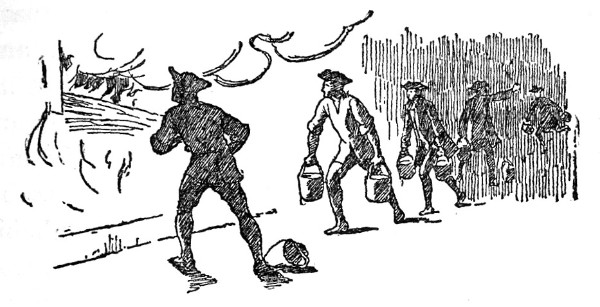 In 1739
arrived
among us from Ireland the Reverend Mr. Whitefield,1 who had
made
himself remarkable there as an itinerant preacher. He was at first
permitted to
preach in some of our churches; but the clergy, taking a dislike to
him, soon
refus’d him their pulpits, and he was oblig’d to preach in the fields.
The
multitudes of all sects and denominations that attended his sermons
were
enormous, and it was matter of speculation to me, who was one of the
number, to
observe the extraordinary influence of his oratory on his hearers, and
how much
they admir’d and respected him, notwithstanding his common abuse of
them, by
assuring them they were naturally
half
beasts and half devils. It was wonderful to see the change
soon made
in the manners of our inhabitants. From being thoughtless or
indifferent about
religion, it seem’d as if all the world were growing religious, so that
one
could not walk thro’ the town in an evening without hearing psalms sung
in
different families of every street. And it
being found
inconvenient to assemble in the open air, subject to its inclemencies,
the
building of a house to meet in was no sooner propos’d, and persons
appointed to
receive contributions, but sufficient sums were soon receiv’d to
procure the
ground and erect the building, which was one hundred feet long and
seventy
broad, about the size of Westminster Hall;2 and the work was
carried
on with such spirit as to be finished in a much shorter time than could
have
been expected. Both house and ground were vested in trustees, expressly
for the
use of any preacher of any religious persuasion who might desire to say
something to the people at Philadelphia; the design in building not
being to
accommodate any particular sect, but the inhabitants in general; so
that even
if the Mufti of Constantinople were to send a missionary to preach
Mohammedanism to us, he would find a pulpit at his service. Mr.
Whitefield, in
leaving us, went preaching all the way thro’ the colonies to Georgia.
The
settlement of that province had lately been begun, but, instead of
being made
with hardy, industrious husbandmen, accustomed to labour, the only
people fit
for such an enterprise, it was with families of broken shop-keepers and
other
insolvent debtors, many of indolent and idle habits, taken out of the
jails,
who, being set down in the woods, unqualified for clearing land, and
unable to
endure the hardships of a new settlement, perished in numbers, leaving
many
helpless children unprovided for. The sight of their miserable
situation
inspir’d the benevolent heart of Mr. Whitefield with the idea of
building an
Orphan House there, in which they might be supported and educated.
Returning
northward, he preach’d up this charity, and made large collections, for
his
eloquence had a wonderful power over the hearts and purses of his
hearers, of
which I myself was an instance. I did not
disapprove of the design, but, as Georgia was then destitute of
materials and
workmen, and it was proposed to send them from Philadelphia at a great
expense,
I thought it would have been better to have built the house here, and
brought
the children to it. This I advis’d; but he was resolute in his first
project,
rejected my counsel, and I therefore refus’d to contribute. I happened
soon
after to attend one of his sermons, in the course of which I perceived
he
intended to finish with a collection, and I silently resolved he should
get
nothing from me. I had in my pocket a handful of copper money, three or
four
silver dollars, and five pistoles in gold. As he proceeded I began to
soften,
and concluded to give the coppers. Another stroke of his oratory made
me
asham’d of that, and determin’d me to give the silver; and he finish’d
so
admirably, that I empty’d my pocket wholly into the collector’s dish,
gold and
all. At this sermon there was also one of our club, who, being of my
sentiments
respecting the building in Georgia, and suspecting a collection might
be
intended, had, by precaution, emptied his pockets before he came from
home.
Towards the conclusion of the discourse, however, he felt a strong
desire to give,
and apply’d to a neighbour who stood near him, to borrow some money for
the
purpose. The application was unfortunately [made] to perhaps the only
man in
the company who had the firmness not to be affected by the preacher.
His answer
was, “At any other time, Friend
Hopkinson, I
would lend to thee freely; but not now, for thee seems to be out of thy
right
senses.” Some of
Mr.
Whitefield’s enemies affected to suppose that he would apply these
collections
to his own private emolument; but I, who was intimately acquainted with
him
(being employed in printing his Sermons and Journals, etc.), never had
the
least suspicion of his integrity, but am to this day decidedly of
opinion that
he was in all his conduct a perfectly honest
man; and methinks my testimony in his favour ought to have
the more
weight, as we had no religious connection. He us’d, indeed, sometimes
to pray
for my conversion, but never had the satisfaction of believing that his
prayers
were heard. Ours was a mere civil friendship, sincere on both sides,
and lasted
to his death. The
following
instance will show something of the terms on which we stood. Upon one
of his
arrivals from England at Boston, he wrote to me that he should come
soon to
Philadelphia, but knew not where he could lodge when there, as he
understood
his old friend and host, Mr. Benezet was removed to Germantown. My
answer was,
“You know my house; if you can make shift with its scanty
accommodations, you
will be most heartily welcome.” He reply’d, that if I made that kind
offer for
Christ’s sake, I should not miss of a reward. And I returned, “Don’t let me be mistaken; it was not for
Christ’s
sake, but for your sake.” One of our common acquaintance
jocosely
remark’d, that, knowing it to be the custom of the saints, when they
received any
favour, to shift the burden of the obligation from off their own
shoulders, and
place it in heaven, I had contriv’d to fix it on earth. The last
time I saw
Mr. Whitefield was in London, when he consulted me about his Orphan
House
concern, and his purpose of appropriating it to the establishment of a
college. He had a
loud and
clear voice, and articulated his words and sentences so perfectly, that
he
might be heard and understood at a great distance, especially as his
auditories, however numerous, observ’d the most exact silence. He
preach’d one
evening from the top of the Courthouse steps, which are in the middle
of
Market-street, and on the west side of Second-street, which crosses it
at right
angles. Both streets were fill’d with his hearers to a considerable
distance.
Being among the hindmost in Market-street, I had the curiosity to learn
how far
he could be heard, by retiring backwards down the street towards the
river; and
I found his voice distinct till I came near Front-street, when some
noise in
that street obscur’d it. Imagining then a semicircle, of which my
distance
should be the radius, and that it were fill’d with auditors, to each of
whom I
allow’d two square feet, I computed that he might well be heard by more
than
thirty thousand. This reconcil’d me to the newspaper accounts of his
having
preach’d to twenty-five thousand people in the fields, and to the
antient
histories of generals haranguing whole armies, of which I had sometimes
doubted. By hearing
him
often, I came to distinguish easily between sermons newly compos’d, and
those
which he had often preach’d in the course of his travels. His delivery
of the
latter was so improv’d by frequent repetitions that every accent, every
emphasis, every modulation of voice, was so perfectly well turn’d and
well
plac’d, that, without being interested in the subject, one could not
help being
pleas’d with the discourse; a pleasure of much the same kind with that
receiv’d
from an excellent piece of musick. This is an advantage itinerant
preachers
have over those who are stationary, as the latter cannot well improve
their
delivery of a sermon by so many rehearsals. His
writing and
printing from time to time gave great advantage to his enemies;
unguarded
expressions, and even erroneous opinions, delivered in preaching, might
have
been afterwards explain’d or qualifi’d by supposing others that might
have
accompani’d them, or they might have been deny’d; but litera scripta manet. Critics
attack’d his
writings violently, and with so much appearance of reason as to
diminish the
number of his votaries and prevent their increase; so that I am of
opinion if
he had never written anything, he would have left behind him a much
more
numerous and important sect, and his reputation might in that case have
been
still growing, even after his death, as there being nothing of his
writing on
which to found a censure and give him a lower character, his proselytes
would
be left at liberty to feign for him as great a variety of excellences
as their
enthusiastic admiration might wish him to have possessed. My
business was now
continually augmenting, and my circumstances growing daily easier, my
newspaper
having become very profitable, as being for a time almost the only one
in this
and the neighbouring provinces. I experienced, too, the truth of the
observation, “that after getting
the first
hundred pound, it is more easy to get the second,” money
itself
being of a prolific nature. The partnership at Carolina having
succeeded, I was encourag’d to engage in others, and to promote several
of my
workmen, who had behaved well, by establishing them with
printing-houses in
different colonies, on the same terms with that in Carolina. Most of
them did
well, being enabled at the end of our term, six years, to purchase the
types of
me and go on working for themselves, by which means several families
were
raised. Partnerships often finish in quarrels; but I was happy in this,
that
mine were all carried on and ended amicably, owing, I think, a good
deal to the
precaution of having very explicitly settled, in our articles,
everything to be
done by or expected from each partner, so that there was nothing to
dispute,
which precaution I would therefore recommend to all who enter into
partnerships; for, whatever esteem partners may have for, and
confidence in
each other at the time of the contract, little jealousies and disgusts
may
arise, with ideas of inequality in the care and burden of the business,
etc.,
which are attended often with breach of friendship and of the
connection,
perhaps with lawsuits and other disagreeable consequences. 1 George Whitefield,
pronounced
Hwit’field (1714-1770). a celebrated English clergyman and pulpit
orator, one
of the founders of Methodism. 2 A part of the palace
of
Westminster, now forming the vestibule to the Houses of Parliament in
London. |
 Click the book image to turn
to the next Chapter.
Click the book image to turn
to the next Chapter.