 Web
and Book design, Web
and Book design,Copyright, Kellscraft Studio 1999-2007 (Return to Web Text-ures) |
Click
here to return to Field Days in California Content Page Return to the Previous Chapter |
 (HOME) |
|
A BIRD-GAZER AT THE
GRAND CAÑON THE
bird-gazer is
peculiar. This is not spoken of bird-gazers in general, who may be much
like
other people, for aught we know, but of a certain particular member of
the
fraternity, the adventures of whose mind in the face of one of the
undisputed
wonders of the world are here to be briefly recounted. He is a
lover of
scenery. At least, he so regards himself. As he goes about among his
fellows,
he finds few who spend more time, or seem to experience more delight,
in
looking at the beauty that surrounds them. He would not rank himself,
of
course, with the eloquent specialists in this line, — with Wordsworth
or
Thoreau, to cite two widely dissimilar examples; but, as compared with
the
general run of more or less intelligent men, he seldom finds occasion
to feel
ashamed of himself for anything like indifference to the “goings-on of
earth
and sky.” He is as likely as almost any one he knows to consume a
half-hour
over a sunset, or to sit a long while under the charm of a
Massachusetts meadow
or a New Hampshire valley. Common beauty appeals to him. His spirit is
refreshed by it. He relishes
it,
to use a word that he himself uses often. But with all this (and here
we come
to the peculiarity), the exceptional and the stupendous are apt to
leave him
comparatively unaffected. As he says sometimes, meaning, perhaps, to
justify
his eccentricity, he admires the grace of the human figure, but takes
no
particular interest in giants or dwarfs. These excite curiosity, as a
matter of
course, but for his part he would not go far out of his way to stare at
them. The
comparison is
rather beside the mark. He would own as much himself. Indeed, he had
come a
long distance out of his way to see the Grand Cañon of the Colorado.
But, after
all, to hear some of the things he began by saying about it (though you
would
not have heard them, since he had the discretion to say them to
himself), you
might have inferred that this stupendous rift in the earth’s surface
was to
him, for the moment, at least, a something rather monstrous than
beautiful. He reached
the
Cañon on a bright Saturday morning in December. All day Thursday he had
ridden
over the prairies of Kansas, gazing out of the car window, and
repeating with
“relish” Stevenson’s line, “Under the wide and
starry sky.” There were no stars in sight, naturally enough, but that did not concern him. It was the word “wide” that pleased his imagination. Whether he should die gladly when the time came, as Stevenson felt so sure of doing, he was unprepared to say; but for the present hour, at any rate, he was living gladly, profoundly enjoying the sense of vastness with which that wide Kansas sky inspired him. A wide sky it surely was, with scarcely so much as an apple tree to narrow it. As often as not there was nothing to point the horizon but a haycock or two an unknown number of miles away. Some of his travelling companions seemed to find the prospect depressing, and the day of the longest, but the bird-gazer passed the hours in surprising content. He almost believed that he should like to live in Kansas, New Englander though he is. Unbroken horizons appeared to agree with him. At
midnight, or
thereabout, he woke to hear the engines puffing as if out of breath.
The grade
must be steep. Unless he was deceived, he could feel the inclination of
the car
as he lay in bed. Then up went the curtain. Hills loomed all about,
with here
and there a solitary pine tree standing in the moonlight like a sentry.
“You
are in Colorado,” one of them said; and the gazer knew it. No more
prairie. The
earth was all heaved up into hills. And just then the train ran into
the
darkness of a tunnel, and when it emerged, the traveler was in New
Mexico. All that
day he
journeyed among hills, now near, now far, now high, now low, now
wooded, now
bare as so many gravel heaps (“not mountains, just buttes,” a
train-hand told
him), now in ranges, now solitary. Indian villages, a long run along
the Rio
Grande, a stop at Albuquerque, brilliantly colored cliffs and crags, a
gorgeous
sunset, — indeed, it was a memorable, many-featured day. And in the
morning,
after miles of level pine forest, — the Coconino Plateau, — he was at
the Grand
Cañon, where he had desired to be. He was not
disappointed. Wise men seldom are. He had known perfectly well that he
should
not see the wonder and glory of the place at a first look. His mind is
slow,
and he has lived with it long enough to have learned a little of its
weakness.
The Cañon was astounding, unspeakable. Words were never made that could
express
it. And the shapes and the colors! “Magnificent! Magnificent!” he said.
“But it
is too much like the pictures. I must wait till they have been
forgotten, and I
can see the Cañon for itself.” So he
wandered off
into the woods, an endless forest of pines and cedars. Perhaps he
should find a
bird or two. And so it was; he had gone but a little way before he came
upon a
flock of snowbirds. But they were not the snowbirds he was accustomed
to see in
New England. Some among them had black heads and breasts, with rather
dull
brown backs, and a suffusion of the same color along the sides of the
body.
Lovely creatures they were; perfectly natural, — true snowbirds to
anybody’s
eye, — yet recognizable instantly as something quite new and strange.
And some
were all of an exquisite soft gray, as well above as below, except that
they
had bright chestnut-brown backs and black lores, — that is to say, a
black spot
on each side of the head between the eye and the bill. These were
neater even
than the others, if that were possible, and decidedly more striking a
novelty.
Our pilgrim was at once in high spirits. What bird-man but would have
been? On
getting back to the hotel and the Handbook, he would know what to call
his new
acquaintances. So he promised himself; but as things turned out, the
question
was not so simple as he had assumed. He was obliged to see the
black-headed one
(the Sierra junco) again to make sure of a detail he had omitted to
note; while
as for the gray one, it was not till he had studied the birds and the
book for
two days that he was fully settled how to name it. The race
of juncos
is highly variable in this Western country (eleven species and
subspecies), and
there were several nice points demanding attention. Luckily the birds
could
always be found with a little searching; and the oftener they were
seen, the
prettier they looked, especially the lighter-colored one, the
gray-headed
junco, as ornithologists name it. After all, thought the bird-gazer,
the Quaker
taste in colors is not half so bad as it might be. But it was wonderful
how
much that little patch of black (a clever beauty-spot, such as he
seemed to
remember having seen ladies wear) heightened and set off the bird’s
general
appearance. He greatly enjoyed the sight of both species, as they fed
in the
road or under the sage-brush bushes, snapping their tails open
nervously at
short intervals (as fine ladies do their fans), just like their Eastern
relatives. “Yes,
yes,” he
said, with a sense of relief; “I may be a little slow with cañons, but
I do not
need a week or two in which to appreciate the beauty of a snowbird.
This is
something within my capacity.” It is no
small part
of the comfort and success of life to recognize one’s limitations and
be
reconciled to them. This first
ramble,
which did not extend far, disclosed surprisingly little of animal life.
At an
elevation of seven thousand feet winter is winter, even in Arizona. The
mixed
flock of snowbirds just mentioned, a jack rabbit that bounded off into
the
woods with flying leaps, and a bevy of chickadees that got away from
the
rambler before their specific identity could be established, these were
all. Then, as
he
returned in the direction of the hotel, his attention was taken by a
two-story
house which some one — a photographer, by the sign over the door — had
built on
a narrow shelf, barely wide enough to hold it, a little below the top
of the
Cañon wall, and he went down the footpath, the beginning of Bright
Angel Trail,
as it turned out, to inspect it. A knock brought a young man up from
below,
with an invitation to enter. An eerie perch it was, and no mistake.
From the
second-story back door, which had neither steps nor balcony, but opened
upon
space, one had only to leap over a narrow wooden platform, one story
below, to
land upon the rocks, a thousand feet, perhaps, down the Cañon. The
photographer
was explaining the superior advantages of the site for artistic
purposes, when
a jay dropped into a pine tree just out of reach; a crestless,
long-tailed jay,
wearing a beautiful fan-shaped decoration on its front; seen at a
glance to be
a congener of the Florida jay, whose exceeding tameness and other odd
ways make
so lively an impression upon visitors along the east coast of that
peninsula.
On being asked if it was often seen, the man replied, “Oh, yes, it is
common
here. But it isn’t a jay, is it?” he added; and, being assured that
such was
the case, he said, “Well, we have another jay much bigger than this.”
At the
moment it did not occur to the visitor to ask for particulars; but it
transpired later, as he had suspected it would, knowing from the
Handbook what
kinds of jays might on general grounds be looked for in this region,
that the
“much bigger” bird was the long-crested jay, which at the most measures
about a
quarter of an inch more than the one, the Woodhouse jay by name, about
which he
and the photographer had been conferring. A capital example, it seemed,
of how
much a certain style and carriage (with a lordly crest) can do in the
way of
swelling a bird’s, as well as a man’s, apparent size and importance.
Have we
not read somewhere that Napoleon could on occasion look some inches
taller than
he really was? Meanwhile,
as soon
as luncheon was disposed of, the bird-gazer, still with jays troubling
his
mind, started along the rim of the Cañon, picking his way among stones,
dodging
the deeper snows and the softer mud-spots, toward O’Neill’s Point,
which could
be seen, a mile or so eastward, jutting out over the abyss, as if on
purpose
for a spectator’s convenience. So he walked, stopping every few steps
to look
and listen, the stupendous chasm on one side and the pine and cedar
forest on
the other. Mostly, as in duty bound, he gave his thoughts to the Cañon;
but if
a bird so much as peeped, his eyes were after it. It was during this jaunt, indeed, that he made the acquaintance of the mountain chickadee and the gray titmouse, two Westerners well worth any man’s knowing. The mountain chickadee, with whose striking portrait he had long been familiar, is a pretty close duplicate of the common black-capped chickadee of the Northeastern States, except that the black side of its head is broken by a noticeable white stripe above the eye. If all birds were thus plainly tagged, the lister’s work would, perhaps, be almost too easy. At least, it would be much less exciting. This
mountain
chickadee has the familiar dee-dee
of the Eastern bird, — though in a recognizably different tone and with
a
different prefatory note, — a sweet, thin-voiced, two-syllabled
whistle, or
song, and the characteristic hurried set of sharp, top-of-the-scale,
sibilant
notes, which, as we may conclude, led the Indians of Maine — so Thoreau
tells
us — to call the chickadee Keecunnilessu.
The gray titmouse is gray throughout, eschewing all ornament except a smart little backward-pointing crest of gray feathers. In general shape, and especially in something about the setting of the eye, it suggests that monotonous and persistent whistler, the tufted tit of the Southeastern States. Both these novelties, as well as the slender-billed nuthatch (the common white-breasted nuthatch, with variations, especially of a vocal sort), which seemed to be traveling with them, were to prove regular, every-day birds in the forest hereabout. All in
all,
whatever he might yet think of the Cañon, our rambler’s first day on
its rim
could be accepted as fairly successful, with five new species added to
his
slender stock of ornithological knowledge. The next
morning,
bright and early (or rather dark and early, for he had breakfasted and
was in
the woods long before sunrise), he took the road in the opposite
direction. He
would go to Rowe’s Point, — another natural observatory to which all
guests of
the hotel are presumed to drive, — partly to see the Cañon, and partly
to see
the forest and its inhabitants. The trees, as has been said, are mostly
— almost
entirely pines and cedars. The pines along the Cañon’s edge (there are
two
taller species, “yellow” and “black,” in the slightly lower valleys of
the
plateau) are small, with extremely short leaves, — so short that very
young
trees look confusingly like firs, — two to the sheath, and prickly
cones hardly
bigger than peas. Piñons,
the
stranger was afterward bidden to call them, which he proceeded to do,
with
lively satisfaction. It is always a pleasure to find a name out of a
book
beginning to mean something. The cedars, many of them ancient-looking
(a
thousand years old, some of them might well enough be), and loaded with
mistletoe, bear a general resemblance to the red cedar of the East
(though
their berries are much larger), and are remarkable, even at first
glance, for
branching literally at the ground, making one feel as if the earth must
have
been filled in about them after they were grown. Here and
there was
an abundance of a shrub, or small tree, which, the photographer had
informed
the newcomer, was known locally as the Mexican quinine bush, still
showing its
last season’s straw-colored flowers, — many stamens and six
prodigiously long,
feathered styles in a spreading, bell-shaped, five-lobed corolla. The
foliage
was much like a cedar’s in appearance, and when crushed yielded a
resiny,
colorless substance and an extraordinarily pungent and persistent,
agreeably
medicinal odor. The bird-gazer was noting these details (the last-mentioned bush, especially, being a most interesting one, with which he hoped some time or other to come to a better understanding), and now and then pushing out to the brink of the Cañon, every point affording a change of prospect, when, to his surprise, he found himself at the end of his jaunt. Here,
surely, was a
grand outlook. He was glad he had come. The Cañon was beginning to
fasten its
hold upon him. Far down (a good part of a mile down) could be seen a
stretch of
the Colorado River, and now for the first time he heard its voice, the
only
sound that had yet reached him out of the abyss. “The
silent Cañon,”
he had caught himself murmuring the day before. Indeed, its silence had
impressed him almost as much as its extent, its wealth of color, and
its
strange architectural forms, which last, one may almost say, are what
chiefly
give to the Cañon its peculiar character. One gazes upon the huge,
symmetrical
artificial-looking constructions (“like the visible dream of an
architect gone
mad”), and thinks of Coleridge’s lines — at least our bird-gazer
thought of
them: “In
Xanadu did Kubla Khan
A stately pleasure-dome decree: Where Alph, the sacred river, ran Through caverns measureless to man Down to a sunless sea.” Scores of
times he
had repeated the verses to himself during the last day or two (they are
worth
repeating for their music, though no less a critic than William Hazlitt
pronounced the poem “a mixture of raving and driveling”), and now, when
he saw
the sacred river, its muddiness visible a mile away, the sight gave him
an
unpleasant shock. The river that the opium-eating poet saw could never
have
been of that complexion. Some such romantic feeling as this was upon him, perhaps, when, happening to turn his head, he beheld close behind him, at the tip of a low, dead tree, the form of a strange bird. “Now, pray, what can you be?” he exclaimed under his breath; and in one moment the Cañon was a thousand miles off. Some distance back he had heard a musical chorus, suggestive to his ear of a chorus of pine grosbeaks, and then had seen the flock for an instant, as it flew across a clear space among the trees, moving toward the rim of the Cañon. And now here was a bird right before him, a finch of some kind, a female, in all probability (if it had only been a male in bright diagnostic plumage!), streaked with dark underneath, sporting a long tail (for a finch), and for its best mark having a broad whitish or grayish band over the eye. So much he saw, and then it was gone, uttering as it flew the same notes that he had heard from the flock shortly before. Probably it was one of the various purple finches, — Cassin’s, as likely as any, a species due in this general region, and having a longish tail. “Probably!” — that is an uncomfortable word for a bird-gazer, but in the present case there seemed no possibility of bettering it; and, when all is said, probability is a kind of half-loaf, to say the worst of it, a little better than nothing. 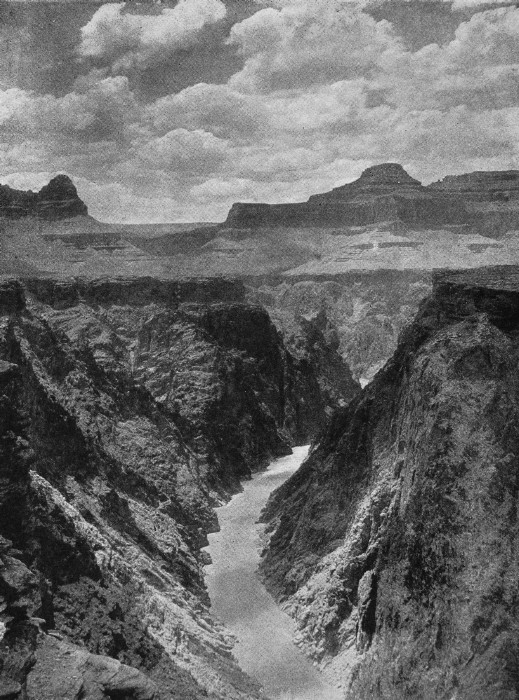 THE GRAND CAÑON Photograph by George R. King Anyhow,
the bird
was gone, and gone for good, and with it had departed for the time
being all
the gazer’s interest in the sacred river, and in the gaudy colors and
bizarre
shapes of the great chasm. A path beckoned him into the woods, and,
with birds
in his eye, he took it. It was well he did, for he had hardly more than
started
before he stopped short. Hark! Wasn’t that a robin’s note? Yes,
somewhere
before him, out among the low piñons, the bird was cackling at short
intervals,
— the very same cackle that a Massachusetts robin utters when it finds
itself
astray from the flock. Half a dozen times or more the anxious sounds
were
repeated, while the listener edged this way and that, more anxious than
the
bird, twice over, scanning the tops of the trees for a sight of the
ruddy
breast. He saw nothing, and anon all was silent. The bird had eluded
him. A
Western robin, he supposed it must have been, and as such he would have
given
something for a sight of it. Well, if he lived a week or two longer, he
should
be in California, and there, with any kind of luck, he would find out
for
himself, what no book had ever been considerate enough to tell him,
whether the
calls of propinqua are
so exactly
the same as those of plain migratoria.
Meantime he had added another name to his Grand Cañon list, and was
back at the
Point for another turn with the Eighth Wonder. And then,
as
frequently before and after, he laughed quietly at his foolish self, so
taken
with the sight of a bird, and so inadequately moved by all this
transcendent
spectacle of form and color. Verily, as common wisdom has it, it takes
all
kinds to make a world; and among the all kinds there must needs be a
few odd
ones. But for
all his
laughing, he was really not quite so absurdly insensible as he was
perversely
inclined to make out. The Wonder was growing upon him. He looked at it
oftener
and longer, and with something more of pleasurable emotion, though it
was still
too monstrous, too strange, too little related to any natural feeling.
He
should need to live on its rim for months or years before it would
affect him
according to its deserts. Nay, he should have to spend long whiles down
in its
depths; for though the present slipperiness of the steep, snow-covered
trail
made the descent seem an imprudent venture for so chronic a graybeard,
yet he
did more than once go down the first few zigzags, — far enough to feel
the
awful stillness and loneliness of the place, and to realize something
of the
power of those frowning walls over the human spirit. At such
times it
was, especially, that he felt a desire to come here again, in a more
propitious
season, and to spend some days, at least, on one of those lower
plateaus, or on
the bank of some far-down stream. Birds and flowers would fill the
place, the
cañon wren would sing to him, and the short, shut-in days would pass
over his
head like a dream. Even as it was, there is no telling how far down he
might
sooner or later have ventured, the desire increasing upon him, but for
a wild,
all-day snow-storm, which, for the remainder of his stay, put all such
projects
out of the question. An hour
after
hearing the robin, while on his return to the hotel, he came upon
another bird
of about the same degree of novelty, — a brown creeper, looking almost
as
New-Englandish as the robin’s voice had sounded; the same
pepper-and-salt coat,
the same faint, quick zeep, a mere nothing of a sound, yet known on the
instant
for what it is, anywhere on the continent, and the same trick of
beginning
always at the bottom of the tree and hitching its way upward. Yet it
was not
exactly the bird of New England, after all; for when the observer met
with it
again, as he did on sundry occasions (always a single bird, — another
characteristic trait), he perceived, or fancied he perceived, that its
coat was
of a lighter shade than he had been accustomed to see. The Rocky
Mountain
creeper, the book instructed him to call it, and the name sounded sweet
to him.
At almost the same minute, too, he had his first clear sight of another
Rocky
Mountain bird, — the Rocky Mountain hairy woodpecker. This was to prove
one of
the very common inhabitants of the plateau. Its emphatic, perfectly
natural-sounding
calls were heard many times daily, and would have passed without remark
anywhere in the East. In personal appearance, however, the bird is
clearly
enough distinguished, even at first sight, by the all but solid
blackness of
its wings. After
luncheon the
bird-gazer again took the field (the altitude was congenial to him, and
there
was no staying indoors), and was soon in a fever of excitement over two
jays
that were chasing each other about in the tops of some tall yellow
pines. It
was evident at once that they were extremely dark in color and had most
extraordinarily conspicuous topknots. “The long-crested,” he said to
himself,
one of the birds he most earnestly desired to see. “Now is my chance,”
he
thought; and it should not be his fault if he missed it. From tree
to tree
the birds went, now together, now separately, uttering a kind of
grunting note,
strangely suggestive of the gray squirrel, ridiculous as the comparison
may
sound; and still he could never get either of them with a satisfactory
light on
its face, which, he knew, should be marked (if his opinion as to their
identity
was correct) by narrow up-and-down white lines on the forehead, and a
little
patch of the same color over each eye. At last
one dropped
to the ground, a happy chance, and began feeding on something found
there; and
now, after patient stalking, our man had his field-glass on the bird
under the
best of conditions. All the marks were present. And what a beauty! (and
what a
crest!) — one of the most striking of all North American birds, of
itself a
sufficient reward for his winter visit to the Grand Cañon. If he were
to tell
the truth, he would, perhaps, confess that the sight of it afforded him
— for
the moment — almost as keen a pleasure as that of the Cañon itself. And
he might
have said as much of a flock of eight or ten pygmy nuthatches, engaging
creatures, seen on three occasions, with notes all of a finch-like
quality (in
that respect like those of the little brown-headed nuthatches of the
Southern
States), and one — a note of alarm, it seemed — almost or quite
indistinguishable from the sharp kip,
kip
of the red crossbill. The hobbyist, — and why should any of us feel
like
shirking the name, since we are all hobbyists of one sort or another, —
the
hobbyist, lucky man, has joys with which no stranger intermeddleth. Every one
to whom
our particular hobbyist ventured to speak upon the subject assured him
that
there were no birds here at this season; and indeed, for long spells
together,
this seemed, even to him, to be something like true. The Coconino
forest is so
almost boundless that the winter denizens of it, mostly moving about in
little
companies, are by no means “enough to go round,” as one of the
hobbyist’s
outdoor cronies is given to saying. So it was that our bird-gazer often
sauntered for an hour without being rewarded by so much as a lisp; yet
he felt
sure all the while, and the result always bore out his faith, that even
here,
and in winter, and on this very day, time and patience could not be
spent
altogether in vain. If he saw nothing, as sometimes was true, on the
two or
three miles to Rowe’s Point, for example, why, there was still the
chance of
something on the return. The very spot that had been vacant at eight
o’clock
might be astir with wings an hour or two later; for, as we say, winter
birds,
with no family duties to tie them, and the cool weather to enliven
them, are
continually on the go. Thus it
happened
that the bird-gazer, retracing his steps after a long jaunt that had
shown him
nothing (nothing in his special line, that is to say; there is always something for a sensible pair
of eyes to
look at), was brought to the suddenest kind of standstill by the sight
of two
or three birds on the ground a few rods in advance. “Bluebirds!
Bluebirds!” he
said. And so they were, here in the very midst of the wood, impossible
as the
encounter seemed to a man accustomed only to the bluebird of the East,
which
might almost as soon be looked for upon a millpond as in a forest. His
glass
covered one of them. All its visible under parts were blue! It moved
out of
sight, and the glass was leveled upon another, and then upon another,
as
opportunity offered. And all but the first one had the regular
red-earth
breast, with blue throats and bellies, and reddish or chestnut-colored
backs.
Then, to the observer’s sorrow, they suddenly took wing with a chorus
of sweet,
perfectly familiar calls, and in a moment were gone. The all-blue one
(the
mountain, or arctic, bluebird, as it is called) was new to him. The
others, of
the kind known as the chestnut-backed bluebird, he had seen once or
twice on a
previous visit to the Southwest. Whether on the deserts of southern
Arizona, or
here in the mountain forests of northern Arizona, they were good to
meet. If only
they would
have stayed a bit to be looked at, or if they could have been pursued,
as in
New England one pursues the first spring bluebird from apple orchard to
apple
orchard for pure joy of seeing and hearing it! But they were gone
whither there
was no such thing as following them, — into the Cañon, to judge by the
course
taken, — and neither they, nor any like them, were seen or heard
afterward. They had
not been
alone, however, and the bird-gazer was still for a few minutes
abundantly busy.
Mountain chickadees were lisping and deeing,
and one of them gave out once, as if on purpose for the Yankee
listener’s
benefit, his brief, musical whistle. “Thank you,” said the Yankee; “do it again.” But
the singer, as
singers will, refused the encore. One or two nuthatches and a hairy
woodpecker
were with the group, almost as a matter of course, and at the last
minute the
tiniest bunch of feathers was seen fluttering about the twigs of a
pine. None
but a kinglet could dance on the wing in just that tricksy fashion;
and, true
enough, a kinglet it was, a goldcrest, seen for a glance or two only,
but, even
so, revealing a strangely conspicuous white or whitish band on the side
of the
crown. Another Rocky Mountain stranger, if you please, the Rocky
Mountain
goldcrest. Two new birds within five minutes. Perhaps the bird-gazer
did not go
on his way rejoicing! The road was rough, — frozen every night, and
muddy to
desperation every afternoon, — but a hobby could still be ridden over
it with
comfort. And here
seems a
good place in which to mention one of the Yankee visitor’s
meteorological
surprises. Somebody had spoken to him of cold weather lately at the
Cañon, —
zero or under, — and he mentioned the report to his friend the
photographer.
“Oh, yes,” was the answer; “probably the mercury has not been far from
zero for
the last two mornings.” The
visitor
intimated incredulity; he had been strolling in the woods before
sunrise on
both the mornings in question, standing still a considerable part of
the time
to make notes or listen, and never once thinking of ears or fingers;
upon which
the photographer smiled and advised him to consult the railroad
station-master,
who, it appeared, had a government thermometer, and was the official
keeper of
the local weather record. Well, the station-master was complaisant,
although an
official, and, on turning to his tally-sheet, found that on the two
previous
mornings the glass had registered respectively zero and two above zero.
The man
from
Massachusetts was dumb. He had heard, as every one has, of the efficacy
of a
dry atmosphere in tempering the impression of cold, but he found at
this minute
that he had never really taken it in. If he had known the standing of
the
thermometer he certainly would not have worn his summer hat, and would
probably
have thought it prudent now and then to try his ears. Three or four
mornings
afterward, though the mercury was only a few degrees lower (five
degrees below
zero), he confesses that he did not loiter. With a raw wind from the
north and
the air full of snow, a somewhat rapid gait was taken, as by instinct.
In fact,
the weather was so much like home that it almost made him homesick —
for
California. On the
second of
the two mornings first mentioned, he had sauntered to O’Neill’s Point,
and had
remarked, as before, how the white frost covered everything (sign of a
warm,
pleasant, day in New England), giving an extra touch of pallor even to
the
pallid sage-brush. He had remarked, also, how warmly an old Indian
squaw was
wrapped as she came riding through the woods on horseback. “Good
morning,” said
the bird-gazer, as they met. “Umph,” said the squaw. Ah, she doesn’t
understand
English, thought the bird-gazer, and he tried her with “Buenos dias.”
“Umph,”
she answered again; and the two parted as strangers. He might have had
better luck
with a chickadee. Only the
commoner
birds had been found, till, on the return, in a break in the forest, of
which
break the sage-brush, always straitened for room, had taken possession,
he
suddenly descried a flock of extremely small birds of a sort entirely
strange
to him: slender gray birds, with long tails, — like gnatcatchers in
that
respect, — and some possible, poorly seen darker patch on the side of
the head.
He looked at them, and looked again (their activity was incessant, and
the
looks were of the briefest), and then, with a chorus of little
nothings, they
all took wing. And the bird-gazer, of course, followed on. Twice he
came up
with them. “Bush-tits,” he said to himself; “they can be nothing else.”
And
bush-tits they were, as he feels confident (but he will be surer, he
hopes,
when he gets to California), of the species known as lead-colored. It
was a
shame they should have been so restless. There was plenty of
sage-brush, on the
seeds of which they seemed to be feeding; but, like winter birds in
general,
they must take a bite here and a bite there, as if, by sampling the
same thing
in a dozen places, they somehow secured variety. They were gone, at all
events,
and the bird-gazer was starting back, half jubilant, half disconsolate,
toward
the road, when, from almost under his feet, a jack rabbit sprang up
and, with a
leap or two over the sage-brush bushes (a great leg with the hurdles is
the
jack rabbit), took his black tail out of sight. Such, by
the
reader’s leave, were some of the trifles with which a Yankee bird-gazer
beguiled his long-anticipated, much-talked-about week at the Grand
Cañon of the
Colorado! Stevenson
begins
one of his early essays by remarking, “It is a difficult matter to make
the
most of any given place.” Of course it is; and not only difficult, but
impossible, as he would have known, had he been a few years older.
There will
always remain a corner unexplored, a point of view not taken, a phase
of modest
beauty imperfectly appreciated. Thoreau himself, it is safe to assert,
did not
make the most of Concord. And after that what hope is there for the
rest of us?
Of course, then, the bird-gazer did not make the most of the Grand
Cañon. How
could he, with the little time at his disposal, the unfavorable season,
the
exceptionally inclement weather of the latter half of his stay (it was
twelve
degrees below zero on the last morning, and his farewell communings
were
nothing like so leisurely as he could have wished), and, chiefest of
all, the
peculiar limitations of his own nature? No doubt
he might
have used words about it, — there is many a fine adjective in the
dictionary;
but adjectives of themselves prove nothing, unless it be, too often,
their
user’s imbecility. “Isn’t it pretty?” he heard a lady ask; and, since
he was
not addressed, he did not reply, as it was on his tongue’s end to do,
“No, my
dear madam, it is not pretty.” On another occasion a man pronounced it
“a right
nice view,”1 and this time the bird-gazer could only nod a
despairing assent. How the
place ought to affect
beholders he does not
assume to decide; some in one way, perhaps, and some in another. For
his own
part, if now and then, when he might have been admiring the painted
walls and
the yawning abyss, he found his eyes resting of their own accord upon
the snow-covered
San Francisco peaks on the southern horizon, who shall say that he was
necessarily in the wrong? A mountain two miles high is a commoner sight
than a
ravine a mile deep; but since when has commonness or uncommonness been
taken as
a test of beauty or grandeur? Let every man be pleased with that which
pleases
him; and as far as possible, — which probably will not be very far, —
unless he
has the difficult grace of silence, let him tell the truth. As for the
bird-gazer himself, it must be acknowledged, since he calls for
truth-telling,
that even to the last there remained with him a question whether it lay
within
the power of this barbaric display of shape and color ever to evoke
those
deeper, tenderer, more serene and blissful moods of rapturous
contemplation,
such as, ever and anon, when the time is right, descend upon the
waiting soul,
responsive to the still, small voice of the commonest and most familiar
of
humble landscapes. So let it
be, he
said, and he stands by it grandeur to visit, but modest beauty to be at
home
with. THE END 1 It was something to his credit that he didn’t say “awfully nice,” a locution which at this minute the bird-gazer hears from the lips of a lady of his acquaintance. She knows better, no doubt, but cannot help following the fashion in the use of words more than in the purchase of hats, though hats and words be alike barbarous. |
Web and Book design,
Copyright, Kellscraft Studio
1999-2007
(Return to Web Text-ures)