 Web
and Book design,
Web
and Book design, Copyright, Kellscraft Studio 1999-2007 (Return to Web Text-ures) |
Click
Here to return to Field Days in California Content Page Return to the Previous Chapter |
 (HOME) |
|
A VISITATION OF
SWANS I HAD
never seen a
wild swan till the twenty‑second of December, 1908. That morning I
walked out,
as I was in the habit of doing every few days, to Laguna Blanca, the
only body
of fresh water in the neighborhood of Santa Barbara; an artificial
lake, at
least in its present size and condition, though an old Spanish resident
of the
city tells me there was always water there. Shooting is prohibited by
its
owners, and throughout the winter, under this privilege of sanctuary,
the lake
is frequented by many kinds of waterfowl. On this particular morning, as I drew near, expecting to find the usual assortment of ducks, coots, and grebes, with gulls, perhaps, and two or three cormorants, I was startled by the sight of a single large white bird, — out of comparison larger than any of these, — which a second glance showed to be, of all things alive, a swan. 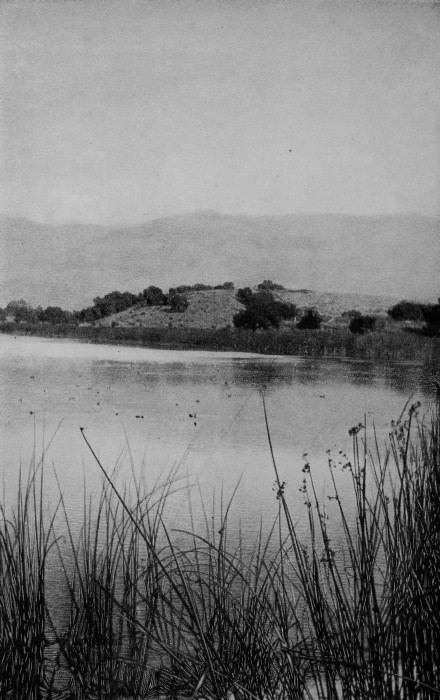 LAGUNA BLANCA, WITH WATER-FOWL I advanced
toward
it at a snail’s pace, standing still after every step (the wonderful
stranger
must not be disturbed if any possible degree of caution could prevent
it), and
presently a flock of seven — my one bird included — came swimming
shoreward
from behind a dense clump of tall tules. I took them in with all
eagerness, not
knowing how soon they might become alarmed and make off, and soon had
them in
an excellent light and at a comfortably short range. Seven wild swans!
And
close by! What a vision! If the heavens had opened, I could hardly have
been
more surprised. Then a
horseman
rode past, while I held my breath and wished him elsewhere; but instead
of
taking flight the magnificent birds simply wheeled about and swam to
the middle
of the lake, where they came to rest, and at once tucked their heads
under
their wings. I rejoiced to see them so perfectly at home. Who could
tell but
they might be proposing to pass the season with us? After
feasting my
eyes upon them sufficiently for the nonce, I proceeded with my walk,
and three
hours later, on my return, came again in sight of the lake. At that
moment the
swans were headed straight toward me with the apparent intention of
coming
ashore. Catching sight of a man, however, they wheeled about, and after
a
little hesitation made for the opposite bank. There they busied
themselves with
dressing their feathers till something startled into flight a multitude
of
ducks and coots. At this the swans lifted their heads, and after
looking
suspiciously around (such a commotion should mean something, they considered)
sailed into the middle of the lake,
reminding me by their stately movement, one behind another in a kind of
formal
order, of the day not long before when a line of sixteen white
battle-ships had
steamed into Santa Barbara channel. To my ornithological mind, in its
present
excited state, one procession seemed scarcely more impressive than the
other. The
following day
was spent among the hills behind the city, and at the height of land on
the
steep, winding trail from Mission Cañon over into San Roque Cañon I
stopped to
breathe and look about me. Laguna Blanca, far below and some miles
away, shone
as one of the fairest objects in the landscape, and it occurred to me
to level
the field-glass upon it to see whether by any possibility the swans
could be
distinguished at that distance. Sure enough, they were distinctly
visible,
grouped in the middle of the lake, which otherwise, for aught the glass
could
tell me, might have been entirely deserted, though it was certain that
hundreds
if not thousands of coots and ducks were resting upon its surface. For
showing
from afar there is no color to dispute with white. As I
neared the
lake the next morning — how could I keep away? — the swans seemed to be
absent;
but before many minutes I came upon them close inshore in a little bay,
surrounded by hundreds of ducks and coots, the coots, most loquacious
bodies,
engaged as usual in an animated conversation. I drew
nearer and
nearer, desirous of improving so favorable an opportunity to make sure
whether
the swans had a small yellowish patch in the loral region (between the
eye and
the base of the upper mandible), an inconspicuous mark, the presence or
absence
of which would determine the specific identity of the birds, whether
whistling
or trumpeter swans. Before I could satisfy myself upon this nice point,
however, the smaller birds took the alarm; and, their noisy, hurried
flight,
with so much dragging of the feet, proving too much for the swans, they
sailed
away to their one place of safety, where they immediately tucked their
heads
under their wings for a forenoon nap. Half an
hour later,
while I was spying upon a strange-looking fox sparrow scratching about
the
roots of the tules, one of the swans sent up a shout, and in another
moment a
big white bird (and big enough he looked) came slanting down from the
sky, and
splashed into the water. The one that had sounded the signal swam at
once to
meet him, and the two gesticulated in each other’s faces as if inclined
to
quarrel, I thought. Probably I misinterpreted their movements, for the
newcomer
at once joined the others; and now there were eight in the group, every
one
with his head behind his wing. If the
coots were
chatterboxes, their tongues always wagging, jabbering to themselves if
no one
else was by, the swans, I had by this time concluded, were fairly to be
called
sleepyheads. A very somnolent set they seemed to be, surely. “Now,
then,” they
were always ready to say, “as long as that inquisitive old body won’t
allow us
to feed alongshore, why not go to sleep again?” In that deep water
there was really
little else for them to do, I suppose, unless they should first acquire
the
impossible art of diving. Some time
later
they woke up, and had a fit of calling. I looked into the sky,
anticipating a
further arrival; but nothing came of it. Had the birds been deceived,
or had
the passers aloft declined the invitation? One thing
I am
bound to admit. It was proved to me more than once. For detecting the
presence
of birds of their own kind overhead they had some means, whether of
sight or
hearing, that lay quite beyond the scope of my senses. But,
indeed, I have
often remarked how surprisingly quick certain kinds of birds are to
notice what
goes on above their level. A flock of curlews, for example, feeding,
heads
down, upon the sand, will discover you instantly on the edge of a cliff
overlooking the beach, say at an elevation of fifty feet, and be off on
the
wing almost before you know it, no matter how slow and noiseless your
approach
may have been; whereas, had you been walking on the beach itself, in
full sight,
the chances are that they would have suffered you to come moderately
close upon
them without betraying any marked uneasiness. It has become a habit
with them,
apparently, to keep a sharp lookout upward, perhaps because their more
usual
enemies come from that quarter. This,
however, can
hardly be true of swans, whose principal apprehensions, I should think,
must be
of rapacious quadrupeds. As for their superior sight or hearing, there
is no
sort of bird, we may safely say, but excels us in some respect, clever
as we
think ourselves. The Powers above have not put everything of the best
into any
one basket. Every creature has its own particular endowment, and
presumably,
living for itself, regards itself as the sum and centre of all things.
Mankind,
if we may guess, holds no monopoly, even of self-conceit. On my
return at
noon, — for I commonly went two miles or so beyond the lake to the
ocean beach,
— I found the swans in a bay or cove, feeding so industriously (no sign
of
drowsiness now) that they permitted me to draw near enough to see
plainly the
small loral patch before mentioned. It was as good as a visiting-card.
Henceforth I was in possession of their full name, Olor columbianus, the whistling
swan. As they fed, holding their heads under water for a surprisingly long time, a number of ducks collected in the vicinity, diving directly beside them, almost or quite under them, in fact, as if — what I doubted not was true — the long-necked creatures were stirring up the muddy bottom with a thoroughness which the ducks found highly to their advantage. “Strange,” says the note-book, “how exceedingly small the ducks, even the canvasbacks, look. As for the ruddies and buffle-heads, they look for all the world like ducklings following their mothers about.” The swans made not the least objection to the ducks’ persistent and rather meddlesome looking activities (“Help yourselves, children, help yourselves,” they might have been saying), but now and then they indulged in what seemed like slight fallings-out among themselves. When they
had fed
thus for some time, they proceeded to bathe: after dinner the
finger-bowl. And
a lively performance it was, with a deal of noisy splashing as they
threw
themselves heavily and rather clumsily first on one side and then on
the other.
“They are bound to make a clean job of it,” writes the pencil. One of
the
adults (known for such by his clear white head) made a particularly
brave show
in drying himself, stretching up to his full height, and shaking his
wings and
tail in a most vigorous manner. “In
calling,” my
note-book records, — though I fail to remember the pertinency of the
remark in
this immediate connection, — “they hold the head straight up, and then
at the
moment of utterance raise it a little higher still with a sudden jerk.
Their loud calls sound
human.” I spent
the better
part of an hour watching their various activities. Then, as I passed a
trifle
too near, they swam out into the lake, from the middle of which three
of them
suddenly took wing, for no apparent reason, rising to a considerable
height and
flying off toward the golf-grounds, as if they were bound away for
good. The
others declined to follow their lead, however, and after a bit the
seceders
returned, flew across the sky directly before me, their necks stretched
out to
the full (looking almost ridiculously slender), and dropped again into
the
lake. Here was
the very
thing I had been wishing to see — swans in flight. And I had seen it to
capital
advantage, and still had the birds with me. A lucky fellow, I called
myself. This was
on the
24th of December. Three days later I was fated to witness a far more
spectacular display of flight with no such happy termination. But
meantime, on
Christmas morning, it pleased me to hear a friend remark, quite
independently
of any suggestion of mine, how wonderfully like a fleet of war-vessels
the
swans looked as they sailed slowly away from us in a majestic,
well-spaced
line. The comparison, I saw, had not been due to my overheated
imagination.
And, while we were admiring their stately manoeuvres, one of them
suddenly
lifted up his voice, and in response to the call two birds dropped out
of the
sky, a sight to stir the blood of a man who was beholding wild swans
for the
first time in his life. Well, two
days
afterward, as I just now began to say, I was at the lakeside again, and
was
disappointed to find the flock reduced by more than half — four birds
instead
of ten. But I need not have fretted, for this was to be by much my most
interesting day. Within half an hour, one thing after another having
detained
me, I heard a volley of loud trumpetings over head, quickly answered
from
below; and looking up I beheld a wonderful, never-to-be-forgotten
sight, a
flock of snow-white swans (twenty-four in number, as the count showed)
already
scaling downward, headed for the lake. Down they came, little by
little, wings
sharply set, necks curved upward and backward, by way of slackening the
descent, as I judged, and the big black feet sprawling out in front,
ready for
the water. Four of the birds took it at once, but the rest acted as if
they
would go farther. Then the eight swimmers set up an appealing chorus:
“Come in!
O come in!” whereupon the twenty turned, and in half a minute or less
the
twenty-eight birds were all in the water in a close bunch. For a
little while
there was a great commotion (“a great hullabaloo” the notebook has it,
a pencil
being always under less restraint in its use of the vernacular than a
pen quite
ventures to be), but in a few minutes everything was quiet again, and
every
bird’s head hidden under its wing. Half an hour later three others were
toled
down into the sleeping circle. “ O rest ye,
brother mariners; we will not wander more.” And now we had
thirty-one! It was
fortune to turn a man’s head; but, as it seemed, it was too good to
last. Within ten
minutes
two men, who had secured a license to fish in the lake, pushed out a
boat; and
instantly the air swarmed with ducks, a thousand or two, and in another
moment
the swans gave cry, and soon every bird of them was on the wing. Would they
turn and
light again? No, this time they were thoroughly frightened; and in a
long line,
not in Indian file, as they commonly moved when swimming, but side by
side,
they rose over the low, rounded, grassy hill opposite me (a sight
surpassing
all imagination, the sun shining full on all those snow-white wings),
and in a
few seconds were out of sight. The lake, which had been covered with
birds a
minute or two before, was now, except for a few hundred coots, all but
deserted.
Needless
to say
what my feelings were toward those miserable fishermen, who trolled
heedlessly
along the shore, and to my heartfelt delight caught nothing. The one
pleasant
feature of the case was that the superintendent of the ranch shared my
sentiments to the full, and declared that no more fishing-permits
should be
granted to anybody as long as the bird season lasted. Indeed, the swans
had
been one of the chief attractions of the place, the more so as no one
could
remember having seen them there before. How
general the
interest in the matter had become was to be shown me amusingly two days
afterward. I had gone home dejected, and yet elated. I had witnessed a
far more
beautiful flight of birds than I had ever dreamed of (a flight of
angels could
hardly have surpassed it in my imagination), but now all was over. So I
thought. But two mornings later, as I was trudging out to the ranch
over a
muddy road, a man whom I did not recognize leaned out of his buggy as
we met,
and shouted after me, “The swans have come back.” And so they had, but
five
instead of thirty-one. “I am
hanging
about,” I wrote in my notebook an hour afterward, “to see if more will
be
called down. The swans are growing tame. They no longer retreat to the
middle
of the lake every time the ducks raise an alarm. Two are now in their
usual
cove fast asleep on one leg in a few inches of water, while the others
are
exploring the shore in front of the engine-house. A casual passer-by
would take
them for domesticated birds without a second look.” Not to
prolong the
story, be it said that the swans remained in varying numbers (from two
to
twelve being always present) until January 29. Their stay had covered
almost
five weeks. Then the last of them started, we may suppose, on their
long
journey towards those far-away northern regions to which so large a
proportion
of our water-birds betake themselves as spring returns. There, for
aught I
know, our sleepyheads may have contracted their habit of midday
somnolence; for
so long as they are there, I suppose, the sun never once goes down. The next
season a
single swan made its appearance at the lake on December 4, and remained
all by
himself in perfect contentment, as far as any of us could judge, till
January
4. In that time he had seemed to become almost a part of the place, and
the men
in charge, who fed him from the first, began to look upon him as
settled with
them for life. But either he fell a victim to some fox or coyote, a not
unlikely fate, or he heard a call, inward or outward, which he could
not
resist, and we saw him no more. Since then, to the best of my
knowledge, no
swan has been seen in Laguna Blanca. |
 Click the book image to turn
to the next Chapter.
Click the book image to turn
to the next Chapter.