
Web
and Book design,
Copyright, Kellscraft Studio 1999-2007 (Return to Web Text-ures) |
 (HOME)
|
|
Chapter 9.
OBSERVATIONS OF THE CARP, WITH DIRECTIONS HOW TO FISH FOR HIM
PISCATOR.
The Carp
is the Queen of Rivers: a stately, a good, and a very subtle fish, that
was not
at first bred, nor hath been long, in England, but is now naturalized.
It is
said, they were brought hither by one Mr. Mascal, a gentleman that then
lived
at Plumsted in Sussex, a county that abounds more with this fish than
any in
this nation. You may
remember
that I told you, Gesner says there are no Pikes in Spain; and,
doubtless, there
was a time, about a hundred or a few more years ago, when there were no
Carps in
England, as may seem to be affirmed by Sir Richard Baker, in whose
Chronicle
you may find these verses: — Came into England all in a year. And doubtless, as of sea-fish the Herring dies soonest out of the water, and of fresh-water fish the Trout, so, except the Eel, the Carp endures most hardness, and lives longest out of his own proper element: and therefore the report of the Carp's being brought out of a foreign country into this nation is the more probable. Carps and Loaches are observed to breed several months in one year, which Pikes and most other fish do not. And this is partly proved by tame and wild rabbits, as also by some ducks, which will lay eggs nine of the twelve months; and yet there be other ducks that lay not longer than about one month. And it is the rather to be believed, because you shall scarce or never take a male Carp without a melt, or a female without a roe or spawn, and for the most part very much; and especially all the summer season: and it is observed, that they breed more naturally in ponds than in running waters, if they breed there at all; and that those that live in rivers are taken by men of the best palates to be much the better meat. 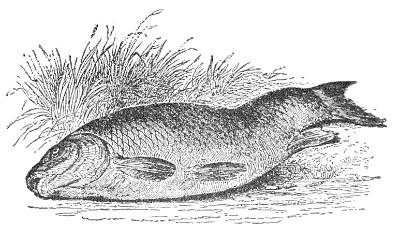 And it is
observed,
that in some ponds Carps will not breed, especially in cold ponds; but
where
they will breed, they breed innumerably: Aristotle and Pliny say, six
times in
a year, if there be no Pikes nor Perch to devour their spawn when it is
cast
upon grass, or flags, or weeds, where it lies ten or twelve days before
it be
enlivened. The Carp,
if he
have water-room and good feed, will grow to a very great bigness and
length; I
have heard, to be much above a yard long. 'Tis said by Jovius, who hath
writ of
fishes, that in the Lake Lurian, in Italy, Carps have thriven to be
more than
fifty pounds' weight; which is the more probable, for as the bear is
conceived
and born suddenly, and being born is but short lived, so, on the
contrary, the
elephant is said to be two years in his dam s belly, some think he is
ten years
in it, and being born grows in bigness twenty years; and 'tis observed
too that
he lives to the age of a hundred years. And 'tis also observed, that
the
crocodile very long-lived, and more than that, that all that long life
he
thrives in bigness: and so I think some Carps do, especially in some
places;
though I never saw one above twenty-three inches, which was a great and
goodly
fish; but have been assured there are of a far greater size, and in
England
too. Now, as
the
increase of Carps is wonderful for their number, so there is not a
reason found
out, I think, by any, why they should breed in some ponds and not in
others of
the same nature for soil and all other circumstances. And as their
breeding, so
are their decays also very mysterious: I have both read it, and been
told by a
gentleman of tried honesty, that he has known sixty or more large Carps
put
into several ponds near to a house, where by reason of the stakes in
the ponds,
and the owner's constant being near to them, it was impossible they
should be
stolen away from him: and that when he has, after three or four years,
emptied
the pond, and expected an increase from them by breeding young ones, —
for that
they might do so, he had, as the rule is, put in three melters for one
spawner,
— he has, I say, after three or four years, found neither a young nor
old Carp
remaining. And the like I have known of one that has almost watched the
pond,
and at a like distance of time, at the fishing of a pond, found of
seventy or
eighty large Carps not above five or six: and that he had forborne
longer to
fish the said pond, but that he saw, in a hot day in sum mer, a large
Carp
swim near the top of the water with a frog upon his head; and that he
upon that
occasion caused his pond to be let dry: and I say, of seventy or eighty
Carps,
only found five or six in the said pond, and those very sick and lean,
and with
every one a frog sticking so fast on the head of the said Carp, that
the frog
would not be got off without extreme force or killing. And the
gentleman that
did affirm this to me told me he saw it; and did declare his belief to
be, and
I also believe the same, that he thought the other Carps that were so
strangely
lost were so killed by frogs, and then devoured. And a
person of
honor now living in Worcestershire assured me he had seen a necklace or
collar
of tadpoles hang like a chain or necklace of beads about a Pike's neck,
and to
kill him; whether it were for meat or malice must be to me a question. But I am
fallen
into this discourse by accident; of which I might say more, but it has
proved
longer than I intended, and possibly may not to you be considerable: I
shall
therefore give you three or four more short observations of the Carp,
and then
fall upon some directions how you shall fish for him. The age of
Carps is
by Sir Francis Bacon, in his "History of Life and Death," observed to
be but ten years, yet others think they live longer. Gesner says, a
Carp has
been known to live in the Palatinate above a hundred years: but most
conclude,
that, contrary to the Pike or Luce, all Carps are the better for age
and
bigness. The tongues of Carps are noted to be choice and costly meat,
especially to them that buy them: but Gesner says, Carps have no tongue
like
other fish, but a piece of flesh-like fish in their mouth like to a
tongue, and
should be called a palate: but it is certain it is choicely good, and
that the
Carp is to be reckoned amongst those leather-mouthed fish which I told
you have
their teeth in their throat; and for that reason he is very seldom lost
by
breaking his hold, if your hook be once stuck into his chaps. I told you
that Sir
Francis Bacon thinks that the Carp lives but ten years; but Janus
Dubravius has
writ a book "Of Fish and Fish-Ponds," in which he says that Carps begin
to spawn at the age of three years, and continue to do so till thirty:
he says
also, that in the time of their breeding, which is in summer, when the
sun hath
warmed both the earth and water, and so apted them also for
generation, that
then three or four male Carps will follow a female; and that then, she
putting
on a seeming coyness, they force her through weeds and flags, where she
lets
fall her eggs or spawn, which sticks fast to the weeds, and then they
let fall
their melt upon it, and so it becomes in a short time to be a living
fish: and,
as I told you, it is thought the Carp does this several months in the
year; and
most believe that most fish breed after this manner, ex cept the Eel.
And it
has been observed, that when the spawner has weakened herself by doing
that
natural office, that two or three melters have helped her from off the
weeds by
bearing her up on both sides, and guarding her into the deep. And you
may note,
that, though this may seem a curiosity not worth observing, yet others
have
judged it worth their time and costs to make glass hives, and order
them in
such a manner as to see how bees have bred and made their honeycombs,
and how
they have obeyed their king and governed their commonwealth. But it is
thought
that all Carps are not bred by generation, but that some breed other
ways, as
some Pikes do. The
physicians make
the galls and stones in the heads of Cam to be very medicinable. But
'tis not
to be doubted but that in Italy they make great profit of the spawn of
Carps,
by selling it to the Jews, who make it into red caviare, the Jews not
being by
their law admitted to eat of caviare made of the Sturgeon, that being a
fish
that wants scales, and, as may appear in Levit. xi. 10, by them reputed
to be
unclean. Much more
might be
said out of him, and out of Aristotle, which Dubravius often quotes in
his
Discourse of Fishes; but it might rather perplex than satisfy you; and
therefore I shall rather choose to direct you how to catch, than spend
more
time in dis coursing either of the nature or the breeding of this
Carp, or of
any more circumstances concerning him: but yet I shall remember you of
what I
told you before, that he is a very subtle fish, and hard to be caught. And my
first
direction is, that, if you will fish for a Carp, you must put on a very
large
measure of patience; especially to fish for a River-Carp: I have known
a very
good fisher angle diligently four or six hours in a day, for three or
four days
together, for a River-Carp, and not have a bite. And you are to note
that, in
some ponds, it is as hard to catch a carp as in a river; that is to
say, where
they have store of feed, and the water is of a clayish color: but you
are to
remember, that I have told you there is no rule without an exception;
and
therefore, being possessed with that hope and patience, which I wish to
all
fishers, especially to the Carp-Angler, I shall tell you with what bait
to fish
for him. But first you are to know, that it must be either early or
late; and
let me tell you, that in hot weather, for he will seldom bite in cold,
you
cannot be too early or too late at it. And some have been so curious as
to say,
the 10th of April is a fatal day for Carps. The Carp
bites
either at worms or at paste; and of worms I think the bluish marsh or
meadow
worm is best; but possibly another worm, not too big, may do as well,
and so
may a green gentle: and as for pastes, there are almost as many sorts
as there
are medicines for the toothache; but doubtless sweet pastes are best; I
mean
pastes made with honey or with sugar: which, that you may the better
beguile
this crafty fish, should be thrown into the pond or place in which you
fish for
him some hours, or longer, before you undertake your trial of skill
with the
angle-rod: and, doubtless, if it be thrown into the water a day or two
before,
at several times and in small pellets, you are the likelier when you
fish for
the Carp to obtain your desired sport. Or in a large pond, to draw them
to any
certain place, that they may the better and with more hope be fished
for, you
are to throw into it, in some certain place, either grains, or blood
mixed with
cow-dung or with bran; or any garbage, as chicken's guts, or the like;
and
then some of your small sweet pellets with which you purpose to angle:
and
these small pellets being a few of them also thrown in as you are
angling, will
be the better. And your
paste must
be thus made: take the flesh of a rabbit or cat cut small, and
bean-flour; and
if that may not be easily got, get other flour, and then mix these
together, and
put to them either sugar, or honey, which I think better; and then beat
these
together in a mortar, or sometimes work them in your hands, your hands
being
very clean; and then make it into a ball, or two, or three, as you like
best
for your use; but you must work or pound it so long in the mortar, as
to make
it so tough as to hang upon your hook without washing from it, yet not
too
hard: or that you may the better keep it on your hook, you may knead
with your
paste a little, and not much, white or yellowish wool. And if you
would
have this paste keep all the year for any other fish, then mix with it
virgin-wax and clarified honey, and work them together with your hands
before
the fire; then make these into balls, and they will keep all the year. And if you
fish for
a Carp with gentles, then put upon your hook a small piece of scarlet
about
this bigness q, it being soaked in,
or anointed
with oil of peter, called by some oil of the rock: and if your gentles
be put,
two or three days before, into a box or horn anointed with honey, and
so put
upon your hook as to preserve them to be living, you are as like to
kill this
crafty fish this way as any other: but still as you are fishing, chew a
little
white or brown bread in your mouth, and cast it into the pond about the
place
where your float swims. Other baits there be; but these, with
diligence and
patient watchfulness, will do it better than any that I have ever
practised or
heard of: and yet I shall tell you, that the crumbs of white bread and
honey
made into a paste is a good bait for a Carp; and you know it is more
easily
made. And having said thus much of the Carp, my next discourse shall be
of the
Bream, which shall not prove so tedious: and therefore I desire the
continuance
of your attention. But first
I will
tell you how to make this Carp, that is so curious to be caught, so
curious a
dish of meat, as shall make him worth all your labor and patience; and
though
it is not without some trouble and charges, yet it will recompense
both. Take a
Carp, alive
if possible, scour him, and rub him clean with water and salt, but
scale him
not: then open him, and put him with his blood and his liver, which you
must
save when you open him, into a small pot or kettle; then take
sweet-marjoram,
thyme, and parsley, of each half a handful; a sprig of rosemary, and
another of
savory; bind them into two or three small bundles, and put them to your
Carp,
with four or five whole onions, twenty pickled oysters, and three
anchovies.
Then pour upon your Carp as much claret-wine as will only cover him;
and season
your claret well with salt, cloves, and mace, and the rinds of oranges
and
lemons. That done, cover your pot and set it on a quick fire, till it
be
sufficiently boiled: then take out the Carp, and lay it with the broth
into the
dish, and pour upon it a quarter of a pound of the best fresh butter,
melted
and beaten with half a dozen spoonfuls of the broth, the yolks of two
or three
eggs, and some of the herbs shred: garnish your dish with lemons, and
so serve
it up, and much good to you! [DR. T.] |
 Click the book image to turn
to the next Chapter.
Click the book image to turn
to the next Chapter.