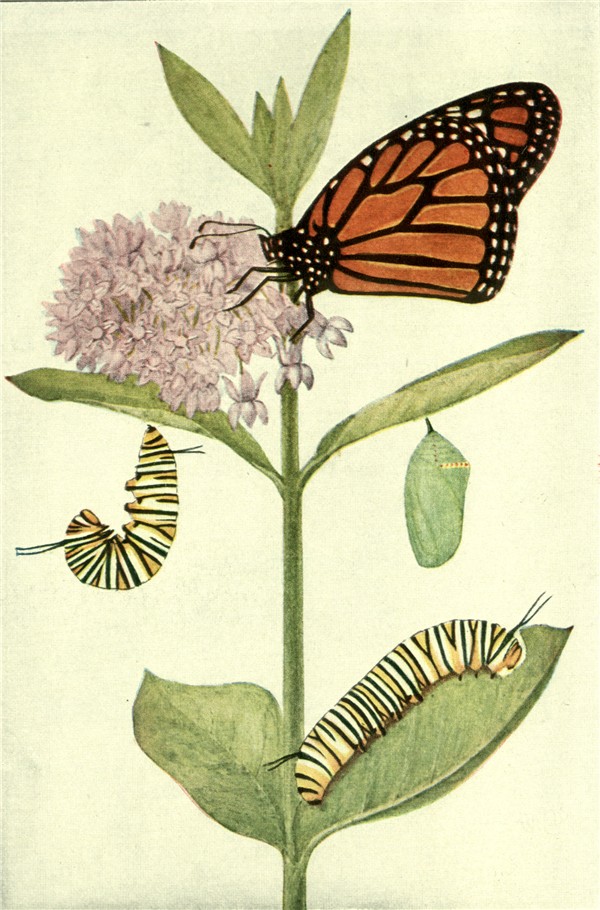
 copyright, copyright, Kellscraft Studio, 1999 (Return to Web Text-ures) |
Click Here to return to Butterflies Content Page Click Here to return to the previous section |
 (HOME) |
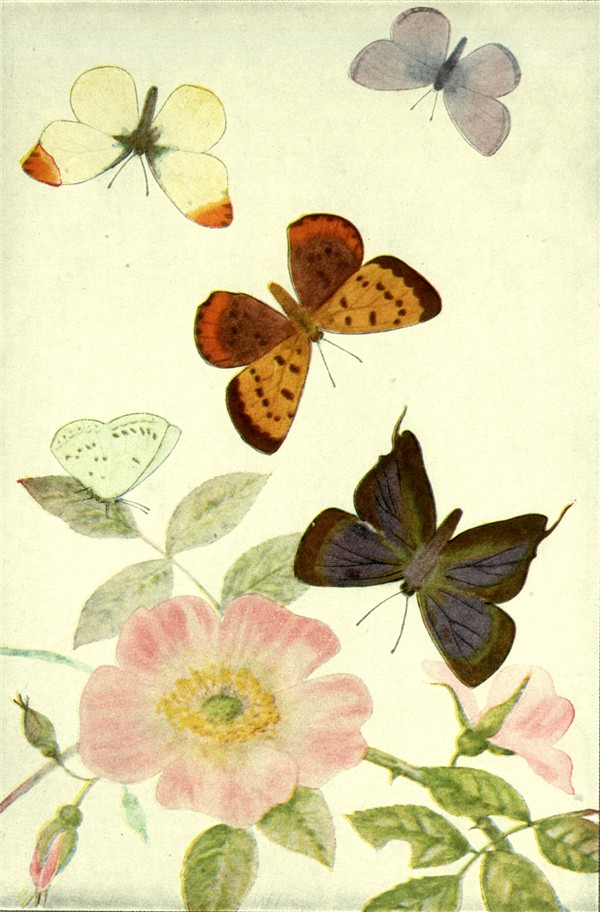
| copyright, Kellscraft Studio, 1999 (Return to Web Text-ures) |
Click Here to return to Butterflies Content Page Click Here to return to the previous section |
(HOME) |
|
PART II
THE TRUE BUTTERFLIES SUPERFAMILY Papilionoidea
The great suborder of butterflies is commonly separated into two principal groups called superfamilies. One of these includes all of the higher butterflies and is named Papilionoidea. The other includes the lower Skipper butterflies and is named the Hesperioidea. The former are characterized by small bodies and relatively large wings, straight clubbed antennae, and the fact that the caterpillars do not make cocoons when preparing for the chrysalis state. The most authoritative classifications of butterfly families are based upon the peculiarities of wing venation and are admirably discussed in such books as Holland's "Butterfly Book" and Comstock's "How to Know the Butterflies." Without attempting to go into the technical details of structure it will suffice here to give the list of families which compose the superfamily Papilionoidea: The
Parnassians. Parnassiidae.
The Swallowtails. Papilionidae. The Whites, Orange-tips, and Yellows. Pieridae. The Nymphs. Nymphalidae. The Satyrs or Meadow-browns. Agapetidae. The Heliconians. Heliconidae. The Milkweed Butterflies. Lymnadidae. The Long-beaks. Libytheidae. The Metal-marks. Riodinidae. The Gossamer-wings. Lycaenidae. It must not be thought that such a list necessarily indicates the degrees of development of the respective families, for this is not true. It is simply a linear arrangement adopted for convenience by leading authorities, notably Dr. Harrison G. Dyar in his standard "Catalog of American Lepidoptera." THE PARNASSIAN
BUTTERFLIES
FAMILY Parnassiidae
It is perhaps a bit unfortunate that the group of butterflies, which is commonly chosen to head the list of families, is one that is rarely seen by most collectors. The Parnassians are butterflies of the far north or of high elevations in the mountains. The four species credited to North America have been collected in Alaska and the higher elevations of the Rocky Mountains, so there is very little probability of any of them being found in the Eastern states. While, structurally, these butterflies have a close affinity with the Swallowtails, one would never suspect it from their general appearance. Their bodies are large and all of the wings well rounded, so that there is more of the suggestion of a large moth than of the Swallowtail. The coloring is also more moth-like than with most butterflies, the wings being very light colored and nearly transparent, with markings of gray and brown, arranged in dots and splashes. All our species belong to the genus Parnassius. The caterpillars show their affinity with those of the Swallowtails by having the curious scent organs or osmateria just back of the head. They feed upon such alpine plants as stonecrop and saxifrage and are well adapted by their structure and habits to the bleak surroundings of the mountain tops. As a typical example of the environment in which these butterflies live, we may take the alpine valleys of such mountain regions as Pike's Peak. Prof. M. J. Elrod has described a visit where, at an altitude of 11,500 feet in the month of August, Parnassius smintheus was flying by thousands, and the earlier stages were so abundant that a water ditch had the surface covered as far as one could see with the dead or dying caterpillars. In such situations, where ice forms at night, and snow frequently falls by day, these butterflies develop apparently in greater numbers than almost any of our other species are known to do in warmer regions. THE SWALLOWTAILS
FAMILY Papilionidae
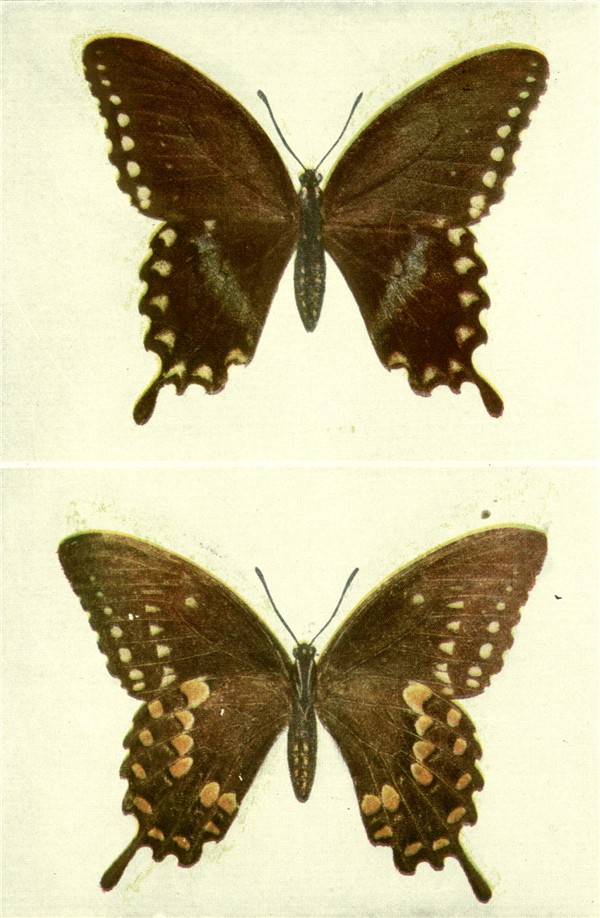
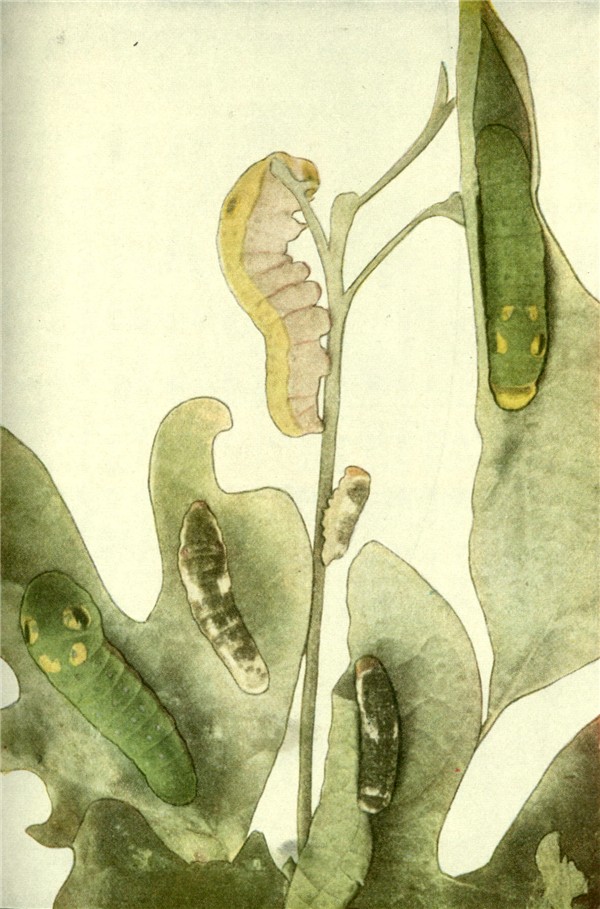
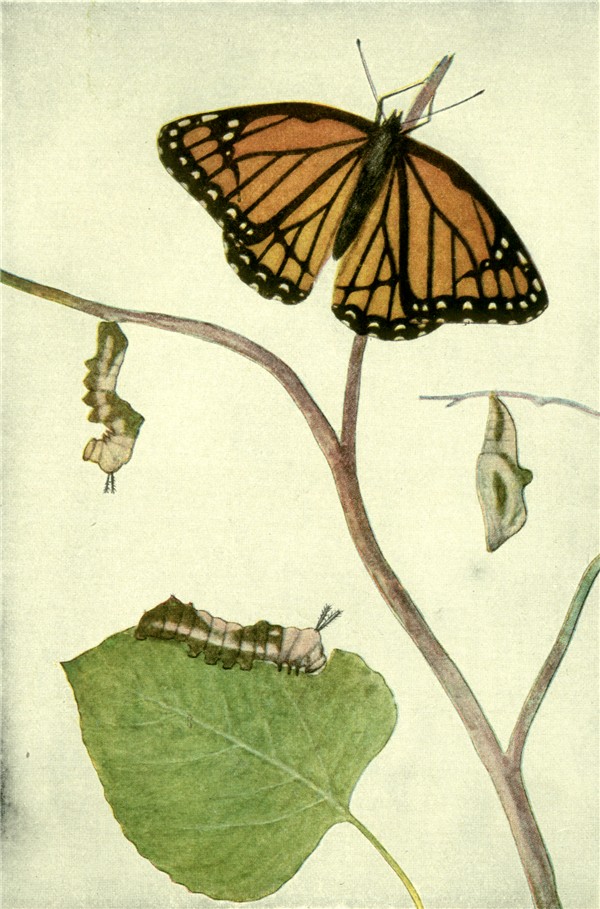
This is probably the most distinctive family of all our familiar butterflies. Its members are characterized by being on the whole the largest butterflies in our region and by having the hind wings prolonged into curious tail-like projections, suggestive of those of a swallow. In general, the basal color of the wings is blackish though this is commonly marked in various striking ways with yellow, green, or blue, while the margins of the wings are commonly adorned with red or orange spots. These butterflies are also characterized by certain peculiarities in the branching of the wing veins which will be found pictured in more technical works. The caterpillars of these butterflies have the characteristic form pictured on the plate of the Swallowtails opposite page 80. When full grown they are large, fairly smooth-bodied worms, showing at most on the surface sparse fine hairs or fleshy threadlike projections. Their most characteristic feature is found in the scent organs called osmateria situated in the back just behind the head. These are thrust out, generally, when the caterpillar is disturbed and appear as orange Y- or V-shaped organs from which an offensive odor is commonly given off. They are supposed to serve the purpose of preventing injury by enemies, possibly birds, monkeys, and other vertebrates. Structurally, they are like long tubular pockets that can be turned inside out. When the pocket is in place it is getting a pocketful of odors. When it is inverted it lets these odors free. On this account Professor Comstock has aptly called these caterpillars "the polecats of the insect world." When ready to pupate, these Papilio caterpillars spin a web of silk upon some more or less flattened surface and a. loop of silk near by. They entangle their hind legs in the former and keep their heads through the latter so the loop supports the body a little behind the head. Then they change to chrysalids which are held in place by these sets of silken threads. The chrysalids are rather large and angular and generally take on colors approximating their surroundings. They vary so much in different species that one familiar with them can recognize the chrysalis and know the kind of butterfly it will produce. The Black Swallowtail
Papilio polyxenes
While the Black Swallowtail is not so large as some other members of the group, it is probably the best known to rarest people. It is found throughout many months of the year in practically all parts of North America south of Canada, and has the habit of flying freely about fields and gardens in search of flowers from which to suck its nectar food, and of plants on which to deposit its eggs. The female butterflies have a remarkable ability in selecting only members of the great family Umbelliferae for this purpose. In consequence the caterpillars are generally to be found feeding upon carrots, parsnips, parsley, and various wild species belonging to this order. (See plates.) The eggs of the Black Swallowtail are laid one in a place upon the leaves of the food plant. Each egg is a small, yellowish, smooth, and ovoid object. It may often be found by watching the butterflies as they fly low in search of umbelliferous plants, and seeing one stop for a minute or so while she lays the egg. About ten days after the egg is laid it hatches into a small black caterpillar marked in a characteristic fashion with a blotch of white in the middle of the body which is suggestive of a saddle. The caterpillar immediately begins to feed upon the green substance of the leaf, continuing thus about a week before the first moult. At this time it does not change much in appearance, still being a spiny creature blackish in color and marked by the curious white saddle. A little later it moults again, retaining its original coloring. At each moult, of course, it gets larger and feeds mole freely upon the celery or other plant on which it may happen to be. When the caterpillar becomes about half grown it takes on a very different appearance from that of its early life. The skin is smooth rather than spiny, and the general colors are green, black, and yellow. The ground color of the skin is green, which is marked with black cross-bands along the middle of each body ring. On these bands there are many large dots of orange yellow, the whole coloring giving the insect a very striking appearance, especially when it is placed by itself against a plain background. When they finally become full grown in this larva state, these caterpillars are almost two inches long. The larvae of the Black Swallowtail have certain characteristics in which they differ from many other caterpillars. After each moult they do not devour their cast skins, which happens in the case of many of their relatives. When feeding, as well as when resting, they remain exposed upon the leaf and seem never to attempt to conceal themselves, as is the habit with a large proportion of caterpillars. It is probable that this instinct for remaining exposed to view bears some relation to the curious means of protection possessed by this as well as other Swallowtail caterpillars. When disturbed one of these larvae will push out from just back of the head the strange-looking, orange-yellow Y-shaped organ which gives off a very disagreeable odor. These osmateria organs are generally believed to be defensive against the attack of birds and various other enemies, although they seem not to be effective against insect parasites. The full-grown caterpillars are likely to leave their food plants when ready to change to the chrysalis state. They wander in various directions until suitable shelter is found. A piece of board, a fence post, or possibly the bark of a tree will answer for this purpose. Here the caterpillar spins a mat of silk in which to entangle its hind legs and a short distance away near the front end of the body it spins a loop of silk attaching the ends to the support. These serve to hold the chrysalis in place during this helpless period. After the loop is made the caterpillar keeps its head through it so that the loop holds the insect in position a short distance back of the head. It is now ready to moult its last caterpillar skin and become a chrysalis. One who has watched hundreds of these caterpillars go through this change, Miss Mary C. Dickerson, describes the process in these words: "In this final moult the chrysalis has to work very hard. The bulk of the body is again slipped forward in the loosened caterpillar skin, so that this becomes tensely stretched over the anterior end, and very much wrinkled at the posterior end. The skin splits back of the head and is forced back by its own taut condition and by the efforts of the chrysalis, until only the extreme posterior end of the chrysalis is within it. Then the chrysalis withdraws this posterior end with its ninny very tiny hooks, from the skin on the dorsal side, and, reaching around, securely fastens the hooks into the button of silk. Then the old skin is removed both from its fastening to the chrysalis and from its attachment in the button of silk." A short time after the caterpillar's skin has thus been cast off the chrysalis takes on a brownish color which as is so often the case is likely to vary somewhat according to the tint of the surrounding surfaces. This is doubtless a protective device and helps the insect to escape attack by birds during the long period of exposure. For this butterfly passes through the winter only in the chrysalis condition, and the larva which went into the chrysalis in September does not come out as a butterfly until the following May or June. There are, however, two broods of the butterflies in the North and at least three in the South. As the adults live for about two months and there is considerable variation in the periods of their development it happens that one can find these Black Swallowtail butterflies upon the wing almost any time in warm weather. either North or South. The Giant Swallowtail
Papilio thoas
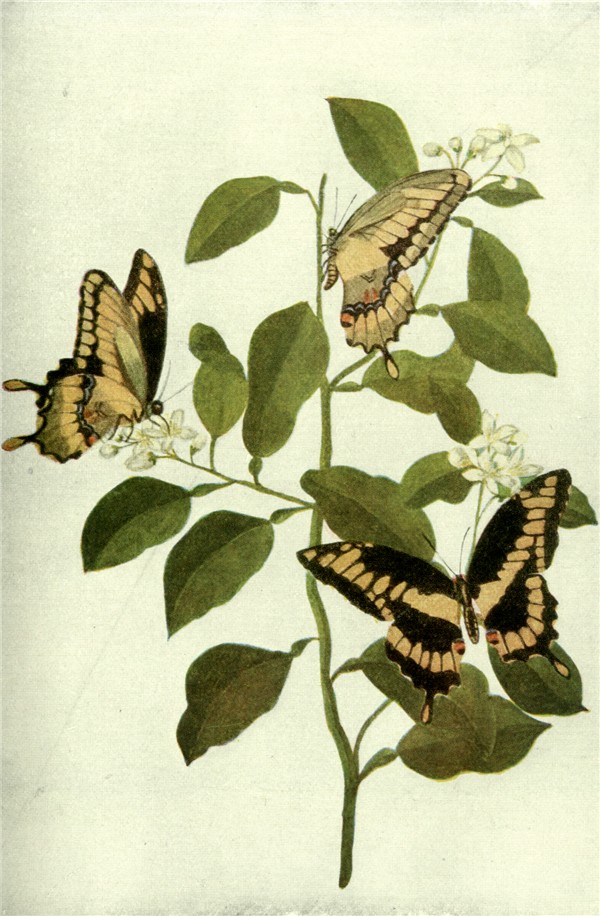
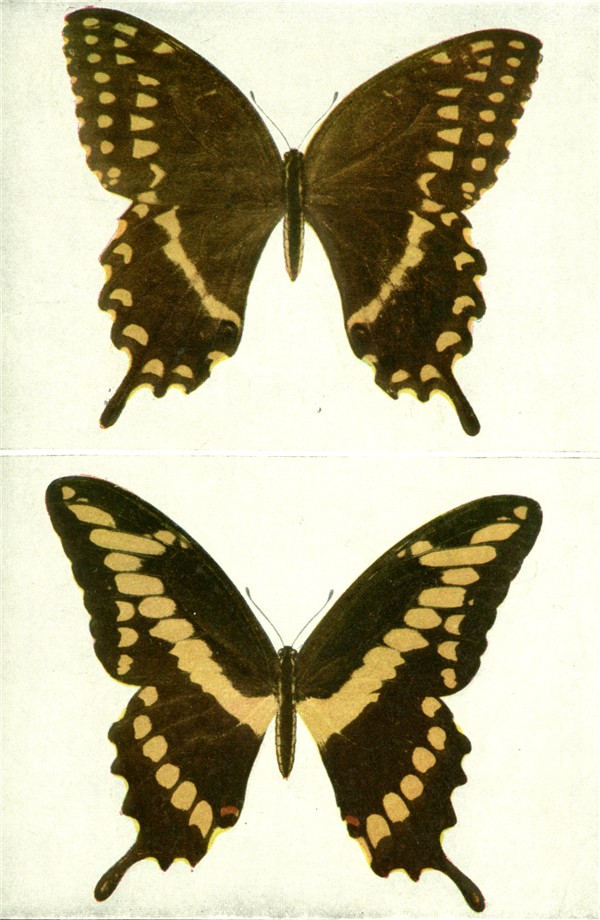
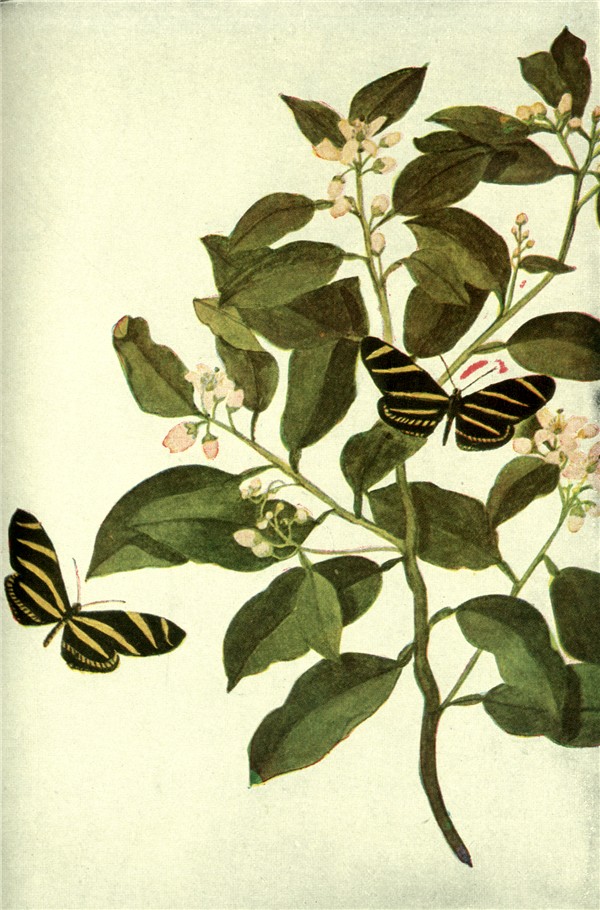
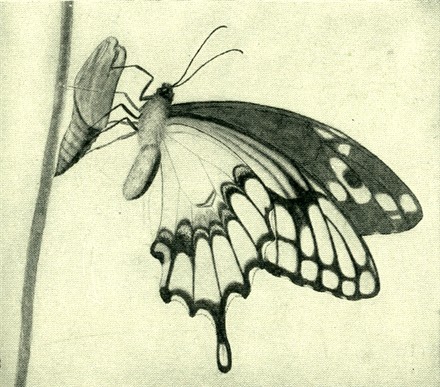
The largest of our North American butterflies is a magnificent insect with a wing expanse of some four inches and with a rich coloring of black and yellow more or less suffused with greenish or bluish iridescence that gives it a striking beauty as it flies leisurely about from flower to flower or stops to lay an egg upon some bush or tree. The tails are long and expanded toward the tip, their prevailing color being black with a broad splash of yellow near the end. In a general way we may say that the upper wing surface is black marked with two bands of orange-yellow, while the under surface is yellow marked with two bands of black. (See plate) The Giant Swallowtail is a tropical species which is abundant throughout the Southern states and during recent years seems to have been gradually extending its northern range. It is now commonly found as far north as forty-two degrees latitude, from Nebraska eastward. In New England it is occasionally taken in Connecticut, Massachusetts, and even in Maine, but its appearance in this region is exceptional. In the orange-growing regions of the Southern states the caterpillars of this butterfly feed freely upon the leaves of citrus fruits and they are often called "orange puppies" or "orange dogs." Probably their curious appearance and their habit of resting for long periods upon leaf or twig gave rise to this name. In the region indicated the life-history of the insect may be summarized thus: The mother butterfly deposits the eggs singly upon the young growth of orange or other citrus fruit trees, generally near the tips of leaves or branches. About a week later each egg hatches into a caterpillar that feeds upon the young leaves, resting upon the lower surface when not eating. After a few days of this feeding the caterpillar becomes too large for the skin with which it was born and it moults, coming forth with a new skin which soon hardens so that it can begin feeding again. A week or so later it moults for the second time, and continues these processes of feeding and moulting until full grown, which is perhaps a month from the time of hatching from the egg. At first the caterpillars eat only the succulent young leaves and branches, but as they grow larger they feed more freely upon the older foliage. They are very voracious and when abundant may often do much damage especially to young trees. When ready to change to the chrysalis each caterpillar attaches itself by silken threads to the bark of the trunk or branch of the tree. Here it changes to a chrysalis which takes on a color so similar to that of the bark that the insect is surprisingly difficult to discover. A fortnight or so later it changes again into a fully developed butterfly that sallies forth in search of the nectar of flowers. (See plate, page 240.) These "orange dogs," like the caterpillars of other Swallowtail butterflies, have curious yellow scent organs which, when the caterpillar is disturbed, protrude from the upper surface just behind the head. These give forth a very disagreeable odor which is believed to serve the purpose of repelling birds and possibly other enemies. It has been noticed that these caterpillars are not molested by birds although they are attacked by various insect enemies. Each mother butterfly is known to be able to deposit four or five hundred eggs and it has been suggested that the injuries of the caterpillars may be checked by shooting the butterfly upon the wing with cartridges loaded with small bird shot. In the South there are several broods in a season. The life-history of this species in more northern regions differs in the choice of the food plant and the number of broods. It feeds upon various members of the rue family, including common rue and prickly ash, as well as upon certain poplars and probably other trees. It is two brooded and apparently winters as a chrysalis. The butterflies of the first brood come from the chrysalis about the last of May and are found on the wing during June. Those of the second brood come from the chrysalis about the last of July and are found on the wing during August and September. The length of time required from the laying of the egg to the emergence of the butterfly varies greatly with the locality and the temperature. Ix commonly extends over a period of four or five weeks.
The Blue Swallowtail
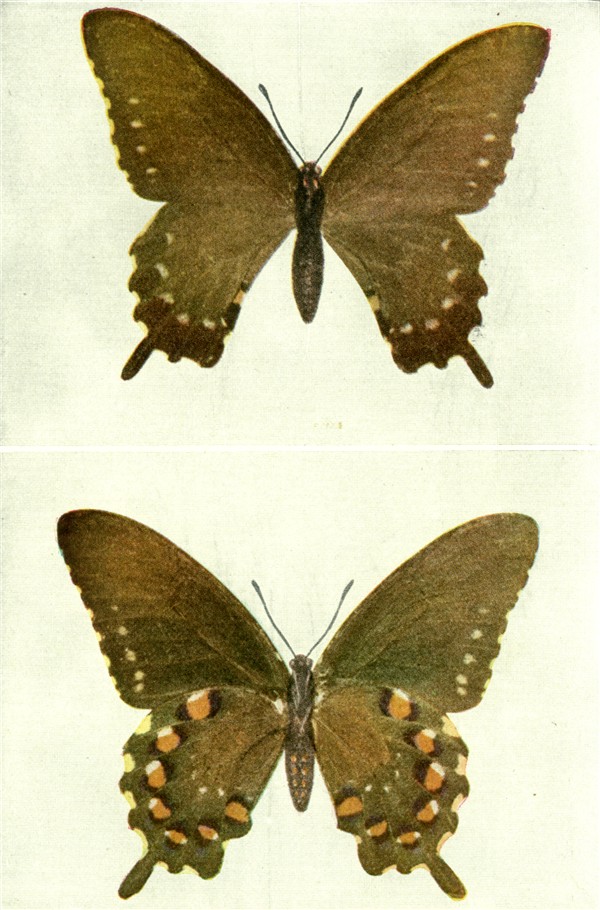
Laertias philenor The Blue Swallowtail is said to have closer affinity with the splendid butterflies of the tropics than most of our other Papilios. The sheen of metallic color upon its wings is certainly suggestive of the broad expanse of similar colorings in the gorgeous butterflies from South America. This species is easily recognized by the general blackness of the front wings and the basal parts of the hind ones as seen from above, about two thirds of the area of the latter being overlaid with blue-green scales that give the metallic lustre characteristic of the species. Near the outer border of the basal half of the front wings there is a row of about five rather indistinct whitish spots, this row being continued more distinctly on the hind wings. On the under surface the white spots of the front wings are more pronounced than on the upper, while each hind wing is brilliantly marked with about seven large orange spots, part of them fringed on one or both sides with a distinct margin of white. The extreme side borders of all four wings are distinctly marked with white crescents and the fringes on the tails as well as more or less of the darker fringes of the hind wings are of a beautiful purple color. In the males each hind wing has along the inner border a slender, pocket-like depression which is said to be the seat of the scent organs. (See plate.) This splendid butterfly is a southern species. It is found from the Carolinas to California, being at times extremely abundant in certain localities over this great region. It seldom occurs as far north as New England and in a general way east of the Rocky Mountains its northern limit approximates that of forty-three degrees of latitude. It varies considerably in size and differs greatly in abundance in different localities and different seasons. 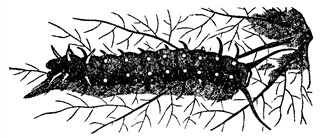 Caterpillar of the Blue Swallowtail (After Riley) Probably the commonest food plant of the caterpillars is the Dutchman's Pipe or Aristolochia, which is frequently planted as an ornamental vine for porch adornment. It also feeds upon wild ginger or Asarum and probably upon other plants. A dozen or more eggs are laid upon a leaf by the mother butterfly, usually in a cluster or grouped near together. They hatch a week or so later into small brownish caterpillars which remain together for awhile in little groups that feed side by side upon the leaf, beginning at the margin and working toward the centre. As they become larger they feed more freely and gradually disperse so that each forages for himself. As they approach maturity their appetites become voracious and their presence is often shown by the defoliated condition of the branches. They have back of the head the osmateria or scent organs which are commonly found in the other caterpillars of this genus, but the odor emitted by them is likely to be less pronounced than usual. When full grown the caterpillars find such shelter as they may and each spins a bit of silken web and a silken loop which hold it while it changes to the chrysalis. This chrysalis is very likely to take on the colors of the immediate surroundings and thus be rather difficult to see. If the egg was laid by one of the spring or early summer butterflies, the chrysalis will soon change to a butterfly which will appear toward midsummer and which may lay eggs for another brood of caterpillars. These caterpillars mature to chrysalids the same season and some of them are believed to change into butterflies in autumn, these butterflies hibernating through the winter; while others are believed to remain unchanged through the winter and disclose the butterfly the following spring. This is an exceptional condition for the Swallowtails and it is worth while to make careful observations along its northern limits to learn more definitely the facts as to the winter condition.
The Green-clouded
Swallowtail
Papilio troilus
This beautiful butterfly is essentially a southern species and is found over a wide range of territory from the Mississippi River to the Atlantic Ocean. It occurs as far north as New Hampshire and Vermont and has even been reported from Alberta, Canada. It is easily recognized by the blue-green clouding of the upper surface of the wings, the general color being velvety black with distinctive rows of yellow spots along the margins of the front wing. These spots are present also on the hind wing where they are almost changed to blue because overlaid with a general cloudiness of this color. On the under surface of the hind wings there are two rows of orange-brown spots, the inner row being nearly crescent-shaped and the outer row oblong. In the living insect the tail projections on the hind wings are usually twisted into a vertical plane at right angles to the plane of the wings. The caterpillars of this species feed upon the leaves of sassafras and spice bush. The distribution of the butterfly appears to be closely related to the distribution of these plants. As is the case with so many of our Swallowtail butterflies, the Green-clouded Swallowtail passes through the winter in the chrysalis stage. Late in spring the butterflies emerge and soon afterward lay their eggs singly upon the leaves of sassafras or spice bush. The eggs soon hatch into lead-colored caterpillars, largely covered with spiny warts. Each caterpillar cleverly makes a protecting nest by eating out a narrow strip in the leaf which frees a flap along the margin that is turned back upon the leaf, making a case in which the larva lives. It spins a silken carpet on one side of the case and rests upon this carpet when at home. During ils feeding periods it goes outside and eats the tissues of the other parts of the same leaf. It continues to occupy this first nest for a week or more by which time the rest of the leaf is likely to be pretty well consumed. Having passed the first moult and thus become larger and having practically eaten itself out of its first house and home the caterpillar now crawls to a larger leaf where it proceeds to make a more enduring structure. In this case it does not need to bite a channel along one side of the midrib as it did before, but instead it begins to spin silken threads transversely across the upper surface in such a way as to fold over the border of the leaf and make a tubular chamber in which it has plenty of room to move about. It uses this as its home for some time thereafter, wandering out at evening to feed upon neighboring leaves as its hunger necessitates. In this way it continues to feed and grow for a week or two. Then it finds it necessary to construct still another home, which it does by bringing together the opposite sides of a leaf, taking care to have a door-like opening at the base of the blade next the leaf stalk. Tiffs third home serves it to the end of its larval existence. It goes in and out as necessary, remaining concealed when it casts its skin and until the body tissues harden afterward. Apparently it devours the cast skin and thrusts the hard covering of the head out of the nest. Consequently these little homes are clean and sanitary and serve admirably their protecting purpose. The full-groom caterpillars have the curious appearance of those of the other Swallowtails. The third ring behind the head is greatly swollen, making, with the rings directly in front of it, a characteristic picture suggesting a grotesque face with large eye-like spots at the top. The general color is green, darker above than below, and there are six rows of blue dots along the body. (See plate.) When ready to change to the chrysalis, the caterpillars desert their leafy homes and on a twig or board or stone each spins a bit of silken webbing and a silken loop. They now change to chrysalids which are likely to resemble the color of the background and which are somewhat smoother than many of the Swallowtail chrysalids. About two weeks later the butterflies emerge. The Eclosion of the Butterfly
The transformation of a chrysalis into a butterfly is always one of extraordinary interest. Comparatively few definite descriptions of this process have been given by careful observers. One of the best of these is that written by Mr. Scudder in connection with the emergence of this butterfly, and it is so accurate and complete that it seems worth while to quote it at length: "The butterfly generally emerges from the chrysalis early in the day," writes Mr. Scudder, "and the first signs of the immediate change are strong forward and backward movements of the chrysalis at intervals of a few seconds; perhaps the third or fourth attempt will be successful, when a click may be heard at the distance of several feet; but all the subsequent movements are absolutely noiseless, though rapid; at intervals of three or four seconds, spasmodic movements similar to the first carry on the process; first the split continues along the thorax; then it runs down either side between the legs and wings, ultimately to the tips of the antennae. As this progresses, the actions become more strenuous and more frequently repeated; with eager efforts the butterfly pushes forward its half-detached head; now an antenna springs from its case, at once assuming its natural attitude; the other soon follows, and then the wings are partially drawn from their sheaths, and while in this position seem to be used as levers or arms to aid in withdrawing the rest of the body; next the legs appear, seize the upper part of the chrysalis skin, and speedily withdraw the whole body. It is now a curious-looking object, the wings wrinkled and bloated, and, although the whole process of escape lasts little more than half a minute, already twice the size of the sheaths they lately occupied. The insect crawls upward until it finds a secure resting place, and there remains until ready for flight; each half of the tongue, drawn independently from its receptacle, is rolled in a separate spiral, and now while the wings are gradually expanding the insect applies all its energies to uniting their two parts, incessantly rolls and unrolls them, and beginning simultaneously at the base, gradually fits them together by their interlocking joints; in about fifteen minutes all but the tips are perfectly united; these require nearly fifteen minutes more, and are not fairly interlocked until the wings are fully expanded, nearly a full half hour after the escape from the chrysalis; the wings, however, are still tender, and generally require two hours to stiffen. When at last the insect ventures upon flight, it is not with an uncertain flutter, but boldly and steadily, as if long accustomed to the action." The butterflies of this second brood of the season are likely to begin to appear early in August, continuing to become more abundant throughout that month. These lay eggs upon the same food plant and the caterpillars grow to maturity in the same way as those of the first brood. They become full grown during September or October, and then change to chrysalids which remain dormant until the following spring. The species thus has two broods each year and passes the winter only in the chrysalis state. These beautiful butterflies are likely to be found in the sort of situations where the food plants of the larvae are growing. Open groves, the borders of woods, and the margins of streams or marshes are the places where one is most likely to find spice bush and sassafras. These are the places to look for these butterflies which one may often see in graceful flight near the ground, pausing now and then to seek a sassafras leaf or to sip the nectar from a flower. The Tiger Swallowtail
Papilio glaueus
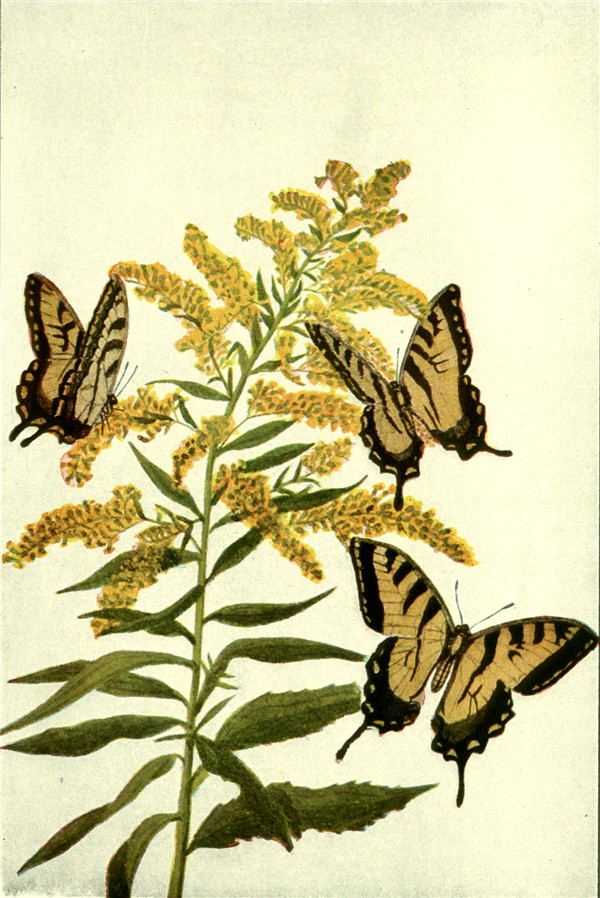
One of the many things that make a study of the life-histories of butterflies of great interest is the variations in the development of many of the species. One who follows the simplest life-story of a butterfly and sees the egg change to larva and the larva change in size and form and color with each successive moult and then change again into the seemingly inert chrysalis, from which there finally comes the winged butterfly--unlike the egg, unlike the larva, unlike the chrysalis--a creature of perfect beauty, wonderfully adapted to living freely in the air and sipping ambrosial nectar from the flowers--one who follows these changes with awakened vision can scarcely fail to have a sense of wonder as to the laws that govern such intricate phenomena. But the marvel is still more pronounced in the case of those butterflies which have two or more forms arising from the same lot of eggs in a way which science has as yet not adequately explained. The splendid Tiger Swallowtail is an example of this dimorphism which is of especial interest because of the fact that the extra form is confined to one sex and to only a part of the geographical area over which the butterfly is found. The species occurs over a very large part of the North American continent, being found from ocean to ocean and from Canada to Florida. In the region north of approximately the fortieth degree of latitude there is but one form of the insect--the familiar yellow-and-black striped butterfly which every one has seen visiting the lilac blossoms in May or June. South of this, however, part of the females take on an entirely different appearance, being almost wholly black with the hind wings touched with lines of blue and bordered with crescents of yellow and orange. The curious thing about it is that a certain mother butterfly may lay a dozen eggs part of which will develop into the usual yellow form and the rest into the black form, both lots being of the same sex. This black form is so entirely distinct in appearance that the two were originally described as separate species, and they were long considered such, until breeding experiments determined the precise condition. (See plate.) This species is of interest also for another reason. The caterpillars during their later life are remarkable examples of that curious resemblance to the head of a serpent which is thought to have a real protective value in frightening away attacking birds and possibly other enemies. The rings of the body just back of the head are much swollen and on the top of the swollen part there are two large circular marks which bear a striking resemblance to eyes. When the insect is at rest it withdraws its head and holds up the front of the body in such a way as certainly to suggest at the first glance that one is looking at the head of a small snake, an impression which is likely to be enhanced when the caterpillar pushes out the curious yellow scent organs from the ring near the top of the head, these organs taking on the forked appearance of a snake's tongue. Obviously it is exceedingly difficult to get definite observations under natural conditions to determine whether these seeming resemblances are really of value to the caterpillar in frightening away birds or other enemies. About the only direct evidence which I have come across upon this point is found in this paragraph by Dr. J. L. Hancock: "When I recall the first sight of this larva, the impression gained of it was a most curious one. The forward mask-like face was remarkably startling. This mask, bearing eye-like spots and the light transverse ridge, gave it an aspect which might easily be mistaken for real eyes and a mouth. This contrivance is only a false face in no way connected with the real eyes and mouth. One might imagine the shock that a bird, or other predaceous enemy, would experience when looking upon this grinning mask. This is in reality the effect produced, for I have seen small birds so alarmed that they lost their appetite and curiosity for these larvae after a brief glance at them. It is certain that these singular markings have the effect of terrifying their bird enemies."(2) The yearly cycle of the Tiger Swallowtail is much like that of the related species. It passes the winter as a chrysalis, the butterflies coming forth just about the time that the lilacs bloom. They remain upon the wing for a few weeks and deposit their eggs upon a great variety of trees and shrubs, for the food plants of the larvae are unusually varied and include tulip trees, birches, wild cherries, apples, poplars, ash, and several other common trees or shrubs. These eggs soon hatch into caterpillars that feed upon the leaves and make for themselves resting places by spinning a web of silk transversely across the surface of the leaf. They remain upon these silken webs when not feeding and in later life are likely to cause the leaf on which the web is made to curl into a partial tube. When fully developed they change to chrysalids which give forth the summer brood of butterflies in July and August. These in turn lay eggs for the caterpillars which change to chrysalids in autumn and remain in that condition until the following spring. The Short-tailed Papilio
Papilio brevicauda
Were one enough of a magician to make one butterfly over into another it would be comparatively easy to take a Black Swallowtail and transform it into this species. One would only need to trim off the long tails so that they project very slightly from the angles of the hind wings and to change the yellow spots to orange. He would thus accomplish what Nature through the long ages seems to have accomplished in a limited northern area in Newfoundland and around the Gulf of St. Lawrence, for the Short-tailed Papilio is confined chiefly to this region, where it lives a life very similar to that of the Black Swallowtail. The caterpillar feeds upon the leaves of various members of the parsley family and is said to have learned to warm itself during the middle of the day by resting upon stones and gravel which have absorbed the sun's heat rays. Presumably there is but one brood a year and the insect hibernates as a chrysalis. The Palamedes Swallowtail
Papilio palamedes
If the magician who had succeeded in converting a Black Swallowtail into the Short-tailed Papilio wished to try his hand on making a Palamedes Swallowtail he could not do better than to use again the same black butterfly. He would only need to make it about one half larger, retaining practically all its color markings and the outline of its wings and tail. For this species bears a remarkable resemblance to the Black Swallowtail, seeming to be a giant variety induced by the warmth of the southern climate where it lives, and possibly by the more generous supply of the magnolia and sassafras leaves upon which the caterpillars feed. This species is distinctly a southern form occurring as far west as the Mississippi River throughout the more Southern states. As one would expect in the long seasons and warm climate of this region there are several broods each year and the caterpillars often hibernate as well as the chrysalids. The adult butterflies are lovers of the sun and are said to roost at night upon the tops of live oak and palmetto trees. The Zebra Swallowtail
Iphiclides ajax
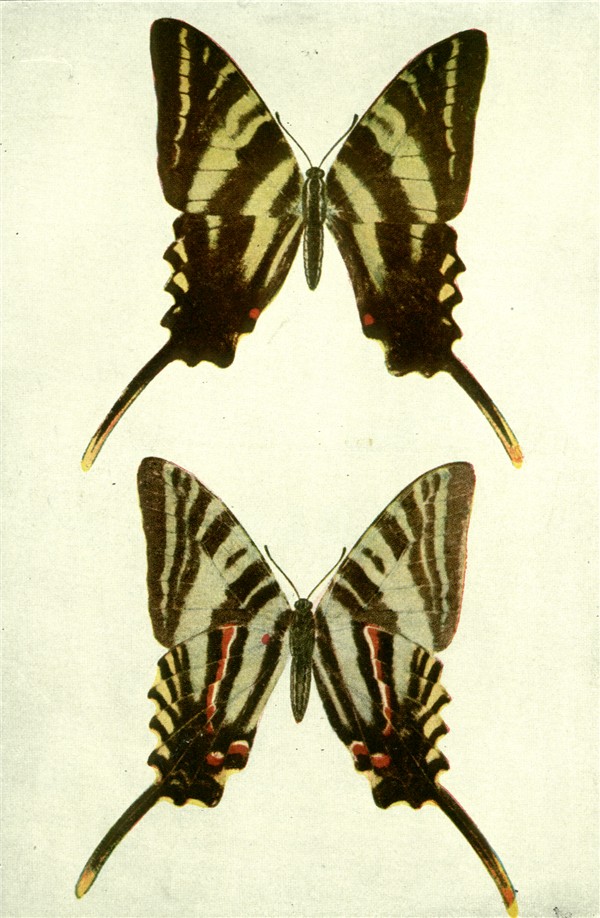
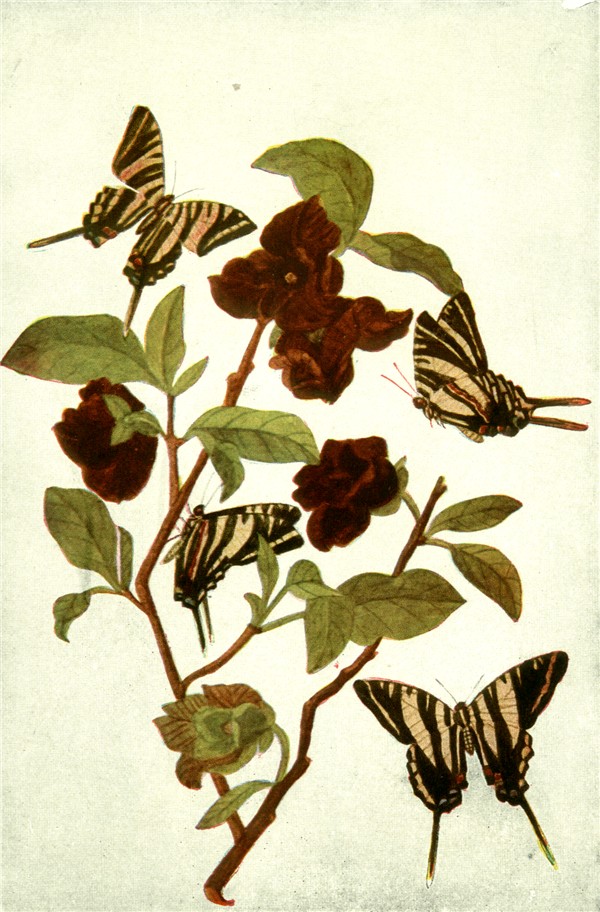
Most of our Swallowtail butterflies are so distinctive in form and colors that they are easily distinguished from one another, but the Zebra species is so different from all the rest that when it is once seen it is likely always to be remembered. The striking combination of green and black stripes with very long tails, set off by beautiful crescents of blue and of red, at once distinguishes this fine butterfly in any of its varying forms, Three distinct forms of this species occur, namely: Marcellus, the early spring form, small in size with short tails, that show white only on the tips; Telamonides, the late spring form, somewhat larger, with tails a little longer and showing more white on the outer half; Ajax, the summer form, decidedly larger with tails very long. It would be a comparatively simple matter to understand these forms if they were simply seasonal variations, with three broods, each form succeeding the other as the season advances. But this is far from being the case. We have instead the most complicated and confusing series of conditions imaginable--conditions for which no one has yet given satisfactory explanations. To make a fairly clear statement of what happens, suppose we assume that we start with twenty over-wintering chrysalids. In April ten of these disclose their butterflies which are Marcellus, the early spring form. In May the other ten disclose their butterflies which are Telamonides, the late spring form. We thus have these two forms appearing successively in spring from the same set of over-wintering chrysalids. After flying about for a short time the Marcellus or early spring Swallowtails lay eggs upon the leaves of papaw trees or bushes. These eggs soon hatch into caterpillars that feed upon the leaves and grow rather rapidly. A little more than a month later they mature into butterflies which are Ajax, the summer form. In a similar way the Telamonides or late spring butterflies lay eggs soon after they appear, also upon papaw leaves, and these eggs in about a month mature into Ajax, the summer form. So we have Ajax, the summer form, developing directly from both the early spring or Marcellus and the late spring or Telamonides butterflies. These Ajax butterflies in their turn lay eggs for caterpillar young. These soon mature into a brood of butterflies which are of this same Ajax form. There may be successive broods through the summer, practically all of them being this same Ajax summer form. The last brood of caterpillars, however, change to chrysalids which do not disclose the butterflies until the following spring. And then the first that come out are the Marcellus form and the last the Telamonides form. So we may have these two forms maturing from the same brood of autumn caterpillars. This seems a sufficiently complicated life-history to suit the most persistent solver of puzzle problems, but there is an additional factor which adds much to the possible confusion of the broods. In each brood of caterpillars from the earliest to the latest there are a certain number of chrysalids which remain dormant through the remainder of the season and the following winter, maturing into butterflies the next spring. Consequently at the end of every winter there are a miscellaneous lot of chrysalids which represent every brood of caterpillars that lived the previous season, and all of these develop into either Marcellus or Telamonides butterflies. Such a condition of affairs certainly represents what an old New Englander would be likely to call a "mixed-up mess," and it is difficult for science to find rhyme or reason to explain it. It speaks eloquently for the perseverance of W. H. Edwards that he was able with infinite patience through years of study and experiment to untangle this intricate web of butterfly existence. While the preferred food plant of this species is papaw, the caterpillars are also known to feed upon the spice bush and upland huckleberry. When full grown these caterpillars are about two inches long and of a general pea-green color, banded transversely with yellow and black, and having an especially conspicuous band of this sort on the third ring behind the head. The scent organs are protruded when the larva is disturbed and emit an offensive odor. The chrysalids are green or brown according to the surroundings. The Zebra Swallowtail is a southern butterfly found as far west as Texas and the Rocky Mountains and having its northern limits in a zone ranging approximately from Massachusetts to Nebraska. It is especially abundant in the Southern states east of the Mississippi River. Mr. S. F. Denton found this species abundant in southern Ohio where the females laid their eggs upon the small papaw bushes. They selected the leaves of these bushes for sleeping quarters, "clinging to the under side of the leaves where early in the morning they might be taken with the fingers." Other Swallowtails
Several other Swallowtail butterflies are found within the limits of the United States, especially in the Far West and along the southern boundaries. Some of these occasionally migrate east or north so that they are collected in the Central states. Thus Papilio daunus, P. oregonia, and P. zolicoan are all found in the "List of Nebraska Butterflies," published by Mr. H. G. Barber, and the same species have been taken in other states in or near the Mississippi Valley. These and various others are described and pictured in Dr. Holland's excellent "Butterfly Book." Synopsis of the Swallowtails
Tiger Swallowtail: Yellow form (Papilio glaucus turnus). Expanse 3½ to 5 inches. Upper surface of wings bright yellow with each black margin marked with a row of yellow spots. Both sexes throughout its range. Black form (Papilio glaucus glaucus). Black all over with blue markings on outer half of hind wings and row of straw-yellow crescents on borders of same. Females only, and only south of about latitude 40 degrees. Giant Swallowtail (Papilio thoas or Papillo cresphontes). Expanse 4 to 5½ inches. Upper surface black with two bands of yellow starting at the inner margin of the hind wings and coming together as a row of yellow spots at the outer angles of each front wing. A yellow spot on each black tail. Under surface yellow. Zebra Swallowtail. Expanse 3 to 3½ inches. Easily known by the stripes of green upon black and the long, slender tails. The different forms vary in size and in the length of the tails. Scientific names are: Early Spring Form, Iphiclides ajax marcellus; Late Spring Form, I. ajax telamonides; Summer Form, I. ajax ajax. Green-clouded Swallowtail (Papillo troilus). Expanse 8½ to 4 inches. Black with about seven yellowish spot, on outer margin of each front wing and eight marginal spots on each hind wing, those at the ends of row orange, the rest yellowish or bluish. Outer half of hind wings clouded with greenish blue. Under surface black with two distinct rows of yellowish spots on front wings and two rows of orange spots on hind wings. Blue Swallowtail (Laertias philenor, often called Pavilio philenor). Expanse about 4 inches. Black or brownish black with most of hind wings showing a bluish green iridescence. A row of marginal spots on each hind wing, more or less distinct on the front wings. Outer fringe with broad white markings interrupted by black ones. Under surface of each hind wing with seven large orange spots, some with partial borders of white. Black Swallow-tail (Papilio polyxenes or Papilio asterias). Expanse about 3 inches. Black with two conspicuous rows of yellow spots on outer half of wings, more distinct in males. On hind wings rows of blue spots or splashes between the yellow ones. Orange-red circle with black centre at inner angle of each hind wing. Under surface with markings more distinct and more orange-yellow. Short-tailed Swallowtail (Papilio brevicauda). Much like the Black Swallowtail but generally smaller, with very short tails, and with the yellow markings more or less changed to orange. Confined to the limited region of Newfoundland and the lands bordering the Gulf of the St. Lawrence. Palamedes Swallowtail (Papilio palamedes). Expanse 4 to 4½ inches. Much like the Black Swallowtail but considerably larger. A curved yellow line on the head back of each eye. Found only in the South.
THE WHITES,
ORANGE-TIPS, AND YELLOWS
FAMILY Pieridae
The most familiar and abundant American butterflies are classified together under the family name Pieridae, or the Pierids. Three groups or tribes of them are popularly known as the Whites, the Orange-tips, and the Yellows. Our two commonest butterflies, the White or Imported Cabbage Butterfly and the Sulphur Yellow Butterfly, are typical representatives of this family. Most of the rest, like these, are of moderate size with rounded wings which are more or less marked with black. There are six well-developed legs and the caterpillars of practically all the species are cylindrical greenish worms which under a lens are seen to be covered with short hairs. When the caterpillars are ready to change to chrysalids they spin a web of silk upon the supporting surface and just back of it, a loop of silk that serves to hold the chrysalis in place and keep it from swaying back and forth. The chrysalids are characterized by having a pointed projection on the front of the head, the rest of the body being more or less angular. Notwithstanding their close general resemblance to their food plants, the caterpillars of this family suffer from attack by various enemies. Birds find many of them, not only eating them themselves but also using them freely for feeding the nestlings. Parasitic insects also take a heavy toll from these caterpillars. This attack of enemies is doubtless a chief reason why many of the common species are not much more destructive. THE TRIBE OF THE WHITES
Three white butterflies of approximately the same size are found widely distributed over the United States. The most abundant species is the White or Imported Cabbage butterfly. The next in abundance is probably the Checkered White, and the rarest in most localities is the Gray-veined White which is a northern form. The White or Imported Cabbage
Butterfly
Pieris rapae
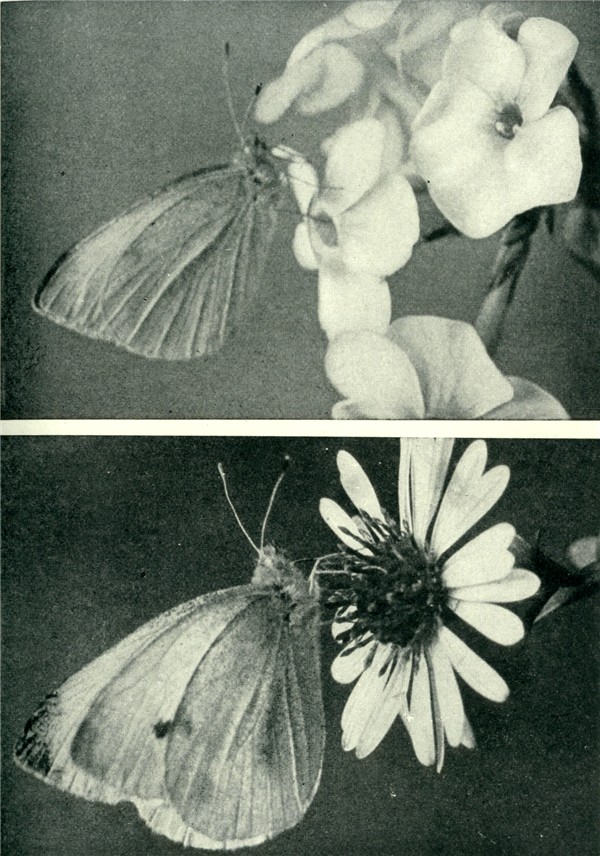
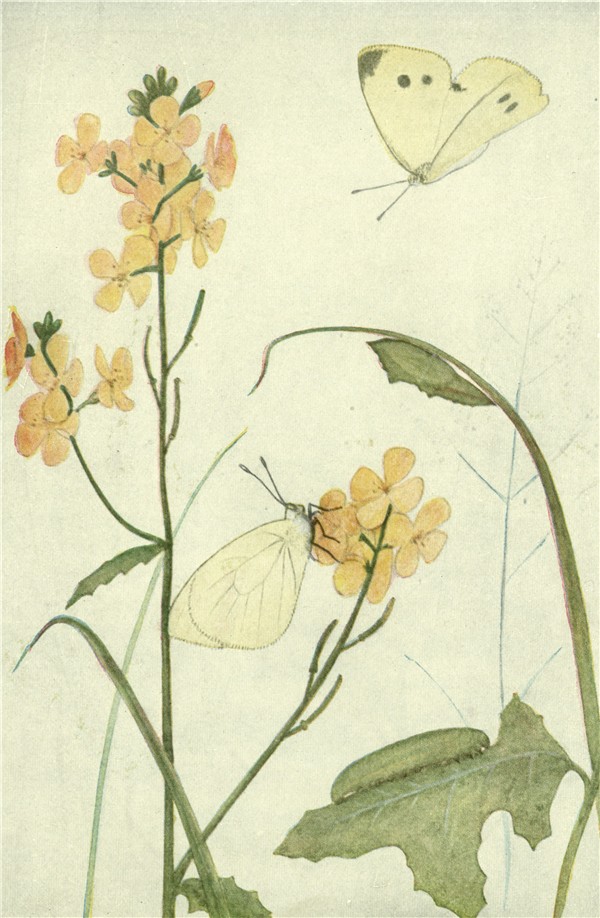
There is probably no butterfly which one can generally find so easily in its early stages as the White or Imported Cabbage butterfly which is found practically wherever cabbages are grown and is generally so abundant that caterpillars and chrysalids are readily discovered. In the Northern states the insect passes through the winter within the chrysalis, coming forth rather early in spring as the familiar white butterfly with black dots upon the wings and blackish front angles of the fore wings. (See plates.) The butterflies that thus appear in spring flit freely about over fields, meadows, and gardens, sipping the nectar of various early flowers through their long, coiled tongues and stopping occasionally to alight upon the leaf of a cabbage or other plant of the mustard family to deposit the small, pale yellow eggs which remain attached by a sort of glue. The adult butterflies continue their leisurely life for a fortnight or more, thus extending the laying of the eggs over a considerable period. About a week after being deposited the egg hatches into a tiny green caterpillar that begins feeding upon the tender surface of the cabbage leaf. It is commonly called the cabbage worm and it is doubtless the most generally destructive insect affecting this crop. It continues to feed for several days before the first moult, after which it becomes decidedly larger and begins to eat again more voraciously than before. It undergoes several successive moults during the next two or three weeks before it becomes full grown as a caterpillar. Unlike most butterfly larvae it has changed very little in its general appearance during its growth. It is always of a pale green color, strikingly like the glaucous green of the cabbage leaf, a fact which doubtless helps to conceal it from the eager eyes of birds and other animals. When the caterpillar is thus full fed it is likely to leave its food plant and find shelter elsewhere. Sometimes it will stop on the lower surface of the outer leaves, but more commonly it will find a piece of board, an overhanging stone, a fence-post, or the side of a building, where it will prepare for the change to the chrysalis. It will do this by spinning a silken thread upon the surface in which to entangle its hind legs and a loop of silk near by with which to hold its body. When these preparations are completed the insect will cast its last caterpillar skin, emerging as a grayish or brownish chrysalis, the color usually varying with the color of the surrounding surface. A week or more later the chrysalis skin bursts open and the white butterfly emerges to expand and dry its wings before it flies away for its leisurely life. There are two or more broods each season, the number varying with the latitude. There is a decided variation in the length of time required for the completion of the cycle from egg to butterfly. In hot weather the insect may mature in about five weeks while in cooler weather it may require as much as five weeks. Its Introduction and Dispersal
While it is well known that a large proportion of our most destructive insects have been imported from Europe, it is only in comparatively few cases that man has been able to make careful records of the times and places where the insects were introduced and to follow the spread of the pest from these original centres. The Imported Cabbage butterfly is one of the few species of which this is true. This insect has been known for centuries in Europe, where it feeds freely upon the leaves of cabbages and turnips. So far as known it was first introduced into North America about 1860, when it appeared in Quebec. Eight years later it was again introduced into the region of New York City. From these two points the insect spread gradually in various directions until in 1871 it covered the whole of New England and various parts of New York and New Jersey. From then on it spread even more rapidly and was evidently accidentally introduced into various parts of the country which became new centres of distribution. Of course it would be very easy for this to happen through the shipment of cabbages from one part of the country to another. Within thirty years of the time of its first introduction it had become a serious pest over practically all the United States and Canada. The introduction and spread of such a pest is of interest in itself, but in this case there is to be noted the additional fact that the presence of this foreigner has practically led to the extinction of two native species of butterflies, both closely related to each other and to the invader and both feeding upon the same plants. An almost pure white butterfly--the Gray-veined White was formerly exceedingly abundant in many of the Northern states, while farther south there was another species, the Checkered White, which was also abundant. Both of these have now so completely disappeared that in some localities they are almost never seen, while their imported relative has become perhaps the most abundant of all American butterflies. The Gray-veined White
Pieris napi
One would naturally suppose that when a butterfly was reduced to the greatest possible simplicity in its coloring there would be little chance for the development of geographical or seasonal varieties. But he would only have to study a large collection of specimens of this species, taken at different seasons and in different regions, to find his supposition at fault. Here is a butterfly which is essentially a slender black-bodied creature with four white wings scarcely touched with color, and yet we are told that there are eleven varieties in the United States so distinct that they have received scientific names, not to mention various others which have been found in Europe. This is indeed a remarkable showing and it is a striking illustration of the infinite variations which Nature can produce with the most limited materials. To me the seasonal variations of a butterfly are always of greater interest than those which are geographical. We know that in the case of a great many animals, from insects to mammals, the different conditions of climate and physical environment found in different regions produce variations of sorts. So it does not seem especially strange that in Alaska there should be a different form of a certain butterfly than is found in Virginia. But that in the same locality there should be two or more forms of a butterfly existing under identical conditions as to climate and environment is not so easily explained. In the case of the Gray-veined White we collect in early spring in New England, or other Northern states, a lot of chrysalids. We keep them until the butterflies come forth and we find even here two distinct forms, one smaller and more delicate than the other, with both surfaces of the wings pure white: scientists call this form, virginiensis; the other larger with the under surface of the wings slightly tinted with yellow: scientists call this form oleracea. The first named has but one brood a year while the second lays eggs which develop into caterpillars that produce butterflies of still a third form, in which the upper surface of the wings is pure white with a slightly greater expanse: scientists call this form cruciferarum. These three varieties occur in Eastern regions and may be found in the same localities, and differ considerably from various geographical varieties found in the Far West. The caterpillar of the Gray-veined White is a bit smaller than those of the nearly related forms, and in color is green with no distinct longitudinal markings, but with many fine dots of black over the surface. The cylindrical body is covered with a fine down. When feeding upon cabbage it is more likely to attack the outer than the inner leaves, and so even when abundant it is less troublesome to gardeners than the imported species. It is now, however, so rare that it seems to feed chiefly upon wild cruciferous plants and is more likely to be found along the borders of open woods than in gardens and fields. The winter is passed in the chrysalis state. The Checkered White
Pontia protodice
Some years ago the Checkered White was commonly called the Southern Cabbage Butterfly but the general distribution of the imported species has had the same effect upon its abundance in the South that it has had upon the Gray-veined White in the North. Consequently, it is now much less abundant than formerly, even in the Southern states where it is most at home. There are two fairly distinct forms: the spring form and the summer form. The latter is practically of the same size as the Imported Cabbage Butterfly: the males have the hind wings nearly white above and the fore wings with a few black dots or spots upon their outer halves. The females are much more definitely marked, having the upper surface of both pairs of wings marked in black or brownish black in such a way as to enclose a large number of white diamonds. The spring form is decidedly smaller and the markings are much less distinct than in the summer form. The seasonal history of this species is comparatively simple. In winter the chrysalids are found. From these chrysalids in early spring the small butterflies of the spring form come forth. These lay eggs upon various cruciferous plants which hatch into greenish caterpillars that eat the leaves and soon mature so far as their caterpillar stage is concerned. They are then about an inch long, with downy cylindric bodies more or less marked with rather pale yellow stripes, touched here and there with purplish green or dotted slightly with fine black dots. These caterpillars now attach themselves by means of a button of silk and a silken loop to some support like a piece of board, the side of a stone, or almost any available shelter. Each casts its larval skin and appears as a grayish chrysalis from which probably a fortnight later the summer form of the butterfly emerges. There are commonly two broods of this summer form, making three sets of butterflies for the entire season. The caterpillars of the second summer brood of butterflies go into the chrysalis stage in autumn to remain throughout the winter. Some very interesting observations upon the sleeping habits of this butterfly have been made in St. Louis by Mr. and Mrs. Phil Ran. The insects were found abundantly resting upon the seed heads of white snakeroot. Early in October, when a warm south wind was blowing, the great majority of the butterflies slept horizontally with their heads toward the wind. At other seasons and in other places, many of them were found in a vertical position but practically all had their bodies toward the wind prevailing at the time. The observers were unable to ascertain definitely whether the insects thus oriented themselves at the time of alighting, so that their wings presented the least resistance to the force of the wind, or whether this was a mechanical result of the breezes. The Great Southern White
Pontia monuste
There used to be in the Northern states before the advent of the Imported Cabbage butterfly a familiar white butterfly which then laid its eggs upon cabbages in much the same way that the imported pest now does. One who has seen this northern Gray-veined White and then sees the Great Southern White will be likely to think of the latter as a larger edition of the former, for in the males of the southern species the wings are practically white save for a narrow dusky border at the outer angle of the front pair, although in the female this dusky margin is wider and the hind wings show a series of dusky triangles near the margin. There is also a curious black marking suggestive of a crescent on each front wing near the middle of the front border, which helps to make the appearance of this butterfly very distinct from that of any other. Although this species is at times so abundant that it swarms in great flocks and although it has been known for many years, its life-history seems not to have been carefully worked out since it was first described by Abbott more than a century ago. The caterpillars feed upon cruciferous plants and when full grown are about an inch and a half long, of a general yellow color, more or less striped with purple lines. The species is distinctly tropical extending northward into our Southern states. Dr. G. B. Longstaff reports this species as abundant in Jamaica where he found that the clubs of the antennae of the living insects showed a beautiful turquoise blue color, although another observer described them as bright green with a tinge of blue. This is an interesting color variation for a member of this group. In the tropics also there are two forms, one belonging to the dry season and one to the wet season. Synopsis of the Whites
Imported Cabbage Butterfly (Pieris rapae). Expanse inches. Upper surface white with a black marginal dash on the front outer angle of the front wing. One round black spot on each of the four wings in the male. Two round spots on each of the front wings in the female and one round spot on each of the hind wings. Under surface of hind wings yellowish white; spots on front wings in same position as on upper surface. A spring form (immaculata) is smaller and the black spots are almost obsolete. Gray-veined White (Pieris napi). Expanse 2 inches. Upper surface white with only a darker marginal splash next the body. Under surface white with gray veins. Checkered White (Pontia protodice or Pieris protodice). Expanse 2 inches. Upper surface white, strongly marked especially in the female with dark grayish brown on both pairs of wings. Along the outer margins these marks axe so arranged as to enclose white diamond spots. Male with front wings only lightly marked and hind wings scarcely marked at all. Under surface much like upper, with a slight yellowish tinge in female. Great Southern White (Portia monuste or Pieris phileta.) Expanse 2½ inches. General color white with a narrow black margin around apical angle of front wings. These margins are wider in the female, in which sex there is a series of marginal spots on the hind wings. Easily known by its large size. THE TRIBE OF THE ORANGE-TIPS
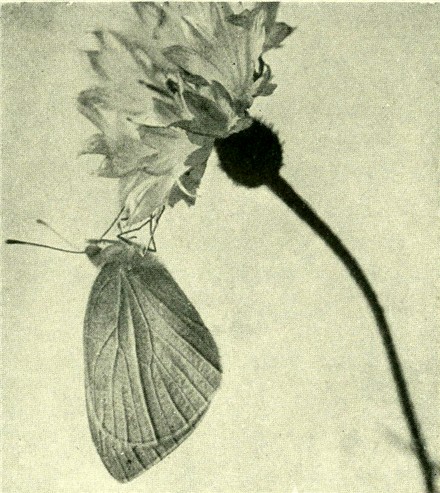
When one sees a gossamer-winged butterfly flitting from flower to flower on a bright June day it seems one of the most ethereal of earth's visions. One could readily fancy that the whole sight--flowers, butterflies, and all--might easily vanish into thin air. So it is something of a shock to hear scientists talk about fossil butterflies and to realize that these fragile creatures have been living generation after generation for untold millions of years. A realization of this fact, however, helps us to understand the many wonderful ways in which butterflies in all stages of their existence have become adapted to the conditions of their lives. There is perhaps no group of butterflies whose beauty seems more fragile than that of the Orange-tips. These are delicate creatures, with slender bodies and almost gauzy wings, of a size somewhat smaller than our common white and yellow butterflies. Perhaps the most remarkable feature is the marking of the wings, the upper sides of the front pair having an orange patch near the apex and the under sides having a background of delicate whitish or yellowish green, lined and spotted with darker coloring in a very characteristic way. This peculiar marking is so significant that it has been called "flower picturing." To understand the reason for its existence one has only to watch the butterflies in their native haunts. He will find them flitting from blossom to blossom among the plants of the mustard family--the Cruciferae. This is one of the most characteristic families in the plant world: the foliage for the most part is small and delicate and the flowers have a characteristic four-petaled structure, being practically always of small size and generally toned in whites or yellows. When an Orange-tip is at rest upon these blossoms it merges so completely into the background that it disappears from view. Should a bird chase one of these insects through the air it would see chiefly the orange tips which are so marked upon the upper side of the wing, and when the butterfly closed its wings and lighted among the flowers the orange color would instantly disappear and there would be only an almost invisible surface against the background of flower and leaf. The adaptations of these Orange-tips to the conditions of their lives are by no means confined to this remarkable resemblance to the flowery background. In the ease of some species the whole yearly cycle has been adapted to correspond to the yearly history of the cruciferous food plant. As is well known many species of the mustard family spring up early in the season, put forth their blossoms which quickly develop into fruits and then die down, the species being carried through until the next year by the dormant seeds. In a similar way the Orange-tips feed as caterpillars upon the host plant through the spring, completing their growth before the plant dies and then changing to chrysalids which remain dormant through summer, fall, and winter and come forth as butterflies early the following spring. The insect has thus adapted itself in a most remarkable manner to the yearly history of its plant host. The Falcate Orange-tip
Synchloe genutia
The Falcate Orange-tip is about the only member of this tribe generally distributed east of the Rocky Mountains. This is a beautiful insect which is sparingly found even as far north as New England. It is more abundant throughout the Southern states, occurring south at least as far as Texas. It appears to be a good illustration of the adaptation of its development to that of its food plants. The eggs are laid upon leaves or stems of such spring-flowering Cruciferae as rock cress (Arabis), and hedge mustard (Sisymbrium). On hatching the caterpillars feed upon stems, leaves, flowers, and even seed pods of these plants, becoming mature in a few weeks and changing to chrysalids under the protection of such shelter as they can find. In the Northern states these chrysalids remain unchanged until the following spring when the butterflies emerge and are found upon the wing for a few weeks in May and early June. In some southern regions at least the species is evidently double-brooded, as Dr. Holland reports that he has taken the butterflies in late autumn in the western portion of North Carolina. 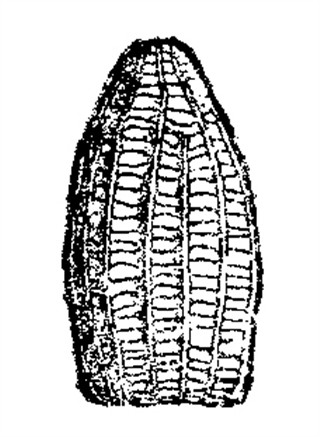 Egg of Synchloe genutia, magnified 20 diameters. (From Holland) This Faleate Orange-tip is one of the daintiest and most exquisite of northern butterflies. It is a prize which any collector will find joy in possessing. It is easily recognized by its general white color, which in the female is relieved only by a distinct black mark on the upper surface of the front wings and a row of marginal markings upon all the wings. The male is slightly smaller and is at once known by the orange blotch on the outer angle of the upper surface of the front wing. This outer angle projects into a distinct point which gives the species its name Falcate. (See plate.) Dr. J. L. Hancock has described in a most interesting manner the way in which this Orange-tip loses itself among the flowers of rock cress. In northern Indiana he found this butterfly abundant in April at the time of the blossoming of Arabis lyrata. The butterflies would be flying about, easily seen in the air. Then they would suddenly disappear and could be found only after the most careful search. They had simply lit upon the flower heads, when the flower picturing of the under surface of the wings blended perfectly with the appearance of the clustered flower. "The green markings of the under side of the wing," writes Dr. Hancock, "are so arranged as to divide the ground color into patches of white, which blend with or simulate perfectly the petals of the clustered flowers. The eyes of the butterfly are delicate pale green and the antennae are whitish, alt of which adds to the effectiveness of the blend. The flowers of Arabis have white petals with the centre yellowish green, as is also the calyx. There is a shade of pink outside the base of the petals. All in all, the adaptation of insect to flower here displayed is one of rare exquisiteness."(3) Dr. Hancock found that the butterflies were able to cling on the flowers during strong winds very persistently, so that even when a storm blew across the sand dunes they were likely to remain in position. They also have the instinct to rest very quietly after they have lit upon the clustered flower heads. The Olympian Orange-tip
Synchloe olympia
In various parts of the Southern states there is at least one other Orange-tip butterfly which is found occasionally in connection with the Falcate Orange-tip. It was named Olympia many years ago by William H. Edwards. It is a delicate white species marked with black and yellow very lightly both above and below, the yellow showing only on the under side of the hind wings and that part of the front wing which is exposed when the insect is at rest. Strictly speaking, this is not an Orange-tip because the orange color is lacking in both sexes. This is rather a rare species which occurs occasionally from the Atlantic states to the Great Plains south of a line drawn from northern Maryland to northern Missouri. Like its allies the larvae feed upon various cruciferous plants, the hedge mustard being one of these and the adults visit the flowers of the same family. They doubtless have habits similar to those of the Falcate Orange-tip, and the extreme delicacy of color must render them practically invisible when resting upon the small white flowers of most crucifers.
Most of the Orange-tip butterflies are found on the Pacific Slope, ranging from Alaska southward, several of them being especially abundant in the western mountain regions. About eight species are recognized as belonging to our fauna, some of which have several well-marked varieties. Synopsis of the Orange-tips
Falcate Orange-tip (Synchloe genutia, Anthocaris genutia or Euchloe genutia). Expanse 1 2/5 inches. Tips of front wings projecting in a hooked angle. Orange blotch on upper surface near tip in male, absent in female. Olympian Orange-tip (Synchloe olympia, Euchloe olympia or Anthocaris olympia). Expanse 1½ inches. Wings white above in both sexes with greenish black markings at base of all wings and along front margin of front wings, especially at apex. No orange patch. THE TRIBE OF THE YELLOWS
A large proportion of our most abundant and conspicuous butterflies belong to the Tribe of the Yellows. Sometimes it is called the Tribe of the Red-horns because the antennae of the living insects are so often red. These insects vary in size from the large Brimstones or Cloudless Sulphurs, expanding three inches, to the delicate little Dainty Sulphur, expanding scarcely an inch. The distinctive characteristics of the tribe are found in the very gradual enlargement of the joints of the antennae that form the club, and the stout palpi, the last joints of each of the latter being short. The Brimstone or Cloudless
Sulphur
Callidrayas eubule
Practically all northern butterflies are variously marked in different colors, while the butterflies of tropical regions are commonly tinted in monotone, though often showing a splendid iridescence. One with very little experience can tell the look of a tropical butterfly and would be likely to say at once that the Cloudless Sulphur is one of these. The upper surface of the wings of the male is a clear plain sulphur with merely the narrowest possible fringe of brown around the margin made only by the colored marginal scales. The under surface is lighter and sparsely dotted in brown. In the females the marginal brown takes on the shape of a series of small crescents and there is a single round brown eye-spot just in front of the middle of each front wing. While the Cloudless Sulphur is without doubt essentially a tropical species it has an extraordinary geographical range. It is extremely abundant in Mexico, Cuba, and the tropical zone in South America. It extends south even to northern Patagonia and north to New England, Wisconsin, and Nebraska. Presumably in the tropics this species breeds continuously, one generation following another in regular succession unless interrupted by drought or other natural phenomena. In our Southern states there is more or less interruption by the winter season, so that it is commonly considered to have only two broods, the butterflies hibernating. Farther north there is probably only one brood in summer, and perhaps not even that in the extreme limit of its range. For there is pretty good evidence that the specimens seen in the Northern states are migrants from the south, coming singly or in scattered flocks in early summer, and if they lay eggs the butterflies of the new generation return south in autumn. But the precise conditions are not well known and need careful observations in various localities. The life-story of a generation of these butterflies is much like that of the other Yellows. The eggs are laid, one in a place, on the leaflets of various species of wild senna (Cassia) and soon hatch into cylindrical caterpillars that devour the tender leaflets. In a few weeks the caterpillars mature and change to curious and characteristic chrysalids. The head projects in the shape of a cone and the back is so concave as to give the side view of the chrysalis a very striking appearance. Like so many of the Yellows this butterfly is sun-loving and social in its habits. Great numbers flock together, their large size and bright coloring rendering them very conspicuous. They often alight on the ground to sip moisture when they have been likened to beds of yellow crocuses. They also fly long distances in flocks that attract much attention. It is likely that the northward distribution takes place in summer through such infiltrating hosts. Other Sulphur Butterflies
The Large Orange Sulphur is a closely related butterfly of about the same size, in which the coloring is uniformly orange-yellow instead of lemon-yellow. It also belongs to the tropics, occurring in our extreme Southern states and ranging occasionally as far north as Nebraska. The Red-barred Sulphur is another splendid butterfly, somewhat larger than the Brimstone, which is easily distinguished by the broad reddish bar across the upper surface of the front wings. It is tropical but migrates rarely even as far north as Indiana, Illinois, and Wisconsin. The Dog's-head Butterfly
Meganostoma caesonia
The Dog's-head butterfly furnishes one of the most remarkable examples of accidental resemblance in wing markings that can be found in the whole order of scale-winged insects. It is comparable with the skull and crossbones on the back of the death's-head moth. In the butterfly the middle of the front wings has a broad band of yellow against a black margin on each side and the yellow outlines make an excellent silhouette of the profile of a poodle with a large black eye-spot in exactly the proper place. The females are less brightly colored than the males but they still show the dog's-head silhouette. This is a southern species, which occasionally strays as far north as New York City, New Hampshire, Wisconsin, and Iowa. The larvae feed on species of Amorpha and are believed to be three-brooded in southern regions where the butterfly occurs. The California Dog's-head is even more beautiful than the southern species. It is remarkable for its pink and purple iridescence--a characteristic which is not common in the butterflies of the Yellow and the White Tribes. The silhouette of the Dog's head is less perfect than in the more eastern species, and the yellow color tones are more tinged with orange. The female is strikingly different, the wings being plain pale yellowish buff marked only with a round blackish eye-spot near the middle of each front wing and the barest suggestion of a dark line around the extreme margin. The Clouded Sulphur
Eurymus philodice
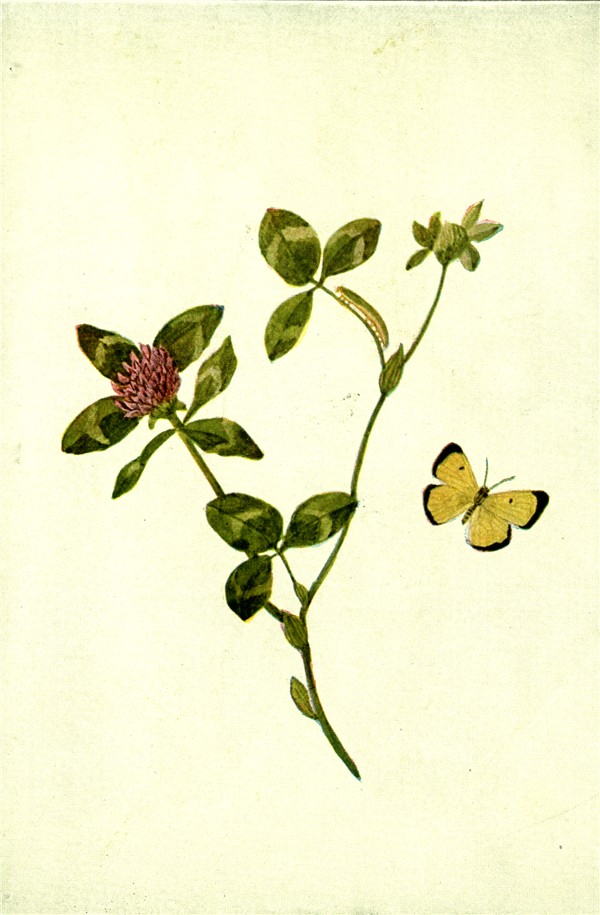
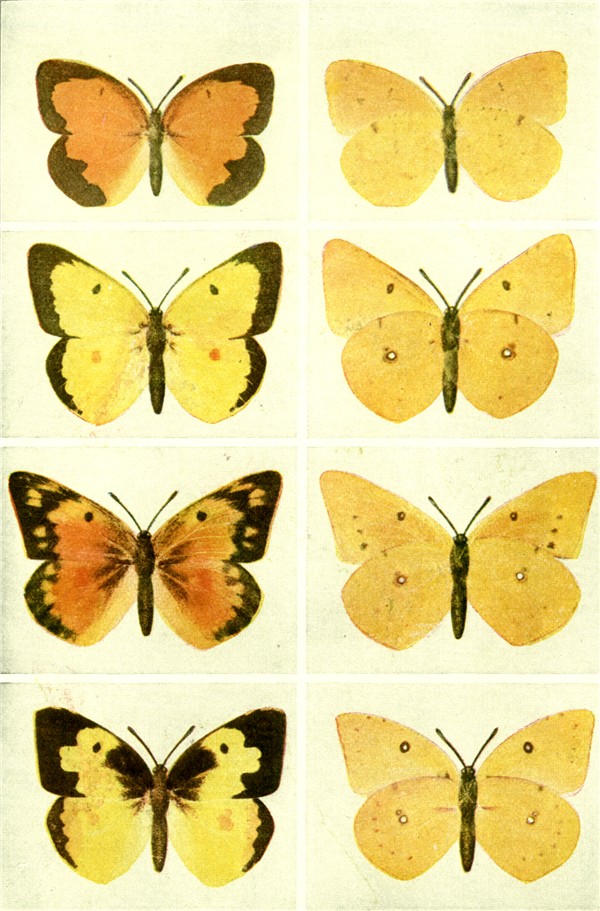
It is an interesting fact that the butterfly which one is most likely to find in fields and along roadsides during practically all the weeks of summer has seldom if ever been noted as a destructive insect. The Clouded Sulphur is probably the commonest species in its group. There may be times when the White Cabbage butterfly or other forms are more abundant, but the Clouded Sulphur retains its place season after season, with comparatively little noticeable variation in its numbers. This is doubtless an illustration of an insect which has established such relations with its food plants and its various insect and other enemies that it remains in a fairly stable equilibrium-an example of what is often called the balance of nature. The Clouded Sulphur is about the only medium-sized yellow butterfly generally found in the North-eastern states. The adults may be seen from spring until autumn. They lay eggs upon clover and other plants. These eggs hatch into small green caterpillars that feed upon the leaves and are protectively colored so they are comparatively seldom seen. When the food plant is disturbed they drop to the ground, crawling up again upon stems and leaves when the disturbance is over. These caterpillars moult several times during their growth. When full grown they find such shelter as they are able and each spins a silken web over part of the surface. It then fastens its hind legs into this web and later spins a loop near the front end of the body. It pushes itself beneath this loop and waits for several hours before the skin breaks open along the back and is gradually shuffled off revealing the chrysalis in position. A week or two later the fully developed butterfly emerges from the chrysalis. These yellow butterflies lend a distinctive charm to our summer landscapes. They are constantly to be seen fluttering from place to place, lightly visiting flowers of many kinds from which they suck the nectar, and gathering in great colonies by roadside pools where they seem to sip the moisture. There are many references to this insect in the writings of New England authors. It evidently was an especial favorite of James Russell Lowell who has often referred to it in passages like this: "Those old days when the balancing of a yellow butterfly over a thistle bloom was spiritual food and lodging for a whole forenoon." The Orange Sulphur
Eurymus eurytheme
Were one able to take a Clouded Sulphur butterfly and change the yellow to a deep orange color he could easily make a specimen that would pass for the present species. The resemblance is very remarkable and shows the close affinity between these two beautiful insects. Like so many others of this group the Orange Sulphur is essentially a tropical species. In the eastern United States it is rarely found north of latitude forty degrees, but south of that it becomes increasingly abundant as one approaches the tropics. It occurs from the Carolinas to Texas, and over the great range in which it lives it takes on many different forms and habits. It is one of the most remarkable examples of variation in coloring exhibited by any of the butterflies. Nearly a dozen species names have been given to its various disguises, all of which are now recognized as synonyms. In the more northern regions where it is found, only one of these forms usually occurs, but in other places bright yellow and pale white varieties are found. The life-history of this butterfly along latitude forty degrees is very similar to that of the Clouded Sulphur. There seem to be usually two broods and the caterpillars live upon leguminous plants, especially alfalfa, buffalo clovers, wild senna, and other species of Trifolium and Cassia. Apparently also it hibernates in both the caterpillar and the butterfly stages. In the extreme Southwest--as on the plains of Texas--the vegetation dries up completely in summer so that there is no succulent leafage for the caterpillars to live upon. In such cases the insect must aestivate rather than hibernate. This species apparently succeeds in doing this by having the caterpillars go into a more or less lethargic condition in which they pass the summer. The adult butterflies utterly disappear in June and are not seen again until early in autumn when the autumn rains have started the growth of vegetation anew. The insects then make up for lost time and produce several broods in rapid succession. In the Imperial Valley of California this butterfly is a serious pest to alfalfa growers. It continues to reproduce throughout a very long season, one brood following another from March until December, and in mild winters there seems sometimes to be practically no cessation of its activities. Mr. V. L. Wildermuth found that the development of a generation in breeding cages in this valley varied from twenty-two to forty-four days, the latter in cool, the former in hot weather. The stages in the first and the third broods in spring varied thus: Egg, first six days, third four days; larva, first thirty days, third twelve days; chrysalis, first eight days, third five days. In this case the first generation extended from March 15 to April 30 and the third from May 28 to June 20. After the fourth brood of butterflies there was such an overlapping of the various stages that it was impossible to distinguish the broods. The Pink-edged Sulphur
Eurymus interior
This beautiful butterfly was first made known to the world of science by Louis Agassiz, the great naturalist who did so much to arouse a scientific interest among Americans. He found it on a famous expedition to the northern shores of Lake Superior, which not only served to bring to light many interesting phases of geological history but also laid the foundation for the copper mining industry which has since become so important in that region. The butterfly thus brought to light has been found to be a characteristic northern species, occupying a rather narrow belt nearly along the fiftieth degree of latitude and extending west almost to the Pacific Coast. The species is occasionally taken as far south as the White Mountains and there are indications that in this region there are two broods a year. The male butterflies are known at once by a beautiful pink edge on all the margins; they bear otherwise a close resemblance to our common Sulphur Yellow. The females are much lighter in color, often having no black markings on the upper surface of the hind wings. The Black-bordered Yellow
Eurema nicippe
This is essentially a tropical butterfly which has spread out over most of our Southern states where it is abundant and widely distributed. It adds a distinct touch of color and life to many landscapes when the butterflies swarm by thousands upon clover blossoms and other low vegetation. The eggs are laid upon the leaves of clover and more especially upon some common species of Cassia, such as wild senna. Each egg soon hatches into a small greenish cylindrical worm, colored and striped in such a way that as it rests upon the leaf it is easily overlooked. This larva develops rapidly and soon becomes about an inch and a quarter long, being rather slender and fairly smooth. It now spins a bit of silk upon a twig or some similar support and also the frailest sort of a silken loop to pass around its back. It now entangles its hind feet in the bit of silk and soon casts off its last caterpillar skin, emerging as a curious looking chrysalis about three quarters of an inch long with a remarkable pointed projection on the front of the head. When seen through a hand lens this pointed projection and the well-developed characteristic wing sheaths give the chrysalis a remarkable resemblance to some of the twig hoppers or Membracids. The colors vary considerably with the surroundings but are commonly toned in various shades of green and yellow brown. A little later each chrysalis breaks open to disclose one of the beautiful butterflies. The conditions under which this butterfly lives at the limit of its northern range are not well determined. It is probable that many of those seen here have flown from considerably farther south, and that these migrants lay eggs from which a brood of butterflies develops, these native born appearing late in summer. Presumably the latter hibernate, but whether they can do this successfully under the rigorous conditions of our northern winters has never been determined. In fact, Scudder wrote some years ago that no caterpillars had ever been found in New England. Here is an interesting opportunity for some young observer to make a real contribution to science. The Little Sulphur
Eurema lisa
Were one to imagine a Clouded Sulphur butterfly reduced to half its usual size and built with a corresponding delicacy of structure, one would have a pretty good idea of the beautiful little creature called by the above name. I well remember in my college days taking what was probably the first of these butterflies ever collected in the region of our Michigan college. It was a prize that very likely had wandered north from Indiana but which served to add much glory to the little collection in which I took such pride, for this is essentially a southern species In many regions of the South it is so abundant that it can be taken by any one. It ranges from coast to coast and extends south into the tropics. In the eastern region it is found from southern Wisconsin to southern New England, occurring sparingly and locally in various places along the line thus indicated. The food plant of the species is chiefly wild senna or other kinds of Cassia. The mother butterflies deposit the eggs singly on leaves or stems, generally on the small leaflets of the compound leaf. Less than a week later each egg hatches into a cylindrical greenish caterpillar that feeds upon the leaflets in a characteristic fashion. Instead of devouring the blade from the margin inward it gnaws narrow strips between the smaller veins. When not feeding, the caterpillars protect themselves from observation by birds or other enemies by resting motionless along the stem of the leaflet or else along the midrib on the under side. As is well known the leaflets of Cassia, like other leguminous plants, close at night. It is probably on this account that these caterpillars feed chiefly by day. The general green color of the skin and the straight stripe along the side help to make this caterpillar very inconspicuous when it is at rest. When full grown the caterpillar reaches a length of three quarters of an inch. It now finds some bit of shelter on which it spins a bit of flat web and a silken loop to hold it in place as it becomes a chrysalis. It then changes and remains quiescent for ten days or more when it emerges as the dainty butterfly. Notwithstanding its abundance and its successive broods its life-history is none too completely worked out. There is still opportunity for careful observations upon the way in which it passes the winter in various parts of its range. While in the South it apparently hibernates as an adult, this fact is not certain in the more northern localities. Notwithstanding its diminutive size this butterfly has been known to swarm in such enormous numbers as to seem a veritable cloud. The most notable record of this has been quoted by Scudder in connection with a swarm that invaded the Bermuda Islands, in 1874, on the first day of October. It was described in these words: "Early in the morning several persons living on the north side of the main island perceived, as they thought, a cloud coming over from the northwest, which drew nearer and nearer to the shore, on reaching which it divided into two parts, one of which went eastward and the other westward, gradually falling upon the land. They were not long in ascertaining that what they had taken for a cloud was an immense concourse of small yellow butterflies, which flitted about all the open grassy patches in a lazy manner, as if fatigued after their long voyage over the deep. Fishermen out near the reefs, some few miles to the north of the islands very early that morning, stated that numbers of these insects fell upon their boats, literally covering them." As is file ease with so many of the related yellow butterflies there is an albino variety of this species. It has been given the variety name alba although it is really a pale yellow rather than a true albino form. The Dainty Sulphur
Nathalis iole
While the Little Sulphur butterfly seems about as delicate a creature as one could ask to see, it loses that distinction when it is compared with the still smaller Dainty Sulphur. The latter expands scarcely an inch when its wings are stretched apart, and its slender body and antennae help to give the suggestion of extreme delicacy. There is more marking of black upon the sulphur-yellow wings than is the ease with the larger form, the upper portion of the front wings showing only a broad yellow band upon a background of darker color. The under wings are nearly all yellow. Synopsis of the Yellows
Brimstone or Cloudless Sulphur (Callidryas eubule or Catopsilia eubule). Expanse 2 ½ inches. Upper surface of male clear, light, sulphur yellow. Female with a brown spot in front of middle of each front wing and a narrow brown margin on all the wings. Under surface deeper yellow with sparsely scattered brownish dots. Red-barred Sulphur (Callidryas philea or Catopsilia philea). Expanse 3 inches. Easily known by the reddish orange bars on the sulphur-yellow wings. Large Orange Sulphur (Callidryas agarithe or Catopsilia agarithe). Expanse 2½ inches. Distinguished at once by its uniform orange-yellow color. Dog's-head Butterfly (Zerene caesonia, Colias caesonia or Meganostoma caesonia). Expanse 2 ¼ inches. Upper surface yellow with black inner and outer borders on front wings and black outer border on hind wings. The black and yellow of each front wing so combined as to make a distinct dog's head with black eye. Clouded Sulphur (Eurymus philodice or Collas philodice). Expanse 2 inches. Upper surface sulphur yellow with blackish borders, the yellow brighter in the male than in the female. Male with line between yellow and black distinct, a black spot just in front of the middle of each front wing and an orange spot near the middle of each hind wing. Under surface of male deeper yellow, with spots as on the upper surface but without black margin, and with a row of sub-marginal brownish dots on each wing. Female with upper surface more generally suffused between marginal mark and the yellow part with more or less duskiness both above and below. Spots on each wing much as in male. In the white form of the female (pallidice) the yellow is replaced by white. Pink-edged Sulphur (Eurymus interior). At once distinguishable from philodice by the narrow pink edge of all the wings, showing both from above and from below, slightly smaller as a rule. Orange Sulphur (Eurymus eurytheme or Cotins eurytheme). Expanse 2 ¼ inches. Much like Clouded Sulphur in markings except that prevailing color-tone is orange yellow. Black-bordered Sulphur (Eurema nicippe, Xanthidia nicippe or Terias nicippe). Expanse 2 inches. Upper surface of wings bright orange with a small black dash in front of the middle of each front wing and a broad black border on all the wings. In the females the borders are interrupted at the rear. Under surface slightly brownish yellow, minutely striated and clouded when exposed when the butterfly alights. Little Sulphur (Eurema euterpe, Eurema lisa, Xanthidia lisa or Terias lisa). Expanse 1 inch. Easily known by its small size and delicate structure. Upper surface of wings yellow with distinct black borders. Under surface yellow with indistinct spots. Dainty Sulphur (Nathalis iole). Expanse 1 inch. Easily known by its small size and narrow yellow wings with black bars across the outer angles and black bands across the back border of the front wings and the front border of the hind wings.
THE NYMPHS
FAMILY Nymphalidae
A large proportion of our most familiar butterflies belongs to this family. The Fritillaries, the Angle-wings, the Sovereigns, and the Emperors are tribes in which practically all the species are of medium or large size. The Crescent-spots include a few which are rather small. The combinations of characters by which the Nymph family is distinguished are these: Front legs dwarfed into lappets; scaly antennae; veins of fore wings not swollen at base; wings of normal shape, not much longer than wide. Larvae cylindrical, but varying greatly in form, color, and skin coverings. Chrysalids angular in most species, in others rounded. The stories of the lives of the many members of this family vary considerably, as one would expect from their variety and numbers. We may take, however, the life of the familiar Antiopa or Mourning Cloak as typical of the group. Briefly summarized, its story may thus be told: During sunny days in spring one may often see a beautiful purple-back butterfly, having a cream-colored border along the outer margin of its wings, flying leisurely about, in the vicinity of woods and in the open fields. This insect is called the Antiopa or Mourning Cloak; it is represented natural size in plate opposite page 145. It has passed the winter in this adult condition, having found shelter in some retreat where it is not directly exposed to the storm and stress of the weather. When the leaves of the elm, willow, and poplar trees are nearly expanded, these butterflies deposit their eggs upon the twigs. These eggs are laid in clusters encircling the twigs, there being twenty or more in each cluster. In the act of oviposition, the butterfly keeps her wings spread out, moving the body and abdomen about as the placing of the eggs necessitates. About two weeks after the clusters of eggs are thus laid upon the twigs of the food plant, they hatch into small blackish caterpillars, each emerging from the egg shell through a small hole that it eats out of the upper surface. They thus enter upon the second stage in their life-history --the larva or caterpillar stage. As soon as hatched, they crawl to the nearest leaf upon which they range themselves side by side, with their heads toward the margin of the leaf. They feed in this position, nibbling at the green surface of the leaf-blade and leaving the network of veins untouched.  Eggs of Mourning-Cloak, laid in a cluster on a twig. (From Holland) These caterpillars continue to feed in this manner for about a week, remaining side by side when feeding, and marching in processions from one leaf to another as the food supply is exhausted. Wherever they go, each spins a silken thread on the surface traversed, so that the combination of all the threads makes a sort of carpet that serves as a foothold for the caterpillars. At the end of the week they moult or cast their skins, a process in which the skin of each larva splits open along the back, and the larva crawls out covered with a new skin that had been formed beneath the old one. This new skin stretches somewhat after the caterpillar emerges, so that the insect is able to increase considerably in size. At the period of moulting, the caterpillars remain quiet for a short time, but they soon become active again and begin feeding with increased voracity. During the next three weeks, this moulting process is repeated three times, the caterpillars becoming larger each time, and leaving their cast skins upon the denuded twigs. They soon scatter more or less over neighboring leaves, but remain in closely associated colonies. As they increase in size, they eat more and more of the leaf substance; when half grown, they devour all but the mid-rib and the side veins; but when they get larger, only the midribs are left. The carpet web that they form becomes more conspicuous as the caterpillars become full grown. They then leave the tree or shrub on which they have been feeding, and scatter about, seeking some sheltered situation. Having found this--perhaps beneath a stump or along the under side of a fence--each caterpillar spins a web of silk along the surface. It then entangles the hooked claws of its hind legs in the silken web, and lets its body hang vertically with the head end curled upward. It remains in this position some hours before the skin along the back just behind the head splits apart and is gradually wriggled upward, until finally it is all removed and there hangs in place of the caterpillar a peculiar object having no definite form. But it rapidly assumes a definite form--that of the chrysalis--which is grayish brown, different specimens varying somewhat in shade. In this quiet chrysalis, the insect is apparently almost as inert as a mummy. If you touch it, it will wiggle a little, but otherwise it hangs there mute and helpless. On the inside, however, the tissues are being made over in such a wonderful way that, in about two weeks, from the mummy case into which the caterpillar entered there conies a beautiful butterfly. When this butterfly first breaks through the mummy shell, its wings are very small, although its body, antennae, and legs are well developed. By means of the latter, it clings to the empty chrysalis, while its wings expand. At first these wings are short, but as soon as the insect takes a position in which the wings hang downward, they begin to expand, and soon reach full length, but are more or less crumpled longitudinally, and the front wings are not so wide as the hind ones, hanging limply inside the latter. After the butterfly has thus reached its full form and size, it crawls from the chrysalis to some neighboring support, where it rests quietly for half an hour or more. During the latter part of this time it exercises its unused muscles by slowly opening and closing its wings, until it finally flies away. THE TRIBE OF THE FRITILLARIES
This is one of the most distinctive tribes of the family of Nymphs. The clubs of the antennae are about twice as long as broad and curiously spoon-shaped. The palpi are large and bushy, with the last joint very short. Most of the species are rather large and practically all are beautifully mottled in various tones of brown, red, black, and silvery gray. A large proportion of our midsummer butterflies are members of this tribe. The Gulf Fritillary
Agraulis vanillae
In tropical America there is a genus of butterflies called Agraulis. These are fairly large insects, approximating the size of the Viceroy, which show most beautiful colors in the tropical sunshine. One member of this genus has come north to our Southern states, and is occasionally found as far up as Virginia and southern Illinois, extending below this from ocean to ocean. It reveals on its upper surface the most exquisite tints of iridescent purples and browns, suggesting by its form and color as thus seen a tropical species. The lower wing surface, when the wings are closed in their natural position, shows only a spangled effect of silver-white and brown, which is very suggestive of the under surface of our northern Spangled Fritillaries. So this beautiful species may fittingly be called the Gulf Fritillary, carrying over from the north some of its peculiar beauty and connecting with the equally distinctive beauty of the tropical south. Like so many other southern butterflies the eggs of this species are laid upon the leaves of passion vines. The caterpillars develop very rapidly and when matured are yellowish or brownish yellow, striped with darker lines along the back and sides. There are black branching spines, arranged in rows beginning on the head and running backward on the body. The whole cycle of life from egg to butterfly may take place within the short period of a month and one brood succeeds another in so irregular and rapid a fashion that it is difficult to determine definitely the number of broods in a season. The Variegated Fritillary
Euptoieta claudia
There is something in the appearance of the upper surface of this butterfly that suggests the other Fritillaries on the one hand and the Emperors on the other. The coloring and marking is a bit like the former and the shape of the wings like the latter. The general color is a golden brown with darker markings arranged in bands and eye-spots in a rather complicated pattern. The under surface, so far as it is exposed when the butterfly is at rest, is a beautiful marbled combination of gray and brown which is probably distinctly obliterative in the haunts of these insects. The front wings have the outer margin concave in the middle, giving a special prominence to the shape of each front outer angle. This butterfly is a southern rather than a northern species, but it is found occasionally from Montana to Massachusetts and southward to Arizona, Mexico, and Florida. Even in northern Indiana it is very seldom found and is considered rare in the southern part of that state. Around Buffalo, New York, it is also rare and is not common in the vicinity of New York City. In the more Southern states, however, it is abundant and extends well through the continent of South America. There is considerable evidence to indicate that this butterfly hibernates as an adult. In the more southern regions it probably also hibernates in other stages, especially the chrysalis and the larva. In regions where it is double-brooded, as it appears to be in the latitude of New York City, the seasonal history seems to run something like this: the partly grown caterpillars which have passed the winter in shelter at the surface of the soil feed upon the leaves of violets and certain other plants. They change to chrysalids, probably in May, and emerge as butterflies in June. These butterflies lay eggs for a summer brood of caterpillars which may feed upon the leaves of violets, May apples, portulaca, and stonecrop. They grow into cylindrical worms of a general reddish yellow color, marked by longitudinal stripes of brown upon the sides and a row of whitish dots upon the back. They become matured in time to disclose the butterflies of the second brood in August and September. Presumably these butterflies lay eggs that develop into caterpillars which hibernate when partially grown. Farther south there are probably three broods a year and hibernation may take place in various stages. There is good opportunity for careful work in determining the life-history of the species in different latitudes. The butterfly is found in much the same situations as the other Fritillaries, flying over meadows and along the borders of woods. The Diana Fritillary
Argynnis diana
This magnificent butterfly differs from the other Fritillaries in the fact that the females are so unlike the males that only a skilled naturalist would even guess that they are related. Both sexes are rather rare and are found only in a comparatively narrow range extending from West Virginia to Missouri, northward to Ohio and Indiana, and southward to Georgia and Arkansas. This species was first described by Cramer a long time ago from specimens of the male sex. It was later described by Say and other writers all of whom saw only the males. The other sex was first recognized by William H. Edwards, whose account of its discovery as given in his splendid work on the Butterflies of North America is worth quoting: "No mention is made of the female by any author," wrote Mr. Edwards, "and it seems to have been unknown till its discovery by me in 1864 in Kanawha County, West Virginia. On the 20th August, I saw, for the first time, a male hovering about the flowers of the iron-weed (Vernonia fasciculata), and succeeded in taking it. Two days afterwards, in same vicinity, while breaking my way through a dense thicket of the same weed, hoping to find another Diana, I came suddenly upon a large black and blue butterfly feeding so quietly as to allow me to stand near it some seconds and watch its motions. It seemed to be a new species of Limenitis, allied to Ursula, which it resembled in color. But on taking it, I saw it was a female Argynnis, and the general pattern of the under wing left little doubt of its affinity to the Diana male, despite its total difference in color and of upper surface. Subsequent captures confirmed this conjecture, and out of the large number that have since been taken the males have been of the known type and the females black, with no tendency in either to vary in the direction of the other. "When my attention was called to the species I found it not very uncommon, always upon or near the iron-weed, which is very abundant and grows in rank luxuriance upon the rich bottom lands of the Kanawha River, frequently reaching a height from eight to ten feet and in August covered by heads of purple flowers that possess a remarkable attraction for most butterflies. Both sexes are conspicuous, the males from the strong contrast of color and the females from their great size and the habit of alighting on the topmost flower and resting with wings erect and motionless. It is an exceedingly alert and wary species, differing in this from our other Argynnids. At the slightest alarm it will fly high into the woods near which, upon the narrow bottoms or river slopes, it is invariably found. It is a true southern species, sensitive to cold, not to be looked for in the cooler part of file morning but flying down from the forest when the sun is well up. From eleven to three o'clock is its feeding time." The life-history of this fine butterfly is similar to that of the lesser Fritillaries. The butterflies appear from mid-summer onward, the males preceding the females, and the eggs are laid on or near violets in August or September. The larvae hibernate and mature early the following summer. As they approach the chrysalis stage they are rather large velvety black caterpillars with rows of fleshy barbed spines that show an orange tint at their bases. There is thus but one generation each year. The Regal Fritillary
Argynnis idalia
The Regal Fritillary, fresh from the chrysalis, still showing the marvelous sheen of its iridescence, furnishes one of the most beautiful exhibitions of color in the world of nature. Over the whole wing surface there are tiny scales that reflect the sunlight in an almost dazzling manner, giving a distinct purplish tone especially to the hind wings. The Regal Fritillary is one of the largest butterflies of the distinctive group to which it belongs. The wings expand some three inches and the rather thick body is more than an inch long. The general ground color of the wings is brown, with distinct markings of blackish which in the hind wings almost obscure the brown. On each of the latter as seen from above there is a distinct row of cream-colored spots across the middle, duplicated by a similar row of brown spots near the margin. The under surface of both pairs of wings is much lighter and thickly mottled all over with light cream-colored spots of a large size and more or less triangular shape. Like the other Argynnids, the Regal Fritillary is single-brooded during the year and it has a rather remarkable longevity in each stage of its life. The newly hatched caterpillars go into hibernation and live through the winter without feeding, finding shelter at the surface of the ground, especially beneath the leaves of violets which form their chosen food plants. When the snow has disappeared and the warmth of the spring sun brings them out of their winter lethargy these tiny caterpillars feed upon the violet leaves and grow slowly for several weeks. They then change to chrysalids, the time for doing this varying considerably with the individual and doubtless with the warmth of the situation in which each is living. The length of time spent in the chrysalis varies also, but in general it seems to be less for those which develop into male butterflies than for the females. It is a curious fact that the former may be found for nearly two weeks before any of the latter appear. The first butterflies of this species are usually disclosed horn the chrysalis late in June or early in July. They continue to come forth for several weeks, apparently until nearly the middle of August. They lead a leisurely life, visiting freely the flowers of goldenrod, iron-weed, boneset, Joe Pye weed, and especially swamp milkweed. They are most likely to be found in lowlands and along the borders of swamps where these favorite flowers are growing. It evidently requires some time for the eggs to develop within the ovaries, for the butterfly cannot begin laying these until the latter part of August. They apparently are normally deposited on the under side of violet leaves, although so far as I know no butterfly has been seen thus laying her eggs. It would be an interesting point for some young observer to determine. Even the eggs take a long time to develop, not hatching for three or four weeks after they are laid. When they do hatch the tiny caterpillars seem not to eat at all but to go directly into hibernation. These butterflies are to be found in their preferred habitats almost any time during July, August, and September. Apparently many of them live as adults for nearly three months so that whether we consider the egg, the larva, the chrysalis, or the adult we have in this species an unusual duration of life. This is doubtless an adaptation to the fact that the species must get through the year with only one brood. This unity of habit with no such variations as occur in many butterflies with a wider range north and south is apparently correlated with the distribution of this butterfly. It is found in a belt of territory running from New England and the Atlantic states westward at least to Nebraska along a line which approximates the annual isotherm of fifty degrees Fahrenheit. The Great Spangled Fritillary
Argynnis cybele
To one who wanders much in the woods and open fields there are few summer scenes more characteristic of the season, than that of a group of milkweeds in full flower, surrounded by a host of brown butterflies busily sucking the nectar from the curious pink blossoms. There are likely to be several species of these winged creatures, but in many regions of America the largest and most conspicuous will generally be the Great Spangled Fritillary. This butterfly is easily recognized by its large size and its combination of two colors of brown, with whitish or silverish spots scattered over the lower surface of the wings. The life-history of this insect is of peculiar interest on account of the way in which it passes the winter. The mother butterfly remains upon the wing through many weeks in summer, so that toward the end of August or early September a large proportion of the specimens have a decidedly frayed appearance. They are patiently waiting for the season of the year when they can deposit their eggs, apparently knowing by instinct that this must not be done until early autumn. When the proper season arrives they lay their eggs upon the leaves or stems of wild violets, apparently without much reference to the particular species. Sometimes they have been reported simply to drop the eggs loosely upon the violet plant with no attempt to fasten them in place. Having thus deposited the eggs the mother butterflies soon die. It would not seem strange if these eggs remained unhatched until the following spring, but the fact is that the eggs hatch very soon into small caterpillars that eat off part of the shells in order to escape and sometimes eat also part of the shell remaining after they have emerged. Various good observers have apparently established the fact that these tiny caterpillars eat nothing else before winter sets in. It seems curious indeed that they should not nibble at the leaves or steins of the violet plants in order to be slightly prepared for the long fast that awaits them before they will find food upon the young buds the following spring. The case is somewhat similar to that of the common tent caterpillar which becomes a fully formed caterpillar within the egg shell before the end of autumn, but remains unhatched until the following spring. In the present case the caterpillar hibernates outside of the egg shell rather than within it. When at last the warm sunshine of spring starts the violets into new growth the tiny caterpillars begin feeding upon the succulent tissues. They nibble away day after day for a week or more before they become so large that they have to east their skin for the first time. They then feed again and continue this process of feeding and moulting until early in summer. They are likely to hide themselves during daylight and have the reputation of being difficult to rear under artificial conditions. The full-grown caterpillar wanders along the surface of the ground in search of suitable shelter for the chrysalis period. When it comes to a large stone with sides projecting more or less horizontally or a log lying upon the ground or even a large piece of loose bark it is likely to stop and change to the pupa or chrysalis. In this condition it is dark brown in colour and well covered with thickened tubercles, especially along the back of the abdomen. About a fortnight later the chrysalis breaks open and the fully developed butterfly comes forth. It rests quietly for a time while its wings expand and the tissues harden and then sallies forth for its long period of flight; for this insect is single-brooded in the Northern states at least and the butterflies that thus mature late in June or early in July are likely to remain alive until early in September. So they have a comparatively long life for a butterfly that does not hibernate as an adult. The Silver-spot Fritillary
Argynnis aphrodite
Our brown Fritillaries are seldom found without several species mingling together. This is not strange, for they have similar habits throughout their entire lives. So when you see a bevy of butterflies collected around the midsummer blossoms of the milkweed, you are pretty sure to find that the Great Spangled Fritillary is associated with the Silver-spot and probably one or two other related forms. The Silver-spot is generally decidedly smaller than the one first named and the surest way to be certain of it is to look on the under side of the hind wing and see whether there is a broad band of buff between the two outer rows of silver spots. If this band has disappeared or is nearly all taken up by the brown ground-color of the wing, you may be pretty sure we have the Silver-spot Fritillary. When one has firmly fixed in mind the life cycle of one of these butterflies, one has a model after which to fashion the rest, for our several species are remarkably alike in this respect. The Silver-spots are on the wing for several weeks in summer. During the latter part of this time the females lay eggs upon violet leaves. These eggs shortly hatch into caterpillars that go directly into hibernation, taking no food before winter sets in. The following spring they feed upon violet leaves and mature in time to change to chrysalids and emerge as butterflies in early summer. There is but one brood a year and the species is widely distributed over southern Canada and the Northern states. It extends south to Virginia and Pennsylvania and west to Nebraska, Montana, and Washington. The Mountain Silver-spot
Argynnis atlantis
If one were able to take a Silver-spot Fritillary and reduce its size about one third he would have a wonderfully good imitation of the present species. Except for the size, about the only difference in the markings is found in the blackish border along the margins of the Mountain Silver-spot which is not present in the other species. The buff sub-marginal border line on the under surface of the wings between the rows of silver spots is also wider in the mountain species. The distribution of this butterfly justifies its name. It is preëminently a northern species, being especially abundant in the White Mountains of New Hampshire and ranging northward far into Canada and west through British America as far as the Mackenzie River. A pair of these butterflies were captured by Merritt Carey on July 16, 1903, on the summit of Mount Tha-on-tha, in the Nahanni Mountains, at an altitude of 2,500 feet. The southern limit of its distribution approximates the isotherm of forty-five degrees. It extends southward in mountainous regions through New York and Pennsylvania and is found in Michigan, Illinois, and Iowa. It also occurs in the Rocky Mountain region of Colorado. The various species of Argynnis show a remarkable uniformity in their life-history. Like the others, this butterfly is single-brooded, laying the eggs on or near violets late in summer, the eggs hatching into larvae that take no food until the following spring. They then feed upon the violet leaves, become mature, and change to chrysalids in time for the butterflies to emerge in June in New Hampshire. These butterflies remain upon the wing for several weeks. They usually appear a week or two earlier than Aphrodite or Cybele in regions where all three species are found. It is worth while for the collector to take a hint from this fact and do his Silver-spot collecting early. For after the other species appear it is not so easy to tell which is Atlantis when the butterflies are on the wing. It is most likely to be found in open places in the woods, apparently preferring such situations to the broad expanse of fields and meadows. The White Mountain Fritillary
Argynnis montinus
This is distinctly a mountain butterfly, known to be found only near the top of Mount Washington and other neighboring parts of the White Mountains. It generally occurs between the altitudes of four thousand and fifty-five hundred feet. It is doubtless closely related to a somewhat similar form found farther north and west, but its isolation from them is complete. Apparently it is single-brooded and very little is known of the early stages. The butterflies visit the flowers of goldenrod and those of the alpine sand-wort which are abundant in the sub-alpine home of this species. This variety is interesting as a living souvenir of the day when New England was buried beneath the ice-sheet.
The Meadow Fritillary
Brenthis bellona
The fact of variation is one of the most universal things in nature. No two animals are exactly alike and every plant differs from every other plant. That this is true of the structure of living things is easily observed but it is not so well known, because not so easily observed, that most species of animals differ also in the precise phases of their growth. We know that the variation in form and color has brought about the remarkable adaptations to surroundings which we call mimicry and protective coloration. A little consideration will make it evident that the variation of different individuals in periods of growth must have led also to the adaptation of the life stages to the conditions of the changing seasons. This is particularly true in the great majority of insects which show remarkable adaptations in their various broods to the seasonal conditions of the localities where they live. From this point of view the attractive little Meadow Fritillary is of especial interest. We are indebted to the studies of S. H. Scudder for our knowledge of the remarkable variations in its growth. These are so complicated that in order to make plain the varying conditions it seems necessary to separate the broods in a somewhat hypothetical manner. We will begin with what we shall call Group A: The butterflies are on the wing in May and early June. They have just come from the chrysalis and continue living for three or four weeks before they deposit eggs, this time being required in order that the eggs may develop in the ovaries of the butterflies. These eggs hatch in about a week and the caterpillars become full grown a month later. They then change to chrysalids in which condition they remain another week, thus requiring five or six weeks for the newly laid eggs to mature into butterflies. Supposing the eggs were laid the first week in June, the butterflies of this second brood would appear about the middle of July. The eggs in the ovaries of some of these butterflies also require several weeks before they are ready to be laid, so that it may be about the tenth of August when this happens. These hatch and mature to chrysalids during the next six weeks, the butterflies of this brood emerging about the middle of September. These in turn lay eggs at once apparently, no extended period being required for their development before they are laid. The eggs laid during the latter part of September and the young caterpillars feed upon the violet leaves for two or three weeks, moulting perhaps twice and becoming approximately half grown. They now stop feeding and go into a lethargic condition in which they hibernate. Then in spring they awaken and feed again upon the violet leaves for a short time, becoming mature and changing to chrysalids sufficiently early to emerge as butterflies late in May. In this hypothetical group we have a fairly normal condition of a three-brooded butterfly hibernating in the stage of the half-grown larva and requiring some weeks for the development of the eggs in the ovaries of the butterflies in the ease of the first two broods but not of the third. In another group, which we may designate as B, the conditions may be similar except that the butterflies lay their eggs very soon after coming from the chrysalis in the case of all three broods. Obviously there would be a tendency here for hastening the earliness of the broods so that the hibernating caterpillars might either become larger or might go into the hibernating condition earlier than those of Group A. In Group C, the variation takes place in the larvae rather than in the butterflies. These may go on in the normal way up to the time the caterpillars of the summer brood become half grown. Then they become lethargic, ceasing to feed and to all appearances going into hibernation. They remain in this condition until the following spring when they come forth from their winter's sleep and feed upon the violets in precisely the same way as the caterpillars of the third brood of Groups A and B. In Group D we have another interesting variation of the larvae. These are the same as C up to the time of becoming lethargic, that is, the larvae of the summer or second brood become lethargic at the same time as those of Group C but instead of continuing in this condition until the following spring they remain in lethargy only three or four weeks, then they wake up (having apparently then changed their caterpillar minds) and begin to feed, soon maturing and changing to chrysalids from which butterflies emerge late in September or early in October. The result is that these butterflies lay eggs so late that the cold nights come on apace and the little caterpillars apparently take no food at all but go into hibernation immediately. In consequence these must eat for a longer period the following spring, so that the butterflies into which they mature will be likely not to appear until well along in June. It is probable that even this rather elaborate statement does not do justice to all the variations in the development of this little butterfly. But perhaps enough has been said to help us to understand something of the way in which such insects are able to adapt their life habits to the conditions of their environment. It is easy to see that if conditions should so change as to give any one of these groups a decided advantage over the others, the tendency would be for the other groups to disappear and for the group of favored habits to survive. The Meadow Fritillary is common in Canada and the Northern states east of the Rocky Mountains. It is found especially in lowland meadows and along the borders of swamps, the yew situations chosen by the food plants of the larva, the blue and the white violets. The butterflies may be often seen sipping nectar from the various species of mint and related plants found in such situations. It is commonly associated with the Silver-bordered Fritillary, from which it is easily distinguished because it has no silver spots upon its wings. The Silver-bordered Fritillary
Brenthis myrina
This attractive little butterfly bears a close general resemblance to the Meadow Fritillary, from which it differs chiefly by the continuous row of silver spots along the border of the under side of both pairs of wings. It is found in the stone localities as the other and its life-history is very similar. The present species is widely distributed in North America, being found as far west as the upper Mississippi Valley and the Rocky Mountains, and southward as far as the Carolinas. In New England and the Atlantic states it is one of the commonest of the smaller butterflies. Beginning with the butterflies which are seen in the fields and meadows in September, the yearly cycle of this insect may be summarized in this way: the eggs laid in September hatch in a few days into tiny caterpillars, some of which become lethargic at once, while others begin feeding upon the violet leaves and continue thus to feed until they are about half grown. These then also become lethargic and find shelter just above the soil surface where they remain until the following spring. They then begin to feed again upon the violet leaves and at about the same time the other caterpillars which became dormant as soon as hatched, also waken and feed upon these leaves. Naturally those which were half grown at the beginning of spring are likely to mature and change to chrysalids two or three weeks earlier than those which were so small at the beginning of the season. Consequently the fresh butterflies will be found from late in May to the latter part of June. Presumably those which first appeared have developed from the larger caterpillars and the later ones from the smaller caterpillars. The butterflies of this first brood of the season lay their eggs upon the violet leaves, generally upon the upper surface of the blade, but occasionally upon the stems or upon near-by grasses. These eggs hatch in about a week into caterpillars that mature during the next three or four weeks, coming forth as a second brood of butterflies late in July or early in August. These in like manner lay their eggs and develop into a third brood which matures as butterflies in September. These lay eggs that hatch into the caterpillars which live through the winter. There are thus three broods of butterflies during the year and it is probable that there is the same remarkable variation in the habits of the different broods that have been found in the case of the Meadow Fritillary. Synopsis of the Fritillaries
Gulf Fritillary (Agraulis vanillae). Expanse 2 ¾ inches. Apex of each front wing produced into a distinct angle. Upper surface of all wings reddish brown, marked with black spots and an interrupted black border, the border on the hind wings enclosing round red-brown spots. Under surface, so far as it shows when insect is at rest, nearly covered with large silver-white spots. Found only in the more Southern states. Variegated Fritillary (Euptoieta claudia). Expanse 2½ inches. Apex of each front wing produced into a distinct angle. Upper surface of all wings fulvous brown, thickly marked with buff and brownish black. A sub-marginal row of black dots on each of the wings, outside of which is a row of buff crescents on the blackish border. Under surface, as it shows when the butterfly is at rest, beautifully marbled in creamy browns and deeper browns. No distinct silver spots in either surface. Diana Fritillary (Argynnis diana). Male. Expanse 3½ inches. Apex of fore wings rounded. Upper surface of all wings, with a little more than basal half, solid brownish black and the rest of the surface orange-brown, marked with darker brown round spots and vein lines. Under surface light buff, marked with black, with silver crescents and spots on hind wings. Female. Expanse 4 inches. Upper surface of all wings blackish with bluish or greenish iridescence, and marginal third marked with blue spots and stripes. These are more prominent on the hind wings. Under surface slaty brown with prominent silver crescents on the hind wings. Idalia or Regal Fritillary (Argynnis idalia). Male. Expanse 3 inches. Front wing's fulvous brown with black spots and markings. Hind wings black except at base with a row of fulvous brown sub-marginal spots and an inner row of whitish or bluish white spots. Female. Expanse 3 ½ inches. Similar to male except for larger size and the fact that the two rows of spots on the hind wings are yellowish brown. Great Spangled Fritillary (Argynnis cybele). Expanse 32 inches. General color of wings fulvous brown with black markings on upper surface and black and silver markings on under surface. The yellow band between the rows of silver spots on hind wings is broad. There is a distinct narrow fulvous stripe on the upper side of the hind wing just inside the outer margin, and a similar stripe along the margin of the front wing, more or less interrupted by the veins. Silver-spot Fritillary (Argynnis aphrodite). Expanse 3 inches. Similar to the Great Spangled but a little smaller, and with the buff yellow band between the rows of silver spots on the lower surface much narrower and almost disappearing at the rear. Mountain Silver-spot (Argynnis atlantis). Expanse 2 ¼ inches. Known by its smaller size and the black marginal border stripe on all the wings, with no brown line dividing this stripe. Silver-bordered Fritillary (Brenthis myrina). Expanse 1 ¾ inches. Known by its small size and a marginal row of silver spots on the under side of each of the wings, and with many other silver spots scattered over the under surface of the hind wings. Meadow Fritillary (Brenthis bellona). Expanse 2 inches. Easily known by the absence of silver spots on all the wings. The wings are long in proportion to their width.
THE TRIBE OF THE CRESCENT-SPOTS
The members of this tribe have the following combinations of characters: scaly antennae, with a short stout club some three times as long as broad, and a pair of slender palpi in which the terminal joint is only about half as long as the middle one. There may or may not be a slight ridge running lengthwise of the naked part of the antennal club. Although more than fifty distinct species belonging to this tribe have been found in North America, very few of these are distributed through the eastern part. Only four are so abundant and widely distributed that they need be treated of here. Baltimore Checker-spot
Euphydryas phaeton
To the naturalist those islands in the seas which are remote from the mainland have long been of especial interest. The life upon them is likely to show the results of many generations of living under unique conditions. The plants and animals are generally distinctive, many of the species having characteristics which differentiate them markedly from those upon the mainland. They show in a thousand ways the effect of isolation and so are of especial value when one attempts to determine the results of unusual conditions upon living things. In a somewhat similar way the peat bogs or sphagnum swamps which occur here and there over a large part of North America are of especial interest, because in a way they are biological islands in which the conditions of a long past age are preserved until the present. These nearly always occur in a little valley surrounded on all sides by hills. Here the water has collected originally into a pond or lake, which has been gradually filling up through the growth of peat mosses and a special set of other plants that develop in such situations. One can still find many stages in the process. In some bogs the surface will be practically covered, although the water beneath may still be so abundant that the matted moss quakes as one walks over it. Sometimes such bogs are really dangerous because the walker may drop through to the water beneath. In most of the bogs, however, the little lake is nearly filled but shows the surface over a small area. The conditions in these peat bogs have changed little since civilization began. They are relics of an earlier era which have come down to us as types of conditions that once existed very generally. The plant life is unique and consists almost entirely of forms which are found practically nowhere else. There are comparatively few animals living in these peat bogs and all of these are likely to be of especial interest. Among the insects none is more remarkable than the Baltimore Cheeker-spot butterfly which has several peculiarities that differentiate it from the other members of the group. It seems to have come down to us unchanged from a far remote past and to be living its tranquil life to-day in precisely the same manner as during the time when the mammoth and the mastodon were likely to invade its haunts. The Baltimore is probably the most local in its distribution of any of the butterflies found throughout Canada and the Northern states. It is to be looked for only in peat bogs and swamps, and it has a remarkable unity in its life-history whether it be found in northern Canada or as far south as West Virginia. The butterfly itself is rather large, measuring a little more than two inches across its expanded wings and being colored with an unusual combination of fulvous and yellow upon a black background. It is present as a rule only from about the first of June to the middle of July. The eggs, in bunches of from one hundred to four hundred, are laid upon the leaves of the plant commonly called snake-head or turtlehead (Chelone glabra). They do not hatch for nearly three weeks; then the little caterpillars emerge together and usually each eats a little of the empty egg shell. They are then likely to form a thin web over the under surface of the leaf beneath which they remain as a small company feeding upon the succulent green tissue. A little later they are likely to begin the construction of a miniature nest by spinning a silken web over the young leaves at the top of the plant. From this time on this silken nest serves as their home, and they utilize it almost as effectively as do our familiar American tent caterpillars the nest which they make in the forks of the wild cherry tree. The Baltimore caterpillars often wander more or less from their tent-like home but they generally come back to feed as well as to moult. If the nest is injured by wind or rain, all the caterpillars turn out to repair it and as the need for new food supplies arises they also unite to enlarge the tent. This habit of working together for the common good is very suggestive of the similar habits of the American tent caterpillars. Doors for going in and out are left in the tent during its construction. The tent thus made is likely to be deserted after the first moult and a new and larger one constructed on another part of the plant. Two or perhaps three such nests may be made from the time the caterpillar hatches until after the second moult. The last nest made is very likely to be upon some neighboring bushy plant or at least to include some branches of such a plant if the bulk of the nest is made upon snake-head. For after the third moult the caterpillars stop feeding and become more or less quiet, thus beginning a nine months' fast, during which they are simply to wait until the return of spring. This fast may be begun any time from the middle of August until early in September, and even when brought indoors the caterpillars cannot be induced to eat. It is evidently the way in which the species has bridged over the winter during the thousands of generations of its existence, and the instinct is so firmly fixed that it cannot be changed. Even in West Virginia, where the caterpillars would have plenty of time during the summer to mature as butterflies that would bring forth another generation of caterpillars that might pass the winter, the condition is the same as in the far northern regions. So within the shelter of the silken nest these Baltimore caterpillars remain from the middle of August until May. Then when the spring sunshine has sufficiently warmed their cool retreats they come forth and feed greedily upon the young leaves. They now soon make up for lost time and complete their growth as caterpillars very quickly. When full fed they wander about in all directions, each hunting its own shelter before becoming a chrysalis. Having found a twig or branch that suits their purpose each hangs downward and changes to a brownish yellow chrysalis, more or less marked with black. It remains in this condition for about a fortnight, when it comes forth as the Baltimore butterfly which thus appears again about the first of June. These butterflies seem to have some of the characteristics of their unique surroundings: There are very few flowers in the peat bogs and it is significant that the butterflies instead of flitting from flower to flower, as do most of our familiar species, fly rather in a slow and lazy fashion from leaf to leaf, lighting upon the foliage or frequently upon the surface of the moss or ground. They seem lethargic and have little of the animation which we usually associate with the name butterfly. In my mind the Baltimore is associated with the White Mountain butterfly as a survivor of a former geologic period. The latter was developed under colder conditions and now survives only on a few isolated mountain peaks; but the former has survived wherever the peat bog has held its sway during the long ages that the surrounding landscape has been taking on its present-day condition. Many things in the life of the Baltimore point to its primitive condition: the laying of the eggs in loose clusters, the long lethargy of the caterpillars, the limited flight of the butterflies--all indicate a creature with habits firmly fixed by long ages of development in a definite environment. No collector should feel sure that the Baltimore is not to be one of his trophies until he has visited in June every peat bog or sphagnum swamp in his locality. One may search years without finding it, and then come across a dozen in a single day. I well remember the interest with which I first found this species on the margin of a great swamp in Michigan when I was eager for every new butterfly to add to my collection. I had never seen it alive before and the thrill with which the first specimen was captured can be realized only by those remembering similar experiences. Harris's Checker-spot
Cinclidia harrisii
This little butterfly so closely resembles the Pearl Crescent and the Silver Crescent that on the wing it is easily mistaken for them. It really looks more like them than it does the Baltimore Checker-spot, which is considerably larger and darker colored than the present species. This is essentially a northern form occurring only in a narrow strip of country east of Minnesota and Wisconsin, running on the north through southern Canada and on the south through Michigan, New York, and Massachusetts. This insect is one of the best-known botanists among all the butterflies. In the very difficult group of asters which has caused endless confusion to human botanists these insects seem always able to select the one species--Aster umbellatus. It has been repeatedly found that the caterpillars would starve rather than eat the leaves of other kinds of asters, and so far as known they have never been found feeding outdoors upon any other. These butterflies appear along roadsides and in fields about the middle of June. They are often very abundant and are much more generally distributed than the Baltimore Checker-spot. A few weeks later the females lay their eggs upon the aster leaves, the eggs being deposited in clusters of twenty or more on the under side of the leaf. Early in July the little caterpillars come forth and remain together in colonies as they feed upon the green tissues of the leaves. Each is able to spin a silken thread so that wherever they go they weave a web and they soon protect themselves with a slight silken shelter, which is suggestive of the nests made by the Baltimore caterpillar. They continue to live in this manner for several weeks in July and August, growing rather gradually and becoming approximately half grown before the frosts of autumn. Unlike the Baltimore caterpillars they now desert their nests and find shelter at or near the surface of the ground. Here they hibernate, to come forth the following spring and feed again upon the new growth of the aster plants, often doing considerable damage by denuding the young shoots of their leaves. They become full grown in time to change to chrysalids so that the butterflies may emerge in June. The Silver Crescent
Charideas nycteis
While this species has not the broad distribution for which the Pearl Crescent is notable it occurs over a large part of the United States. Its distribution is bounded broadly by a line running from southern Canada north of Maine to a point in southern Canada north of Montana, whence it runs south through Wyoming and Utah to the corner of Arizona, and thence east through New Mexico and Texas to Ohio and West Virginia, extending south near the coast to North Carolina. It thus includes a broad belt of territory occupying fully one half of the area of the United States. Throughout this vast area the Silver Crescent is often a purely local species, occurring abundantly during its brief season in some favorable locality but seldom being seen in other places near by. In the north it is single-brooded, the butterflies appearing on the wing during June and commonly disappearing early in July. Late in June the females lay their eggs in clusters of a hundred or less on the under surface of the leaves of various composite plants, notably sunflowers, asters, and a common species of Actinomeris. A week or more later these hatch into little caterpillars that feed together in colonies upon the green tissues of the leaf, taking only the succulent parenchyma and leaving the network of veins. As one leaf is thus denuded they migrate to another, in this way passing from leaf to leaf for several weeks in summer. They continue to feed until about half groom when they desert the food plant and find shelter at the soil surface. Here they become lethargic and hibernate until the following spring. They then arouse again and feed upon the tender leaves of the new growth, continuing to eat and grow for a few weeks before they become mature as caterpillars and change to chrysalids. A little later the chrysalids disclose the butterflies which as already indicated appear in June. In more southern regions the life-story of the species is not so simple. There is at least a partial second brood and it is probable that in many localities the species is both single-brooded and double-brooded. In such a case some of the caterpillars go into hibernation probably about midsummer, remaining quiescent through the later weeks of summer and all the weeks of fall and winter, while others would mature to chrysalids and butterflies in summer, and the butterflies would lay eggs for a second brood of larvae which would hibernate when partially grown. There are opportunities for careful observers to do good work upon the life-history of this species in many parts of its range. The Pearl Crescent
Phyciodes tharos
Some years ago Mr. Samuel H. Scudder, the most notable student of New England butterflies, wrote a delightful essay with the title "Butterflies as Botanists." From his long experience in rearing the eggs of these insects he concluded that the egg-laying females know in a most remarkable way the precise kinds of leaves upon which to oviposit. He educed many illustrations in proof of the fact and quoted a remark of Asa Gray, the most eminent of American botanists, that is worth repeating. At that time Scudder had reason to believe that the Pearl Crescent laid its eggs exclusively upon the New England aster. Now the asters as a group have been a source of much trouble to the botanists who have attempted to classify them as to species and variety. The various forms are so similar to one another that different authorities have not agreed as to the limitations of the species. So when Gray was told that this little butterfly was able always to distinguish and select for her egg-laying a single species of this vexing tribe he replied: "If your butterfly selects only that, it is a better botanist than most of us." While later observers have found that this beautiful little insect is not so exclusive in its choice of a food plant as was formerly believed, it serves to illustrate the fact that a large proportion of the caterpillars of this group have a very narrow range of food plants. In nearly every case where the food is thus restricted the insect feeds only upon species which are closely related to one another, generally falling within a single genus according to the classification of the botanists. There has been much discussion in regard to the way in which the mother butterfly knows the particular species which she chooses for oviposition. Experiments apparently have shown that she is not dependent upon the sense of sight but rather upon the sense of smell, which as is well known is much more highly developed in insects than in the higher animals, I suppose it is not very strange that a creature which has fed from infancy upon leaves with a certain taste and odor should in its later life respond only to that particular odor and should neglect all others. In a way the butterfly itself is a product of the plant and it probably is not necessary to assume that each butterfly differentiates the odors of all kinds of plants but only that she responds to the fragrance of the one with which she has been particularly associated. This idea may suggest to various observers an interesting point of view. When you see a butterfly flying leisurely from plant to plant and alighting upon the leaves rather than the blossom, you may be pretty sure that she is bent upon egg-laying. Now watch her to see if she goes at once to the particular kind of leaves she finally selects or does she stop momentarily upon neighboring plants, apparently trying to find the one from which the fragrance emanates until at last she reaches it. Such observations have only rarely been recorded and if carefully made, notes being taken on the spot, they would have decided scientific value.
Abundance and Distribution
Few butterflies are more abundant or more widely distributed throughout North America than the beautiful little Pearl Crescent. It occurs over practically the whole of the United States and Canada and is found from early in spring until late in autumn. It is a rather small species with a wing expanse of only about an inch and a quarter, the upper surface of the wings being that tone of reddish brown called fulvous, more or less marked with black wavy lines and dots. The under surface is similar in color, with a small silver crescent near the outer margin of each hind wing. These butterflies are not very active creatures, although they are commonly found in meadows and pastures along brooks and by the borders of open woods. Instead of laying their eggs singly as do so many of the more active butterflies, they lay them in clusters, often of a hundred or more, one layer of eggs being placed above the other upon the aster leaf. In at least one case observed, the caterpillars hatch from the layer farthest away from the leaf surface before those of the layer next the leaf surface emerge. This is an interesting provision, for were the latter to come out first they would be likely to disarrange the unhatched eggs. The caterpillars appear about a week after the eggs are laid and remain together in crowded colonies that feed upon the upper surface of the aster leaf. At first they eat only the green tissue, leaving the bare veins, although they are not careful to denude the entire surface of the leaf as so many other caterpillars do. As one leaf is exhausted they pass to another near by, continuing thus to feed in companies for a few weeks. Their general color is blackish, although the black is relieved with yellow dots along the back and a band of a similar color on each side. Unlike the larger social caterpillars of the Mourning Cloak and other butterflies these larvae do not spin any threads as they crawl from place to place, so there is absolutely no nest made upon the aster leaf. This may possibly be correlated with the fact that these caterpillars are sluggish creatures and when disturbed drop quickly to the soil beneath. When the caterpillars are full grown, they fall or crawl to the ground and scatter more or less in search of shelter. Each attaches itself to any protection it may have found and changes to a grayish or brownish chrysalis more or less angular. It remains in this condition for a period that varies greatly with the weather conditions, averaging about two weeks. There are two distinct forms of these butterflies which vary so greatly that they were once considered separate species. They are now known, however, to be only seasonal variations. In New England two broods of the insect occur, one in spring, the other in summer. The spring form is called technically Phyciodes tharos tharos. In this form the under surface of the hind wings is very distinctly marked with blackish spots. The summer form is called Phyeiodes tharos morpheus. It is noticeably larger than the spring form and it has very few markings on the under surface of the hind wings. The Yearly History
As it occurs in New England the yearly history of this little butterfly runs something like this. The spring form of the adult appears in May and lays eggs upon the aster leaves. These eggs hatch into caterpillars that feed upon the aster leaves for several weeks and then change to chrysalids, remaining in the latter stage ten days or two weeks. They then come from the chrysalids in the form of the summer butterflies which begin to appear about the middle of July and continue to emerge for at least a month. These lay eggs upon the aster leaves again and the little caterpillars that hatch from them feed for a few weeks or until about the last of September. They are then only partially grown, but they make no attempt to complete their transformation at this time. Instead they drop to the ground and go into hibernation, remaining in this condition until early the following spring. They then begin feeding again and complete their development in time to emerge as the spring form of the butterfly in May. Some very interesting experiments by William H. Edwards have shown that the smaller, darker spring form of the butterfly is due to cold. He placed upon ice chrysalids that would normally produce the summer form and found that the specimens so treated produced the spring form. This butterfly is one of the best known examples of the variation in the yearly cycle due to differences in latitude. This is readily shown by a brief summary of its life-history, from north to south. In the far northern climate of Labrador there is but one brood a year and the butterflies belong to what I have been calling the spring form. The butterflies appear on the wing in early summer, lay their eggs upon the aster leaves, and die. The eggs hatch into caterpillars that feed for several weeks, then become dormant and remain in such shelters as they can find until the following spring. They then change to chrysalids to emerge as butterflies a little later. There is thus but one brood a year and the only form of the butterfly is the small, darker colored variety. As far south as southern Canada there is a slight variation in this yearly cycle. The spring form of the butterflies appears in May and lays eggs. The eggs hatch into caterpillars; part of these caterpillars mature within a few weeks, change to chrysalids, and come out in July or August as the larger summer form of the butterfly, which in turn lays eggs for the caterpillars that are to winter over in a dormant condition and mature the following season. But the significant fact is that not all of the caterpillars which thus have hatched in spring go through this cycle. Part of them become dormant when partially grown and continue dormant through summer, autumn, and winter, just as they did in Labrador. Then in spring they develop into the spring form of the butterfly, along with the caterpillars that have hatched from the eggs laid in summer. There is thus what is called an overlapping of the broods. Farther south, in southern New England, the life-history is more definitely two-brooded each year, as already described in an earlier paragraph. Still farther south, in the region of the Virginias, it is definitely three-brooded, there being at least two summer broods during the year. How is it that the instinct to become lethargic lies dormant in the summer broods of caterpillars and shows itself only in the autumn brood? Is it perhaps due to a reaction to the colder nights of the later season? If so, possibly one could get interesting light upon the subject by experimenting with placing the summer caterpillars temporarily in an ice chest. Synopsis of the Crescent-spots
Baltimore Checker-spot (Euphydryas phaeton or Melitaea phaeton). Expanse 1 ¾ inches. General color purplish black with the upper surface marked thus: a marginal row of red-brown spots between the veins; two rows of creamy yellow spots inside of the row just mentioned; two or three small red and two or three small white spots near front border of each front wing. Under surface checkered in red-brown and creamy yellow on a blackish background. Harris's Checker-spot (Cinclidia harrisii or Melitaea harrisii). Expanse 1 ¾ inches. This species bears a close general resemblance to the Silver Crescent. It may be distinguished by the fact that the middle joint of each palpus is of uniform size from end to end instead of tapering toward its outer end. The tibial joint of the last pair of legs of the male butterfly is very thick. The upper wing surface is so marked with black that the tawny red coloring shows only in the middle. Silver Crescent (Charidryas nycteis, Melitaea nycreis or Phyciodes nycteis). Expanse 1 ¾ inches. This species may be known from Harris's Checker-spot by the fact that the middle joint of each palpus tapers from the middle to the tip and that the tibia of each front leg in the male is slender rather than stout. On the lower surface of the wings there is a narrow yellowish marginal line. Pearl Crescent (Phyciodes tharos or Melitaea tharos.). Expanse 1½ inches. General color much lighter than either of the preceding. Terminal joint of each palpus less than a third as long as the middle joint. THE TRIBE OF THE ANGLE-WINGS
The special characteristic that distinguishes the members of this important group from the other Nymphs is the fact that on that portion of the club of each antenna which has not hairs there are three longitudinal ridges. The tribe includes a large number of our most familiar butterflies. Nearly all of them are rather large, with bright attractive colors. They fly freely along roadsides and in orchards, fields, and meadows so they are commonly seen by every one. The Violet-tip
Polygonia interrogationis
The Violet-tip is one of the largest of the Angle-wings, as well as one of the most beautiful of all our species. It has a wonderful violet iridescence which is especially marked on the projecting tip of the hind wing. On fresh specimens, however, it may be seen practically all over both surfaces of the wings and in bright sunlight gives them a sheen of remarkable beauty. The expanded wings measure nearly two and a half inches, the upper surface being marked with dark brown upon a ground of orange-brown. The under surface has a bark-like effect in brownish gray brought about by rather indefinite markings of varying tone. The most characteristic feature is a distinct silver semicolon on the middle of the under surface of each hind wing. This marking closely resembles the Greek interrogation point and so the species was given the specific name interrogatiords by Fabricius early in the history of science. It has since often been called the interrogation butterfly as a translation of its Latin name, but in as much as the marking on the wings is not at all like the English interrogation point, this has led to considerable confusion and people have considered it a misnomer. It has also been called the Semicolon butterfly which is correct enough so far as this most characteristic feature is concerned; but it leads to confusion in connection with the Latin name. The recent practice seems the better, which is to call it the Violet-tip butterfly. Life-history
The life-history of this butterfly is much like that of the related species. Briefly summarized, this is its story: The adult butterflies, more or less worn and faded from their long hibernation, appear in fields and pastures in May. They fly for several weeks sipping nectar from many kinds of spring flowers. The females search for the leaves of the elm, hop, nettle, false nettle, and perhaps other related plants on which they deposit their ribbed eggs either singly or in small groups, it often happening that one egg will be laid directly on top of another. About a week later the eggs hatch into small spinose caterpillars which begin feeding upon the leaves near by. They continue to feed and grow rather rapidly until they become full size. Each then fastens a bit of pink silk to the stem of the plant or some other support, in which it entangles its hind legs and hangs downward to become a chrysalis which is remarkable for its numerous protuberances and the beautiful silvery and golden spots along the middle of the back. Within these chrysalids the change from larva to butterfly takes place, usually in less than two weeks, so that this new brood of adults appears on the wing early in July. Eggs are laid by these for a second brood of caterpillars that feed upon the host plants in the same way as the others, and mature as butterflies late in August or early in September. These butterflies visit the fall flowers and suck the juices of fallen fruits, until the cold weather of autumn warns them to seek shelter for the winter. They now find crevices within the bark of trees or places in hollow logs or stone piles or other similar situations, where they close their wings together, so that only the bark-like under surface shows, and remain quiet for long periods. They hibernate in this way, coming forth again the following season to start the cycle for the new year. In regions where hops are grown commercially the chrysalids of these butterflies are often called "hop merchants." There is a quaint fancy that the price of the crop varies with the lustre of the golden spots upon the chrysalids. When these stand out conspicuously, according to this fancy, the hops are to sell high--bringing much gold to the owners. When these are inconspicuous the hops are to sell at a low price, with a corresponding diminution in the returns. But this fancy does not apply at all to the chrysalids when they are nearly ready to disclose the butterfly, for at this time they lose their metallic lustre. The Hop Merchant or Comma
Polygonia comma
There are two species of butterflies which commonly lay their eggs upon the hop and which resemble each other so closely in their earlier stages that they are frequently confused by ordinary observers. One is the Violet-tip or Semicolon and the other is the one which has long been called the Comma. The chrysalids of both are marked in silver and gold and the variation in the golden lustre has led hop growers to deduce from them the probable price of hops. On this account the chrysalids are commonly called Hop Merchants and the name has been transferred to the butterflies themselves. (See plate.) The Comma is easily distinguished by the conspicuous silver mark in the middle of the under side of each hind wing. This bears a striking resemblance to a comma, hence the name. The butterflies are somewhat smaller than the Violet-tips and show to a remarkable degree the angularity in the borders of the wings. The under side is cleverly marked in imitation of the bark of trees, which is doubtless of much benefit to the species in eluding observation during the long months from October until April, when the butterflies are hibernating in such concealed shelter as each happens to find. The crevices beneath loose bark, the openings in fallen logs and hollow trees, the interspaces in stone piles, as well as the interior of buildings, all serve this purpose. Like the other over-wintering butterflies, the specimens that come forth in spring are commonly faded and more or less frayed from their long wait since bursting forth from the chrysalis. They may often be seen sunning themselves on bright days in April and May, resting upon stones or logs in sheltered spots with their wings fully expanded to receive the greatest benefit from the rays of sunshine.
When spring has sufficiently advanced for the leaves of the elm and the
hop to be fairly well developed, the mother butterflies lay their eggs
in a curious and characteristic fashion. Under a lens these eggs look
like tiny barrels with vertical ribs. They are deposited in columns,
the egg first extruded being attached to the leaf, generally the under
surface, and those which follow are placed one upon the other sometimes
to the number of six or eight, the group thus making a miniature
column. Now if the egg which was first laid should hatch before the
others, when the little caterpillar came out it would be very likely to
cause the others to fall off and when they hatched they would find
themselves in what would be to them an impenetrable forest of weeds and
grasses from which there would be small chance to escape to reach the
elm or hop leaves. To avoid this calamity we find an interesting
adaptation. The egg at the end of the column hatches first, although it
was necessarily the one laid last. The tiny caterpillar eats its way
out of the shell and crawls over the other eggs to the leaf. Then the
others hatch in succession. 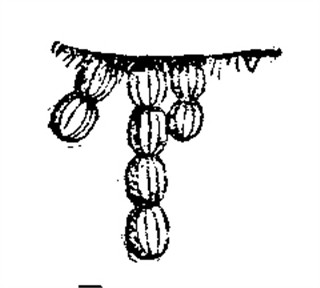 Eggs laid in string-like clusters on the underside of leaf. Magnified. (From Holland) The eggs thus deposited by the hibernating butterflies are likely to be laid late in May or even early in June. They hatch into caterpillars less than a week later and these caterpillars feed for about a month, when they change to the characteristic chrysalids in which they commonly remain for a week or ten days. They then emerge as the summer brood of butterflies, most of them in New England appearing during July. These remain upon the wing for several weeks, the females laying their eggs upon the elm and hop leaves. These in turn soon hatch into caterpillars that change to chrysalids in August and emerge as butterflies late that month or during September. This autumn brood of butterflies is quite abundant for a time but soon seeks the seclusion of winter quarters to remain until the following April. There are thus two distinct broods during the year in the Northern states while as far south as West Virginia there are likely to be three broods. These caterpillars at first simply eat small holes in the green substance of the leaf, but as they become larger each takes un its abode on the under surface of a single leaf and makes a sheltered tent in somewhat the same fashion that the Painted Lady does upon the nettle leaf. The caterpillar eats out more or less of the base of the blade on each side of the midrib, thus weakening the edges so that they can be fastened in a tent-like manner by silken threads. This serves as a resting place from which it sallies forth to feed, commonly only toward the tip of the leaf. As a result it often eats itself out of house and home and has to crawl to another leaf and construct a new shelter. While the Comma is generally spoken of as a characteristic northern species it has a very wide range, being found from New England to Texas and from the Northwestern states to the Carolinas. It is one of those species which have two distinct forms of coloring. The winter form has been given the variety name harrisi. The butterflies of this brood are decidedly lighter in color than those of the summer brood to which the variety name dryas has been given. The latter was originally described as a distinct species by W. H. Edwards. The Change to the Chrysalis
The manner in which a larva changes to a chrysalis is second in interest only to that in which a chrysalis changes to a butterfly. There arc not a great many careful descriptions by competent observers of this process in print. One of the best of these is that by W. H. Edwards in his splendid work on "The Butterflies of North America," in which he describes the transformation of the Comma caterpillar. It is as follows: "When about to transform, the caterpillar selects a convenient place on the under side of a projecting rock, or of a fence rail, or of a weather board of the house, or the midrib of a hop leaf, and having spun a little button of pale red silk fixes the hooks of its hind legs therein and hangs suspended, head downward, in the shape of a fishhook and remains immovable for the space of twenty-four hours, no change being perceptible except in the color of the skin, which becomes partly transparent and loses its dark color owing to its gradual parting from the chrysalis within, Suddenly, and to a looker-on without any premonitory symptom, a rent takes place in the skin at the back of the head, just wide enough to allow the passage of the chrysalis, the head of which at once emerges. By a rapid contraction and expansion of the folds of the abdomen the larva draws the skin upward, successively discovering the parts of the fully formed chrysalid until at last, and in scarcely more than one minute of time, the entire skin is gathered about the hind feet. It now bends itself violently to disengage the end of the chrysalis, which is long, pointed, and hard, furnished with several little hooks, meanwhile retaining its hold of the skin by the folds of its abdomen until after a severe effort, convulsively reaching out and feeling in all directions for the object of its search, it touches the button of silk and at once grasps it with its hooks and fixes them in it securely. Then by a twisting motion it manages to disengage the loose skin which falls to the ground and the chrysalis rests. The whole process is most interesting to witness and excites renewed wonder with every repetition at the ingenuity of the means employed and the delicacy of the instinct displayed. How to strip off the skin and much more the legs by which the creature is suspended without losing its hold, and at the same time to securely fasten the chrysalis, is a problem that would seem impossible to solve; and yet this little insect accomplishes it unerringly when to fail would be certain destruction And not this species only, but the larvae of all butterflies which form suspended chrysalids, embracing the whole of the great family of Nymphalidae, that is, a large proportion of all the existing species of butterflies, undergo a similar transformation. "The chrysalis is now green in color, soft and indefensible, susceptible to the slightest injury, and for a few moments the several parts of the future butterfly may be seen and readily separated; the wings folded close and enveloping the thorax, the antennae, and proboscis stretched at length along the back; but very speedily a complete casing is formed by the exuding from parts of the body of a viscous fluid, which binds together the tender parts and covers the whole with a coating like varnish. This soon hardens and the chrysalis is ready to take its chance against injury." The Gray Comma
Polygonia progne
This butterfly is rather darker colored, especially on its under side, than the one last discussed. The silver marking takes on a little more definitely the form of an L than a comma, and the under surface of the wings is darkened by many blackish thread-like lines running across the veins. When at rest with wings closed these butterflies are very easily overlooked. Except for a difference in the food plants of the caterpillar, the life-history of the Gray Comma is very similar to that of the other Comma. The butterflies hibernate, and in spring lay eggs singly on the leaves of currants, gooseberries, and related plants. The eggs soon hatch into caterpillars that feed upon these leaves but do not make any suggestion of a nest. They grow slowly and change into angular chrysalids which disclose the summer brood of butterflies in July. These lay eggs for another brood of caterpillars which mature into butterflies in August and September. These generally go into hibernation before the middle of October, sometimes choosing simply the under side of a branch where their dark coloring, so near like that of the bark, is likely to cause them to be overlooked by their numerous enemies. The Green Comma
Polygonia faunus
The Angle-wings exhibit interesting variations in the geographical distribution of the species. Some are characteristic members of the Canadian fauna, others of the Alleghanian fauna. Some of those which are characteristic of the former are scattered south well into the latter, but the Green Comma is distinctively a northern species--being found abundantly in the great regions traversed by the trappers of the Hudson Bay Company and occurring south as far as northern New England, being very rare as far south as northern Massachusetts. It is abundant on the higher slopes of the White Mountains. As one might expect from the short seasons of the far northern regions in which this butterfly lives, there is only one brood each year. In consequence the adult butterflies live a long time. Coming from the chrysalis generally the first weeks in August, they remain upon the wing a month or more before they go into hibernation. They come from their winter quarters in May and commonly continue alive until late in June. Thus it is evident that many of these butterflies must live at least ten months as adults, an extraordinary longevity for one of these frail creatures. The caterpillars are known to feed upon the foliage of several kinds of plants. These include alder, currant, gooseberry, willow, and black birch, the last two named apparently being those most often chosen. Mr. S. H. Scudder called attention to the fact that these butterflies are able to make a slight clicking noise as they start into flight. He described his experience in these words: "Starting up a pair just at my feet on the Mt. Washington carriage road one day, I stopped abruptly to see whether they would settle again. After flying a few yards away to escape the cause of their disturbance, one turned back and dashed straight at my face, turning only when within three or four inches of my nose, and then suddenly whisked off with a distinct click as it did so, snapping its fingers, as it were, in my very face. There was no sort of doubt about this click, though if it had not been made so close at hand it would probably not have been heard. But other butterflies in the tropics have long been known to emit sounds like this, which can be heard at a considerable distance; others, including some of our own butterflies, are known to produce a rustling sound by the rubbing of one wing upon another; and movements of one sort and another have been so often observed, as of the opposite rubbing of the erect wing's in most Lycaenids, and the tremulous agitation of the wings in many different sorts when excited, as to leave little doubt that sounds made by themselves and for the advantage of warning their brethren play a not unimportant part in the lives of butterflies."
The Red Admiral or Nettle
Butterfly
Vanessa atalanta
Among the weedy plants which have been intimately associated with mankind ever since his slow upward progress in civilization began, the nettle has probably played almost as important a part as the thistle. While it lacks the winged seeds of the latter it is even more effectually protected from the attacks of vertebrate enemies on account of its irritating hairs. At any rate, nettles of various kind are widely distributed over the earth's surface, and consequently it is not surprising that the Nettle Butterfly or Red Admiral should be almost as cosmopolitan as the Thistle butterfly. The two species are closely related in structure and habits and the life-history of the one is very similar to that of the other. About the middle of May one may see in open fields and along sunny highways these Red Admirals flitting from flower to flower, or stopping occasionally upon green leaves in search of opportunities to lay their eggs. Should you observe them closely you might notice that some of them seemed frayed and worn while others seemed perfectly bright and fresh. The Life-story
Late in May and early in June these butterflies deposit their eggs upon the leaves of the nettles. As a rule only one or a few eggs are laid on a leaf, but when the butterflies are abundant many leaves upon the plant may become infested. About a week later the egg hatches into a larva, which is likely to eat more or less of the empty shell before crawling up the stem of the plant to the unfolding buds at the top. Here it makes its first nest by webbing together the still closed upper surface of a leaf not yet unfolded. It is thus able to furnish itself with protection from weather and enemies, as well as an abundant supply of succulent food. It remains in this first home about a week, then it casts its skin, still within its protection, and stays until it has recovered after the process. It now migrates to another larger, expanded leaf where it very cleverly proceeds to construct its second nest. In order to do this it weakens the midrib at the base of the leaf by biting nearly through it. Then it cuts a hole in the blade of the leaf at the base in such a way that the margins are made to droop, so that they can be fastened together with silk to form a little tent. We thus have a tent-like nest hanging down from the stem of the leaf on the under side of which the caterpillar will find shelter, while near at hand is the green tissue of the inner surface of the leaf waiting to be eaten. This improvised tent serves as the home during this second stage of the caterpillar. Here also the second moult commonly takes place, after which the caterpillar migrates to a new leaf and constructs its third nest. The rest of the story of the caterpillar's life consists of similar chapters. After each moult a new tent is formed and even the chrysalis is often hung within the last one. The eggs which were laid late in May develop into butterflies during July. These in turn lay eggs for the second brood of caterpillars most of which develop into butterflies late in August or early in September, but some of which apparently remain in the chrysalis stage unchanged throughout the winter, and mature as butterflies about the middle of the following May. This is the explanation of the fact mentioned at the beginning of this discussion that one can find late in spring and early in summer some butterflies which seem worn and frayed while others seem perfectly fresh. They are all the progeny of the midsummer brood of the previous summer, but some of them have been living as full-grown butterflies through eight long months of tempestuous weather, while others have just been disclosed from the protecting walls of the chrysalis. The world-wide distribution of this butterfly is shown in the statement that it occurs throughout Europe, and in North America from Newfoundland to Cuba and Guatemala. It is a safe guess that it is found in practically all localities where nettles grow. It is not alone the association between a butterfly caterpillar and its host plant which has been brought about during the long ages through which one generation has been succeeding another, but there have been also many developments of similar associations between the caterpillars and their parasitic enemies. The Red Admiral is a good example of such a development. During its long growth as a species it has been exposed to attack by vast numbers of tiny foes which live at the expense of other insects. Several of these foes have found in the bodies of the caterpillars good opportunities for growth, so that now the Red Admiral, as a species, has to reckon with many enemies among these tiny parasites. The interaction between caterpillar host and uninvited parasitic guest has much to do with the great irregularity in the numbers of the butterflies. It is simply another example of that complicated struggle for existence, by means of which nature keeps ever a fairly even balance of her myriad forces. The Painted Beauty
Vanessa huntera
One of the most interesting phases of the study of butterflies is to learn how often they take advantage in their life-history of any peculiarity of the food plant which has a protective value. The Painted Beauty is an excellent illustration of this. The caterpillar feeds upon the leaves of the common Everlasting or Gnaphalium. This is an abundant and widely distributed plant, found along roadsides and in fields and pastures. It is notable for the woolly covering on stems, leaves, and flowers--this dry, hairy surface being so evident that the flowers will apparently continue in blossom when they have dried, hence its common name Everlasting or, as the French call a similar flower, Immortelle. (See plate.) The utilization of the hairs upon the leaves is begun by the mother butterfly when she lays her egg upon the upper surface, pushing it down among the hairs so that it is almost concealed. Should you be fortunate enough to find one of these eggs you would see that it is a small, yellowish green object, looking like a tiny barrel with several vertical ribs upon its surface. A few days after the egg is laid it hatches into a minute caterpillar that begins eating off the hairs where they are attached to the leaf, in such a way that it soon has a free space beneath a bunch of these hairs which it has more or less matted together by means of silken thread. The little caterpillar has thus provided for itself a protecting nest that effectually conceals it from birds or other enemies. It now begins feeding upon the succulent surface of the rather thick leaf, where ii has removed the hairs. After several days of such feeding it moults, still under the shelter of its hairy covering. This process of moulting and feeding continues for two or three weeks, the caterpillar occasionally making a new covering as needed for its food supply. The later nests are likely to be made by folding two or three leaves together, binding them with silken thread. The caterpillar in doing this takes advantage of the fact that the terminal leaves are vertical before they have spread out, so that it is a comparatively simple matter to make a little house by binding their edges together with silken threads. The larva feeds upon the inner walls of the house it thus constructs, and as it becomes larger the buds and blossoms are also utilized for food. When the caterpillar is full grown it thus finds itself fairly well concealed within a very substantial sort of a home. Many of them have the apparent good sense to realize that this is as safe a place as they are likely to find for shelter during the period of the chrysalis. So the caterpillar makes the nest especially secure near the centre of what might be called the ceiling and in this web it entangles its hind legs and hangs downward, preparatory to changing to the chrysalis. A few hours later the skin splits apart and is wriggled off, leaving the chrysalis hanging in place of the caterpillar. About a fortnight later the butterfly emerges and crawls at once to the outside of the nest, where it rests quietly while its wings expand and its tissues harden. Then it flies away in search of the nectar of thistles and many other flowers which it visits freely. This Painted Beauty is a wonderful example of harmonious coloring. The general tone of the upper surface of the wings is fulvous, with some distinct white markings on a blackish background at the outer angles of the front pair. There is also more or less blackish shading on the base and margin of all the wings with an indistinct row of about four dots, more or less run together, near the margin of the hind wing. The under surface of the wings is even more beautiful than the upper, and furnishes a striking example of flower-picturing. There is a little fulvous background near the middle of the front wings, but the rest of the surface is spotted and striped with blotches and circles of gray and brown in a most intricate design. On each front wing near the outer angle are three indistinct eye-spots in a row, and on the outer half of each hind wing there arc two bull's-eye circles, one smaller than the other, which form the most conspicuous feature in the marking of the insect. When full grown the caterpillars are a little more than an inch long with a general color of velvety black, marked with fine yellow lines and more or less covered with bristly spines. There is also a distinct row of whitish spots along each side beginning a short distance back of the head. This is a widely distributed butterfly, occurring from Canada to the Southern states and beyond. In most northern regions it seems to be two-brooded, the butterflies commonly hibernating as adults; but sometimes the winter is passed in the condition of the chrysalis. Along its southern range there are three and perhaps four broods each year. The Painted Lady or the
Cosmopolite
Vanessa cardui
Our story of this beautiful butterfly ought really to begin with that of one of the most successful plants in the world. Now a plant is successful from its own point of view when it is able to multiply abundantly in many different sorts of situations and to spread easily over a large area. The plant I have in mind is the thistle, which from time immemorial has been one of the commonest neighbors of man. It is found over the whole habitable globe, as well as in many parts which are scarcely habitable. It has many advantages in its struggle for life The roots penetrate deeply into the soil; the thickened, spiny leaves are so protected by their juices and their spines that they arc molested by very few enemies; the flower stalks are also clothed in a similar armature; and the great heads of flowers are surrounded with prickly involucres that generally prevent their being eaten by browsing animals or even by phytophagous insects. The brightly colored blossoms are abundantly provided with nectar and pollen, and they attract great numbers of bees, moths, and butterflies, in order to bring about cross-fertilization. But all of these advantages are of little significance so far as wide distribution is concerned, compared with the feathery seeds which are produced in such abundance and so generally scattered by the slightest breath of wind that the word thistle-down has come into general use to express a lightly moving object. These airy seeds have been riding on the wings of the wind all over the surface of the earth for untold millions of years. Doubtless during severe storms they may be carried thousands of miles, and it is easy to think that one of them might readily go half-way round the world before it found a resting place. Wherever such a seed alighted and found the condition of a moist soil and slight protection, it would be likely soon to spring into growth and to start anew the development of its ancient race. The thistle, however, has not been entirely unmolested during its aeons of existence. There has been developing along with it one of the most beautiful of our butterflies which has received various scientific names and the common name of the Painted Lady, although it is also often called the Thistle Butterfly and the Cosmopolite, which latter title perhaps is to be preferred. This butterfly, however, can scarcely be considered a troublesome enemy of its host plant, for it is seldom sufficiently abundant to injure the thistle appreciably. The relation between the two is rather suggestive of that mutual toleration by which two living things develop together with advantage at least to one and without serious disadvantage to the other. The universal distribution of the food plant has led to a like distribution of the butterfly. Consequently the Thistle butterfly has long been recognized as the most cosmopolitan species of its group. (See plate.) Aside from the wide distribution of its food plant and possibly correlated with it through the diversity of climatic conditions under which the insect has developed, this butterfly is remarkable for its powers of flight. Many instances are known where it has been taken at sea long distances from land. This is due not only to the propensity of the individual for taking aerial journeys, but also to the fact that this is one of the butterflies which has the instinct to congregate in swarms and to migrate long distances when thus congregated. In 1879 such a flock started from Africa and migrated to Europe. One of the most remarkable things about this butterfly is our ignorance of what it does with itself in winter. American entomologists are agreed that the adult butterfly hibernates, but where it does so seems not to be known. Here is an excellent opportunity for some young naturalist to go scouting, hunting in board piles, under loose bark, or with a flashlight searching the interiors of hollow trees to find between November and April living specimens of this butterfly. Such a discovery would be a real service to science and should at once be made known through some scientific journal. In Europe there seems to be a belief that the insect hibernates partially at least in the condition of the chrysalis. The Life-story
While we may not know just where the butterflies have been throughout the winter, we do know that in southern New England they begin to be seen in fields and along roadsides about the middle of May. Many of the specimens then have a ragged appearance which is a pretty good indication that they came from the chrysalis the fall before and have been lying concealed through all the weeks since. These butterflies lay their small greenish, barrel-shaped eggs on the leaves of the thistle. The mother butterfly chooses the location rather carefully and deposits only one egg upon a leaf. The butterflies continue thus to visit flowers and to lay eggs until about the middle of June when apparently they perish. About a week after the egg has thus been laid, it hatches into a small spiny caterpillar which does not take the trouble to devour its egg shell as so many other caterpillars do. Instead it crawls around to the lower side of the leaf and gnaws off enough of the silken surface of the leaf to furnish material for making a webby covering, the leaf particles being woven together by threads from the caterpillar's mouth. In this way the little creature soon provides itself with a snug enclosure which serves it as a temporary home. It remains in this home much of the time when not eating, going out occasionally to feed upon the green tissues of the adjacent parts of the leaf. This first home of the young caterpillar, made as it is as a flat blanket upon a flat surface, can be used only by a very small larva. Consequently, the caterpillar soon finds these quarters too cramped and it deserts them to make a new home with larger space. This second nest is commonly made on the upper surface of a leaf, the edges of which are likely to be more or less drawn together and other supports connected from other leaves or a near-by stem. The caterpillar continues to use this nest number two as a place for remaining when not feeding and for protection during the process of moulting. But even this larger nest is likely to be given up about the time the caterpillar becomes half grown, and a third nest is begun in the upper part of the plant. This is likely to be very commodious, its walls being made of leaves or stems bound together by a silken web. Within this the caterpillar completes its growth, going out and in through one or more doors when it wishes to feed. Sometimes it even remains within this nest during the process of changing to the chrysalis, hanging downward from the upper part in much the same way that the caterpillar of the Fainted Beauty butterfly does. In ease it leaves the nest when fully developed it generally finds a place near by in which to pupate. About ten days after the caterpillar has changed to a chrysalis it changes again to the adult butterfly. In southern New England these butterflies appear about the middle of July and lay eggs soon afterward, these eggs hatching into butterflies that change to chrysalids and change again to butterflies late in August or early in September. This autumn brood doubtless furnishes the butterflies that will be seen upon the wing the following May, so that it is pretty certain that they must find some shelter in which to pass the intervening months. The full-grown caterpillar of the Thistle butterfly is about one and a quarter inches long and of a general yellowish color, more or less marked with blackish as well as with paler lines of color. There are many transverse rows of spines along the segments, each yellowish spine having a circle of smaller ones at the top. Notwithstanding its fondness for thistles, these caterpillars occasionally feed upon various other plants. One might readily expect them to be able to live upon other composites upon which they are found, but it seems a bit strange that they should be recorded as being "especially fond of mallows." The Mourning-cloak
Vanessa antiopa
One of the most scholarly students of American insects has happily called the butterflies "the frail children of the air." It seems a fitting term for creatures so ethereal that they are readily wafted on the wings of the slightest breeze and so delicate in structure that they are likely to be sadly mutilated by the lightest touch of human hand. Such creatures one would say belong to regions of perpetual summer and have no place in the blizzard-swept winters of our Northern states. Yet if one goes into the snow-clad woods during one of the midwinter thaws one is likely to see in every open glade several dark-colored butterflies flitting from tree to tree, or resting with expanded wings in the sunniest spots. These butterflies obviously have endured the coldest weather and if they are to survive until another season must continue to endure still more. This species is commonly called the Mourning-cloak butterfly--not a particularly happy name for so beautiful an insect. In England it has the more suggestive title of Camberwell Beauty, and country boys are said to call it the Yellow Edge butterfly. Its general life-story has already been told on pages 112-115. The caterpillars of the Mourning-cloak butterflies are restricted to comparatively few food plants. In regions where they are not especially abundant, they are likely to be found upon willow, poplar, or elm. In general, as many observations indicate, they are as likely to be found upon any one of these food plants as upon either of the other two; but in certain localities where they become especially abundant it seems that they are more likely to occur upon the elm. On this account they have been called the Spiny Elm caterpillars. There is considerable evidence to show that they prefer the American elm to other species of the genus, although in the case of willow and poplar there seems to be little if any preference as to the species. Miss Caroline G. Soule has seen the butterflies depositing their eggs upon the white and canoe birch, and it has been recorded as feeding in Labrador and Europe upon a species of birch. There is one record of the caterpillars having been found feeding upon the hackberry, and also of their having fed greedily upon the leaves of rose bushes, and still another of their having almost defoliated a pear tree. Linden and nettle are also included in the European lists of the food plants of this species. (See plates.) It is evident, however, that all of these, except the three first named--willow, poplar, and elm--are to be regarded as exceptional cases, and that the normal food of the species is the foliage of a plant belonging to one of these three genera. It has generally been supposed that this species is double-brooded in central and southern New England, the butterflies of the first brood appearing early in July. These are said to deposit eggs which hatch into caterpillars that mature into butterflies early in September. These butterflies live through the winter, laying eggs the following spring. It is very probable that as far north as southern New Hampshire the species is commonly single-brooded. During one season when the caterpillars were unusually abundant, a very careful watch was kept for the second brood in New Hampshire and Vermont by several competent observers. Only one colony of caterpillars was found and this was at Durham in the southern part of New Hampshire near the seacoast. Consequently, it seems safe to conclude that in northern and central New England, at least, a single brood is the rule rather than the exception. This involves the conclusion that the butterflies seen upon the wing early in autumn are the same ones that developed in July, and that these same butterflies remain alive through the winter and until, in the following May, they lay their eggs. Thus there is a period of ten months of existence in the butterfly state, an extraordinary length of time for a butterfly to live. To a large extent the butterflies disappear in August, and the question arises as to what becomes of them. Our observations lead to the conclusion that they go into summer quarters similar to those which they seek out for winter shelter. Apparently they fly about for a few days after coming from the chrysalis and then retire to cool woods, where under the side of a log or beneath the loose bark of a dead tree they settle down and to all appearances go to sleep. The instinct to remain quiet is very strong in these butterflies. In taking the accompanying photographs, I found that even shortly after coming from the chrysalis the butterflies when disturbed would fold their wings with the antennae between them and drawing the legs against the body would lie quietly on their sides for a long time. These same butterflies would also hang downward from a limb by the hour in the hibernating position as shown in plate opposite page 32. In the cooler weather of early autumn, the butterflies come from their retreats and fly about in the sunshine. They are especially likely to be seen along the borders of woods or in open glades. At this time they love the sunshine, and will settle in a sunny place to bask in it. Going into Winter Quarters
When the warm days no longer tempt them abroad, the Mourning-cloaks seek shelter in many sorts of situations-under loose bark, in hollow trees, under culverts and bridges, in woodpiles, in crevices of rocks, or alongside logs lying on the ground. In such retreats they remain until the sunshine of spring again calls them forth. Prof. G. H. Parker's observations indicate that these butterflies are very sensitive to changes of temperature, and he has seen the interesting action of the butterflies crawling into their hiding places, finding that this takes place each day after they had been sunning themselves. Thus he writes: "These butterflies remain during cool spring nights in places similar to those in which they hibernate in winter, viz., in openings in stone walls, in old out-houses, in openings under the bark of trees, etc. They retire to these places with considerable regularity, so that in the open woods, where dozens of individuals may have been seen flitting about, all may have disappeared a quarter of an hour later. I have watched their retreat with some care. On a clear afternoon in early April I took my stand in a woodland where many Mourning-cloak butterflies were on the wing. They continued actively flying about till approximately four o'clock, when I began to notice a diminution in their numbers. By a quarter past four not a butterfly was to be seen. During the fifteen minutes from four o'clock on I followed two to their hiding places. One alighted on the front of a fallen tree and without expanding its wings crept immediately into a large crack in the bark. The second settled on a stone fence and crept into a hole between some loose stones. The period during which this occurred was marked not so much by a diminution of light as by a rapid fall of temperature." That the habit of lethargy in cold and of resting upon the bark of trees is practically universal with this species is shown by a statement quoted by H. G. Adams in his book, "Beautiful Butterflies," published in England in 1871. The writer quoted says: "in a wood on the summit of the Drachenfels, when the wind was rather keen, I found numbers resting on the backs of fallen trees in a state of stupor. They made no attempts to escape and when thrown into the air their wings barely opened or flapping feebly eased their fall or enabled them to seek repose on the stem of a rotten trunk." Its Rarity in England
In many books this species is spoken of by its English name Camberwell Beauty. It is so called because it was first observed in the neighborhood of Camberwell in the county of Surrey, England. It seems that in that country it is a very rare species. This is a bit curious considering the fact that in America it is so extremely abundant. In his attractive little book quoted above, Mr. Adams begins the discussion of this species with this statement: "This is the crowning glory of the British butterfly collector's cabinet, and a happy man is he who gets a perfect specimen of an insect which is at once so rare and so beautiful." And later in the same discussion is this further statement concerning the scarcity of the species: "In neither the larva nor the pupa state has the insect been found, we believe, in this country where its appearance occurs, except just here and there a single specimen or two, at long and uncertain intervals. About eighty years ago it was seen in many parts of the kingdom and again in 1819, but not since then although almost every year one or more specimens are taken or seen." A curious fact in regard to the Mourning-cloak, as found in England, is that the border around the wings seems to be much more generally white than it is with us. J.O. Westwood in his book on British butterflies describes the margin as of a white or whitish color and other writers speak of the same fact. Kirby in his "Butterflies and Moths" makes this comparative statement: "The border is whitest in British specimens, and perhaps yellowest in American ones." He speaks of it also as one of the rarest British species. It is sometimes called by the common name the White Border and also occasionally the Grand Surprise, appellations which bear out what has been said above both in regard to the color of the border and the rarity of the insect. The
Mourning-cloaks subsist upon a considerable variety of liquid food
which they suck through their long tongues. In spring, when they first
come from their winter quarters, they visit the stumps of recently cut
trees and suck the exuding sap, a habit which they continue whenever
opportunity offers. Mr. W. P. Fiske has noticed that they commonly sip
the sap of maple twigs where the squirrels have gnawed the bark. A
little later they visit the willow catkins to suck the nectar secreted
by these blossoms, and still later they hover about the delicate
blossoms of the mayflower, or trailing arbutus, for a similar purpose.
Probably many other flowers are thus rifled of their sweets, although
this butterfly seems to be a less regular visitor to flowers than are
many of its allies. A little later, when the aphids, or plant-lice,
have become sufficiently abundant so that the so-called "honey dew" is
to be found upon the infested shrubs, these Mourning-cloaks sometimes
sip the liquid sweet from the surface of the leaves. In April and May
they occasionally visit the flowers of moosewood, and later in the
season have been observed upon the blossoms of the common milk.. weed.
From the time the early apples ripen these butterflies may often be
seen beneath the orchard trees, sipping the liquids of the fallen and
decaying fruit.
The Parasites of the Egg.
One fine spring morning I came upon a Mourning-cloak depositing a cluster of eggs upon a willow twig. She was so busily engaged that I was able to draw near and watch the operation for some time before she flew away. As soon as she was gone I was much interested to see a tiny parasitic fly running eagerly over the newly laid eggs, and this fly also was so busily interested in her work that I was able to cut the twig off and sit down to observe at leisure through a lens the actions of the insect. I dictated to a companion my notes of these observations and so was able to get rather a complete record of the process of oviposition. The tiny fly would stop over one of the butterfly eggs, holding its body vertical with the hind legs far back and the other legs so straightened out as to hold the front of the body high up. Then it would insert its tiny ovipositor through the egg shell and proceed to deposit an egg of its own inside of the larger egg of the butterfly. At least it seemed a safe assumption flint this was what happened although of course it was impossible to see the smaller egg at the time. While thus engaged the antennae of the tiny fly were bent directly downward to the egg beneath. In about a minute the fly withdrew its ovipositor and after running around for a few seconds again settled upon another egg and repeated the operation. Then it tried again on a third egg, after which I got out my watch and began timing the process. These are the results in the case of the next dozen eggs that were laid. It required:
It thus required an average of about two minutes per egg for the laying of these fifteen eggs. I then caught the little fly and sent her to Dr. L. O. Howard, our greatest authority on this group of insects, to learn the name of the parasite. He identified it as Telenomus graptae, a well-known parasite of the eggs of the Mourning-cloak and related butterflies. The most interesting thing about this observation was the fact that the little fly had apparently begun its operation before the mother butterfly had finished laying her cluster of eggs. There were thousands of willow twigs in the immediate vicinity. How did this tiny creature arrive at this particular place at the particular moment when from its own point of view it was most needed? Had it been riding around upon the body of the butterfly waiting for the time when she should lay the eggs? Or was it attracted to them from somewhere in the immediate vicinity? That this early arrival probably takes place generally is indicated by the fact that a similar observation had been made in the White Mountains by Prof. C. W. Woodworth. The history of the egg parasite after the laying of the egg seems to be comparatively simple. It soon hatches into a tiny larva that develops within the shell at the expense of the contents. It finally changes to a pupa which in turn changes to the little fly that gnaws a hole through the egg shell and emerges to the outer world. The Parasites of the
Caterpillars
After hatching from the egg, the Mourning-cloak caterpillars are also subject to the attacks of various parasites. One of these is quite minute, not a great deal larger than the egg parasite. It is a tiny four-winged fly which deposits many eggs in a single caterpillar. The eggs hatch into tiny maggots that grow at the expense of the caterpillar, finally killing it and changing to four-winged flies again. As many as 145 of these parasites have been known to emerge from a single dead caterpillar. These little flies are called Chalcids by entomologists. There is still another group of four-winged flies, some of which attack the Antiopa caterpillars. These are much larger than the Chalcid flies and are called Ichneumon flies. In the case of these, only one or two parasites develop in each caterpillar or chrysalis. In addition to these various four-winged flies, there are certain two-winged flies, called Tachinid flies, that develop at the expense of the caterpillars. In New Hampshire, during recent years, these appear to have been the most abundant parasites of these insects. An egg is laid on the skin of the caterpillar by a two-winged fly, similar in general appearance to the figure below. The contents of this egg shortly develop into a tiny grub that burrows through the egg shell and the skin of the caterpillar into the inside of the body. Here it remains, absorbing the body substance of its host and gradually increasing in size. In a few weeks it becomes fully developed in this grub state. By this time the caterpillar has become sluggish from the effects of the parasite. If the branch upon which it feeds is disturbed, the other caterpillars are likely to crawl away, but the enfeebled victim remains in its place. Shortly after becoming full grown, the Tachinid grub breaks through the skin of the dying caterpillar and, falling to the ground, changes to a peculiar pupa; the outer skin of the grub turns brown and becomes hard, forming a protective covering for the body inside. A week or two later the insect undergoes another change and emerges as a two-winged Tachinid fly, like the one that laid the egg some weeks before.  Tachinid Parasite. Other Enemies
Besides those insects that develop on the inside of the bodies of these Antiopa caterpillars there are other insect enemies which attack them from the outside and devour them bodily. The most notable of these, perhaps, is a large beetle commonly called the Caterpillar Hunter; it is known to entomologists as Calosoma scrutator. This is a very active insect, with large strong jaws, that runs rapidly about in search of victims. In some cases it has been observed while destroying many of the Antiopa larvae. In the Southern states a common reddish wasp--a species of Polistes--has also been observed attacking these caterpillars, and there are probably various other insects that destroy them, although definite observations showing this have not been recorded. The Antiopa caterpillars are such spiny creatures that comparatively few birds attack them. They are devoured, however, by the two species of cuckoos--the yellow-billed and black-billed--and it is probable that they are sometimes killed by Baltimore orioles and various other birds. They are also greedily devoured by toads, but of course they do not often come within the reach of these useful animals. Even the adult butterflies of this species have to be on the lookout for enemies. During the long months of their life many of them probably succumb to the attacks of birds or other creatures. I have seen but one such tragedy. While riding along a country highway with a bird-loving friend one spring day we saw a male Maryland yellow-throat flit by with a Mourning-cloak in his mouth. The bird lit on a fence, from which I startled him so that he dropped the butterfly, a worn and faded, half-dead specimen. The places where the bird held the insect were indicated by missing pieces of the wings. The American Tortoise-shell
Aglais milberti
This beautiful butterfly is one of the most distinctive of all our species. It is of moderate size, its wings rarely expanding more than two inches, and it has sufficiently irregular outlines to indicate its relationship with the Angle-wings. The most striking feature of the upper surface is the broad band of orange-brown extending clear across both wings a little inside the border. The remaining surface is a darker brown marked with two orange-brown spots near the front margin of each front wing and having scattered iridescent scales which show plainly under a lens, The suggestion of the coloring of a tortoise-shell is easily seen in these rich brown tones. The under surface is a wonderful illustration of protective coloring. With wings closed and resting against the bark of trees or lying beneath the trees among fallen leaves, it would require a keen eye to detect the insect. (See plates.) The American Tortoise-shell is distinctly a northern species. North of latitude forty-three degrees it seems to occur practically from ocean to ocean, extending far up toward the arctic region. It is commonly found in British America as far north as Fort Simpson in latitude sixty-one degrees. There are specimens in the British Museum collected by the explorer Ross in arctic America, and there are many in our own National Museum collected in the Hudson Bay region by various American explorers. In New England the species is abundant at times in New Hampshire, Vermont, and Maine. In the vicinity of New York City and Buffalo, New York, it is rather rare. And south of this latitude it is found chiefly at the higher elevations in mountainous districts. As a rule it is likely to vary in numbers from year to year, sometimes being extremely abundant while more commonly it is rather rare. These are the same sorts of fluctuations that we find in the ease of the Mourning-cloak, the American tent caterpillar, and various other insects whose larvae live in colonies. The variation is probably due to the fact that when the caterpillars become unusually abundant they become correspondingly conspicuous and so provide a shining mark that is soon discovered by their insect enemies or by various fungous diseases. The Story of Its Life
In its manner of laying eggs this butterfly differs from most others. The great majority of our familiar species lay their eggs one in a place or possibly two or three near together. Some species deposit several in a group, while some, like the Mourning-cloak, may lay two or three dozen in a cluster. Very few, however, deposit hundreds in a bunch. Two of these are the Baltimore and this American Tortoise-shell. In the case of the latter the eggs are loosely laid, hundreds together, upon the leaves of the common stinging nettle. Probably each female can deposit six or eight hundred eggs. In less than a week the eggs hatch into minute blackish caterpillars that feed upon the tender tissues of the leaf upon which they were born and then migrate together toward the top of the plant. In their habits they are quite similar to the caterpillars of the Mourning-cloak. As each walks it spins from its mouth a silken thread and the combined effect of hundreds of these threads is to make a noticeable silken web over the leaves. The caterpillars remain in colonies, feeding together from day to day and gradually denuding the upper branches of the nettle plant, leaving an unsightly silken web as a memento of their presence. This webbing is very suggestive of the similar result left behind by a colony of Mourning-cloak caterpillars upon the twigs of elm or poplar. When about half grown these caterpillars are likely to scatter more or less in accidental groups which may make small shelter tents from the larger leaves. In each little nest there may be four or five or more of the dark-colored caterpillars. From these shelter tents they sally forth to feed upon the adjacent leaves and a little later become full grown as caterpillars. Each now wanders away and finding such shelter as it is able to, spins a button of silk and becomes a chrysalis. It remains in this condition but a short time before it emerges again as the beautiful butterfly. This species is commonly reputed to have three broods a year, hibernating both as a butterfly and as a chrysalis. It has been suggested, however, by Sir. W. F. Fiske, one of our most painstaking entomologists who has studied the butterflies of New Hampshire for many years, that it is more probably double-brooded with a period of aestivation during the later weeks of summer. This seems a very probable condition and it is to be hoped that some observer will make such a careful study of this species as to settle the point definitely. In the case of many butterflies the distribution of the species coincides with the distribution of the food plant. This American Tortoise-shell, however, is perhaps the exception that may prove the rule, for its southward limit is far north of the southern range of the stinging nettle. Evidently, it is a species which has developed in adjustment to the cool climate of northern regions or high altitude, and it does not easily adapt itself to a warmer territory. The White-J Butterfly or
Compton Tortoise
Eugonia J-album
During bright days in March and April one is likely to find two kinds of butterflies on the wing in open glades of the woods. One is the familiar Mourning-cloak and the other is the Compton Tortoise the latter generally much less abundant than the former. Both make the most of the brief periods of sunshine and quickly disappear when the sky is overcast. The Compton Tortoise butterflies which are thus abroad in early spring have been in hibernation since October. They are helping to carry the species over from one season to another, and as the days become longer and warmer they appear on the wing more and more, seeking such liquid food as the field and forest yields during the days of early spring. The sap exuding from holes in bark made by woodpeckers, or from the tappings of the maple trees by man, the nectar of willow catkins, the moisture of roadside pools--these help to yield a precarious sustenance to these butterflies after their long winter fast. They remain upon the wing week after week, while spring slowly progresses in the northern regions they inhabit. When at last the leaves push out on their food trees--willow, birch, and elm--the females lay their eggs and then, having lived to what for a butterfly is a ripe old age, they die, after nearly ten months of adult existence. Apparently the eggs are laid in clusters on the twigs, although this seems to be one of the many facts about butterflies awaiting observation by some careful student. The caterpillars feed together in small colonies but make no nest. They become full gown in about a month. They are then nearly two inches long with spinous, greenish bodies, striped with lighter lines. Some change to chrysalids about the middle of June and ten days later change again to butterflies, the first of which appear early in July while others continue to emerge for nearly a month. These, butterflies may be seen rather frequently from midsummer on, visiting various flowers and sipping the juices from decaying fruits beneath the trees. At times they seem to disappear in August to reappear in October, a fact which has led some observers to suggest that there is a second brood. The caterpillars of this brood, however, have never been observed and a much more probable explanation has been made by Sir. W. F. Fiske who studied the butterflies of New Hampshire carefully for many years. He found that in the hot summer weather this butterfly goes into a seclusion similar to that of its winter rest--that is, it aestivates in summer and hibernates in winter. "The possibility that the October J-album did not represent a second brood," writes Mr. Fiske, "was rendered almost a certainty by repeated observations which failed to disclose a single specimen approximating in freshness to average August individuals, and the question of their whereabouts during the interim was unexpectedly answered one warm August day by my finding several snugly packed away under the shingles on an old roof. The theory of the aestivation of the butterflies of this group will explain a good many points hitherto obscure in the life histories of the other species." In October these butterflies seek their winter quarters, finding them in woods and groves. Apparently they commonly rest upon the bark of the trunk as well as crawl into such crevices beneath loose bark as they can find. Here they remain through fall, winter, and spring, except when called into brief periods of activity by the unwonted warmth of the winter sunshine. Then in spring they come forth again to lay the eggs for the caterpillars of the new generation. The fresh butterflies are creatures of exquisitely modulated coloring. The name Compton Tortoise has reference to the rich brown tones of the upper wing surface, suggestive of those of fine tortoise-shell. In fresh specimens much of the surface, especially in the middle and along the front border, is overlaid with iridescent purple scales. Near the front outer angle of each of the four wings there is a distinct white spot, divided near the middle by a darker line of the vein running through it. The under surface is one of the best examples of mimicry of gray bark to be found in any butterfly. The tones vary considerably in different individuals, but in all the protection must be well nigh perfect when the insect is at rest with dosed wings upon the bark of a tree. The striking angularity of the wing's border doubtless helps to conceal it, and the habit of dropping motionless to the ground when disturbed must also have protective value. Near the middle of each hind wing there is a small white J which led to the specific name J-album. This butterfly is essentially a member of the Canadian fauna. It ranges from far north in Labrador, British America, and Alaska, south as far as Pennsylvania, but toward its southern limit it occurs only on the higher elevations of mountains like the Alleghanies. The Buckeye
Junonia coenia
Some genera of butterflies seem to belong almost exclusively to the north temperate regions, seldom occurring even in our Southern states. Others belong equally exclusively to tropical regions, seldom straying into the north. The Buckeye is an illustration of the latter group. The genus Junonia to which it belongs is essentially tropical, as it contains several species which are found throughout the tropics in both the Old and the New Worlds. In fact, this is apparently the only species which occurs north of the tropics. It has an extraordinary range, being found from Cuba to Massachusetts and from the Atlantic to the Pacific coasts. Toward the northern limits of its range it is very rare and one of the greatest prizes which the collector can obtain. In our Southern states it is an abundant and generally distributed butterfly and, as it hibernates as an adult and one group follows another throughout the season rather rapidly, it is likely to be taken at almost any time. (See plate.) The mother butterflies select as food plants for the larvae various members of either the plantain or figwort families. They lay eggs, one in a place, upon the leaves of plantain, figwort, gerardia, and related plants generally near the tip of the leaves. Less than a week later these hatch into spiny caterpillars which feed upon the green substance of the leaves during the next few weeks. Fer the most part they eat between the veins leaving a ragged effect which may help in finding them. When full grown they change to chrysalids which hang straight downward and bear a general resemblance to those of the Thistle butterfly. Curiously enough, those chrysalids which are attacked by parasites take on a characteristic golden hue; although the normal healthy chrysalids are dark brown with a few touches of a decidedly lighter brown. In its tropical home, where there is no winter period to interrupt its growth, this butterfly doubtless continues to develop generation after generation without any break in the sequence. As the species goes north, however, there is necessarily such an interruption--in which case the winter seems commonly to be passed by the adult butterfly. In our Southern states there are commonly three or four broods each year, while in the northern parts of its range there is but one brood a year. In the South there is such an overlapping that all stages of the insect may be found at one time. Synopsis of the Angle-wings
I. The Polygonias
The most angular of the Angle-wings are grouped in the genus Polygonia. They are characterized by having the outer margin of the front wings projecting in two places in a way to give an angular effect, and by having the hind or inner margin distinctly excised toward the outer end, so that this margin is curved rather than straight. Violet-tip (Polygonia interrogationis or Grapta interrogationis). Expanse 2 ½ inches. Under surface of each hind wing marked by a silvery semicolon, made up of a dot and a crescent. Hop Merchant (Polygonia comma or Grapta comma). Expanse 2 inches. A white comma with expanded tips on lower surface of each hind wing. Lower surface of all the wings mottled with brown. Green Comma (Polygonia faunus or Grapta faunus). Expanse 2 inches. A white comma with expanded tips on lower surface of each hind wing. The lower surface of all the wings more or less mottled with green toward the margins. Gray Comma (Polygonia progne or Grapta progne). Expanse 2 inches. A white comma with tips narrowed rather than expanded on lower surface of each hind wing. II. The Vanessids
Our beautiful species of the genus Vanessa may be known by the long scales that make up the fringe on the wing margins, in alternate groups of black and white. There are also several white spots on the upper surface of the outer angle of each front wing. Red Admiral (Vanessa atalanta, Pyrameis atalanta or Cynthia atalanta). Expanse 2 inches. Upper surface of front wings blackish, marked with white spots on outer angle and a broad orange stripe across the middle. Painted Beauty (Vanessa huntera, Pyrameis huntera or Cynthia huntera). Expanse 2½ inches. Upper surface orange-brown with black, white, and blue markings. Lower surface of each hind wing with two large eye-spots, each extending across two veins. Painted Lady or Cosmopolite (Vanessa cardui, Pyrameis cardui or Cynthia cardui). Expanse 2 ½ inches. Easily distinguished from the Painted Beauty by the four or more small eye-spots on the lower surface of each hind wing, each eye-spot being included between two veins. III. Other Angle-wings
The other common Angle-wings are readily distinguished by the following characters: Mourning-cloak (Euvanessa antiopa or Vanessa antiopa). Expanse 3 ½ inches. Easily known by the nearly black wings with creamy white borders. American Tortoise-shell (Aglais milberti or Vanessa milberti). Expanse 1½ inches. One of the smallest of the Angle-wings. Easily known by its small size and the broad orange band extending across the upper surface of all the wings just beyond the middle. Under surface dark mottled gray without distinct white markings. Compton Tortoise (Eugonia j-album, Vanessa j-album or Grapta j-album). Expanse 3 inches. Best known by the straight line of the inner margin of the front wings and the white j on the under side of each hind wing. The Buckeye (Junonia coenia or Vanessa coenia). Expanse 1 ¾ inches. Distinguished by the large eye-spots on the upper surface of the wings, one on each front and two on each hind wing. Eyes not hairy.
THE TRIBE OF THE SOVEREIGNS
No other small group of American butterflies has attracted so much attention as the species of the genus Basilarchla, which have been happily called the tribe of Sovereigns. These are rather large butterflies with rounded wings which are found in one species or another over practically the whole of North America. Some of them are of exceeding beauty and all of them present life-histories of extraordinary interest. At least two of the species are the most notable examples of the mimicry of other butterflies that are shown in our fauna. They also present some extremely interesting problems for the study of natural hybrids and they illustrate in their development some of the most wonderful cases of adaptation to environment that have ever been found. These butterflies may be considered from so many interesting points of view that it is a bit difficult to know which phases to emphasize. In general, there is a striking similarity in their structure and habits in the earlier stages. The eggs are very nearly alike; the caterpillars resemble one another so closely that even expert entomologists sometimes have to decide what species a collected caterpillar belongs to by seeing what plant it is feeding upon, and the chrysalids are also very similar. Some of the more interesting phases in the development of these insects are discussed in connection with the life-stories of the different species. A phase which is characteristic to all of them may well be emphasized here. From the time the caterpillars hatch until they change to chrysalids they illustrate to a marked degree an adaptation through structure and habit which must very largely protect them from attack by birds and other enemies. Their structure and markings are almost grotesque. The body is covered with strange club-like appendages and it is colored with a curious mottling of tones of green, drab, brown, and white which is very difficult to describe but which suggests, as the caterpillar rests upon rough bark, simply a bit of bird dung or some natural excrescence. The caterpillars have the habit of feeding at night and remaining upon their perches by day, often assuming positions which are very unusual among insect larvae. Such positions, in which they remain motionless for hours at a time, are undoubtedly of protective value and help to conceal the insect. After the caterpillars are half grown they rest not upon the leaves upon which they feed, but rather upon the bark of twigs or branches where their peculiar structure is likely to make them inconspicuous. The chrysalids of the Sovereigns are also curiously mottled in color tones that will probably lead to their being overlooked. Three distinct species of Sovereigns are found in eastern North America, namely: The
Viceroy, Basilarchia archippus.
The Banded Purple, Basilarchia arthemis. The Red-spotted Purple, Basilarchia astyanax. The first species, the Viceroy, has a much wider distribution than either of the others. It apparently is found in nearly all localities in which either of these occur, and so includes within its range almost the whole of the United States and much of Canada. The second of these, the Banded Purple, is a northern form. It is found commonly at least as far north as the Mackenzie River region in British America and southward to central Massachusetts. It also occurs as far west as Nebraska so that it has a very wide distribution in northern regions. It is especially abundant in Canada and the White Mountains. The third, the Red-spotted Purple, is the characteristic form south of latitude 42 degrees. Its range overlaps that of the Banded Purple for about one degree but it is seldom found north of latitude 42 degrees. It seems to range about as far west as the Banded Purple. There are several other butterflies belonging to this genus which are rarely found and which occur only in certain limited regions. There has been much discussion in regard to these. Some entomologists have thought them simply varieties or dimorphic forms while others have considered them hybrids. An analysis of the conditions shows that these doubtful butterflies occur only in regions where the different species overlap. Thus in the boundary connecting the Banded Purple and the Red-spotted Purple there are forms which resemble these two species in such a way as to suggest that these are the parents of the hybrid. In localities where the Viceroy and the Banded Purple occur there are other forms which seem to connect these two species, and in the locality where the Viceroy and the Red-spotted Purple occur there are still other forms which seem to suggest these as the parents. So the evidence seems pretty conclusive that where these butterflies overlap there are likely to be occasional crosses between the species which result in these natural hybrids. In the far Western states there are certain other species of Basilarchia which take the place of the eastern form. One of the most abundant of these on the Pacific Coast is sometimes called Lorquin's Admiral (B. lorquini). In Florida there is another species, B. floridensis, which is found in the Southern states. It is the only one whose coloring resembles that of the Viceroy. The Viceroy
Basilarchia archippus
The common name of this butterfly was probably giver it in allusion to its resemblance to the Monarch butterfly. For the Monarch and the Viceroy have been closely associated in the minds of many observers ever since people began to study butterflies in America. These two insects have become famous as the most notable examples that we have of the mimicking of one butterfly by another. According to the theory which has been held by many naturalists, the Monarch is distasteful to birds and other animals and it advertises the fact by its bright combination of brown and black. The Monarch is thus an example of what has often been called warning coloration. On the other hand, the Viceroy is commonly supposed to have no objectionable taste when eaten by birds, but it so closely resembles the Monarch in its color pattern and its habits of flight that it has been assumed that birds would not touch it because of its resemblance to the distasteful butterfly. There has, however, recently been a reaction among naturalists in regard to the validity of many supposed examples of warning coloration and the whole subject is still open to careful investigation. (See cover; and plate.) Whether the Viceroy deserves its celebrity as an insect mimic or not, it is well worthy of study for other reasons. It is a common and attractive butterfly and it has most interesting habits in the larval state, it is found over a large part of North America and flies freely from spring until autumn over meadows, fields, and open glades. The Yearly Cycle of Life
To trace the yearly cycle of this butterfly's life, let us begin with one of the mother insects flitting along a stream in early summer. She stops now and then to lay an egg on the tip of a leaf on a willow or poplar. She then continues on her way occasionally sipping nectar from any early flowers she may chance to find, and continuing her leisurely life perhaps for several weeks. The egg thus laid upon the poplar leaf remains in position for a week or more, unless it should be devoured by some wandering ant or discovered by some tiny parasite. If it escapes these dangers, it hatches into a minute caterpillar that escapes from the egg shell through a hole in its side. After it has come out it turns around and eats the remainder of the shell. It then begins feeding upon the tender tissue of the leaf it is resting upon, nibbling at the sides until its appetite is satisfied. Then it retires to the midrib on the lower surface where it remains quietly through the day and thereafter feeds chiefly at night. After about a week it becomes too large for the skin with which it was born, so it moults and immediately devours its cast skin. It continues these operations of feeding and moulting at occasional intervals for several weeks, finally becoming a rather large and curious looking caterpillar, mottled in greenish olive and light gray, with two large horn-like projections from the front of the body. It finally becomes full grown in this larval state. Then it spins a web of silk upon the bark of the twig and entangles the hooked claws of its hind legs in the silken web. It thus hangs downward until the larval skin is shuffled off and the curious pupa with the conspicuous hump upon the middle of its back remains in its place. This chrysalis is of a mottled coloring, very similar to that of the caterpillar. A week or so later the chrysalis skin breaks open, and the butterfly comes out, catching hold of the twig with its legs and hanging quietly in position while its wings expand. The butterflies of this brood are likely to appear late in summer. It is the second breed of adult butterflies for the season. These insects have the same leisurely habits as those that were on the wing earlier in the season. In a similar way the mother butterflies lay their eggs on the leaves of willows and poplars, and these eggs soon hatch into young caterpillars that look like those that hatched in early summer. The caterpillars, however, of this autumnal brood have a most interesting habit which was entirely lacking in those of early summer. Soon after hatching they begin to make for themselves little houses in which to pass the winter. This is very cleverly done by utilizing part of the leaf upon which they are feeding. Each side of the leaf toward its tip is eaten off with the midrib remaining untouched; then the lower half of the leaf which has not been eaten is rolled into a tube and securely sewed together with silken threads. The stem of the leaf is also covered with a similar silken web and securely fastened to the twig in such a way that it is impossible for the leaf to fall off when the other leaves do. The little caterpillar thus cleverly provides itself with a safe winter home into which it retreats on the approach of cold weather to remain until spring. They enter these little cases head first, and apparently seldom emerge again until the warm spring sun brings them forth to feed upon the developing willow catkins or the unfolding leaves. The caterpillars that thus pass the winter in these pitcher-like cases are perhaps a third grown. They develop rapidly in spring and are likely to use the eases for resting purposes when they are not feeding. After a few weeks they become full-grown caterpillars and change to chrysalids, to change again a little later into the butter. flies that appear in early summer. There are thus two broods of each stage of the insect during the year. Curious Caterpillar Habits
This brief summary of the yearly history of the Viceroy is by no means adequate as a story of the many interesting things to be told about this insect, which has been carefully studied by several eminent naturalists. One of these is the strange habit the very young caterpillars have of fastening a few bits of leaf together by means of silken threads and then tying the bunch to the denuded rib of the leaf. To explain this, allow me to quote from an admirable essay of the late Samuel H. Scudder, whose studies of butterflies have added so much to our knowledge of these beautiful creatures: "Soon after birth," wrote Mr. Scudder, "when it has eaten but a very few swaths down the leaf, the little fellow constructs a small and loose packet from minute bits of leaf and other rejectamenta, loosely fastened to one another and to the midrib, close to but scarcely touching the eaten edge of the leaf; and as fast as the leaf is eaten, it removes this packet (continually added to until it becomes almost as big as a small pea) farther and farther down the midrib away from its perch, always keeping it near the eaten edge. It should be noted that it is so loosely attached(the bits of leaf at all possible angles) that it is moved by the least breath. Meanwhile, the caterpillar has been growing larger and more conspicuous, and thus in greater peril from its enemies. There are two possible services that this odd packet may render. A spider wandering over a leaf and observing its motion may seize it, and thinking it has a prize, hurry away with it and leave its architect unharmed. This seems to me rather a strained suggestion, for a wandering spider would probably proceed to investigate it on the spot. Another explanation seems more probable. It should be remembered that the leaves preferred by these creatures as food are mostly such as are easily shaken by the wind, and as the caterpillar moves with the leaf and with all the surrounding leaves (in a continual fluttering in the case of the trembling aspen, and to a less degree in the other food plants), this of itself is a protection to it, as it would more readily escape observation as an object distinct from the leaves, all being in motion together; but on the more stable leaves, like the willow, the motion in a feeble wind would not be sufficient to be serviceable, and here, at least, the packet comes into play. An object in motion among others at rest is a noticeable thing; a fact well recognized among animals, as a host of them show when they fear being seen. This packet attached by loose silken threads moves, as stated, with a breath of wind, and so would distract attention from its architect near by, who has taken pains to place it at the farthest remove from his perch while still (to avoid undesirable steps) on his daily track. If this be really its object, it is surely one of the oddest devices in nature." The curious winter cases of the Viceroy were first carefully described by the late Dr. C. V. Riley, in one of his classic reports on the insects of Missouri. It is one of the best accounts which has ever been written and is well worth quoting at some length: "The larvae of the autumnal brood," wrote Doctor Riley, "when about one fourth or one third grown, build for themselves curious little houses in which they pass the winter. First and foremost--with wise forethought and being well aware through its natural instincts that the leaf which it has collected for its house will fall to the ground when the cold weather sets in unless it takes measures to prevent this--the larva fastens the stem of the leaf with silken cables securely to the twig from which it grows. It then gnaws off the blade of the leaf at its tip end, leaving little else but the midrib. Finally it rolls the remaining part of the blade of the leaf into a cylinder, sewing the edges together with silk. The basal portion of the cylinder is of course tapered to a point as the edges of the leaf are nearly drawn together, not overlapped; and invariably the lower side of the leaf forms the outside of the house so as to have the projecting midrib out of the way of the larva as it reposes snugly on the inside. The whole, when finished, has somewhat the appearance of the leaf of a miniature pitcher-plant (Sarracenia), its length being .50-.65 inch, and its diameter .11-.14 inch. "These curious little cases may be commonly found upon our willows and poplars in the winter time. I have examined hundreds of them and although they are invariably built upon this plan, they vary greatly in the degree of perfection which the architect attained; and this is especially the case where they have been built in confinement. The blade on the tip piece is sometimes gnawed off right down to the rib; at others it is left almost as broad as the tube. Sometimes it is bent over the orifice; at others not. They are also much more irregular and ungainly when made with broad leaves, such as those of the silver poplar, than when made from the more narrow leaves of the willow tree. These autumnal larvae have also another peculiar habit: they exhibit a tendency to build from the time they are hatched and will always eat the leaves from the side, gnawing large holes and cutting along the sides of the midrib. They commence at the tip, and as they work downward toward the base, they collect the debris into a little bunch which they fasten with silk to the midrib. When the hibernaeulum is finished the seam is perfectly smooth and the hole inside is lined with silk. The larva, having completed its work, composes itself for the winter with the hind end toward the orifice. Here it remains till the catkins are in bloom the next spring when it retreats from its house and commences feeding. Not the least wonderful part of this phenomenon is that it is only the autumnal brood of larvae that form pitcher-like houses to live in during the inclement season of the year--the summer brood having no occasion to shelter themselves from cold." It is an interesting fact that in most northern regions these winter eases are nearly always made so near the ground that they are protected by snow during most of the winter. When an insect has such a curious habit as that of making these winter cases it seems comparatively easy to explain it as an acquired instinct brought about through the conditions of life during the long period in which successive generations have been laid. But, as Doctor Riley seems to suggest above, it is much more difficult to explain this sort of phenomenon when it occurs only in one of two or more broods during the season. The Banded Purple
Basilarchia arthemis
None of our common butterflies shows more striking color markings than the Banded Purple. A broad white stripe runs midway through the wings on both surfaces, the white making a strong contrast to the purplish or brownish black of the rest of the wings. This white band is supplemented by rows of fulvous and of blue dots, especially on both surfaces of the hind wings. This butterfly is a northern form ranging to a large extent north of the regions occupied by the Viceroy. Its life-history is very similar to that of the latter insect. The caterpillars have the same curious habits and bear a close general resemblance to one another. The Banded Purple butterflies appear in June and lay their eggs in July upon the tips of the leaves of birches, especially the black birch. Almost all of these eggs are laid within two or three feet of the ground. They are of grayish green color. The caterpillars are greenish- or olive-brown. About a week after the egg is laid it hatches into a small caterpillar that feeds upon the sides of the leaf and rests upon the midrib just as the Viceroy caterpillar does. It continues to feed through July and the early part of August, moulting once or twice before it begins to form the winter case. It usually goes into this during the latter part of August, when it is in the second or third caterpillar stage. From then on it remains quietly in its winter home, being covered by the deep snows during several months, and coming out about the middle of the following May, when the spring warmth starts the buds of its food plant. It then feeds for two or three weeks before it changes to a chrysalis to emerge in June as a butterfly. There seems to be normally but one brood each year although under exceptional conditions some of the eggs laid in July mature into butterflies the same season. But it is probable that these butterflies either do not lay eggs and perish as the cold comes on, or that if they do lay eggs the caterpillars that hatch from them do not get large enough to construct their winter cases. Consequently, it is doubtful if we can consider the insect really two-brooded even in part. The Red-spotted Purple
Basilarchia astyanax
Were it not for the wonderful iridescence of its wings the Red-spotted Purple would be one of the most plainly marked of the Sovereigns. But the upper surface of both pairs of wings is thickly covered with iridescent scales which give the insect a shimmering beauty that makes it conspicuous among northern butterflies, suggesting some. thing of the marvelous coloring of the large tropical species. The general coloring is a purplish black with rows of white dots along the borders of the wings. The under surface shows much more of the fulvous brown which is so characteristic of the Viceroy, the brownish background being rather thinly overlaid with iridescent scales, but with a large number of spots and stripes, where the fulvous color alone shows. The favorite food plants of this species belong to the great order Rosaceae which includes the apple, pear, cherry, rose, and many other common trees and shrubs. The egg is laid upon the extreme tip of the leaf, a characteristic habit of all the species of Basilarchia. It obviously must have decided advantages in preserving the eggs from attack by ants, spiders, Ichneumon flies, and other enemies. All of these creatures are constantly patrolling leaf surfaces in search of eggs and minute insects. They are much more likely to find their victims upon the broad general surface than upon the extreme tip of narrowly pointed leaves. The eggs of all these butterflies are small, and pitted much like a tiny little honeycomb with a large number of tiny hairs arising from the surface. These hairs are very similar to the hairs upon the surface of many leaves and they probably assist in leading other insects to overlook the eggs. Yet, notwithstanding these devices for protection, it remains true that a large proportion of the eggs are attacked by tiny parasites and probably many others are eaten by ants and spiders. This very fact emphasizes the necessity of such protective features as the laying of one egg in a place upon the tip of a leaf and the hairy covering on the egg shells. A few days after the eggs are laid each hatches into a small caterpillar that immediately begins feeding upon the green tissues beside it--first, however, devouring the empty egg shell. It does not eat the midrib of the leaf, but utilizes it as a perch, generally winding it more or less with silken threads, apparently to make it stronger and to prevent it from curling up. The caterpillar seems to feed chiefly at night, resting quietly by day. After a week or so it moults and then continues feeding as before. It continues to feed and grow for several weeks, moulting regularly until it becomes full fed as a caterpillar. It then spins a web of silk closely upon the bark of twig or branch or possibly upon some other object near at hand. In this web it entangles the hooked claws of its hind legs and hangs downward preparatory to the change to the chrysalis. Soon afterward the last larval skin is shed and the chrysalis hangs in place of the caterpillar. This chrysalis has the characteristic form of all the members of this limited group, the outer skin being well hardened and there being a very prominent projection on the middle of the back. The chrysalis hangs thus, buffeted more or less by wind and rain for about ten days, then the skin breaks apart and the butterfly emerges. Over a large part of its range there are two broods of this butterfly each year. The adults appear in early summer and lay eggs which develop into butterflies again during the latter part of summer. The life-history of this generation is the one described in the last paragraph. The eggs laid by these late summer butterflies, however, require a somewhat different story. They hatch in the same way as the others but when the caterpillars have moulted about twice they form a winter case or hibernaculum, in exactly the same way as the caterpillars of the Viceroy. They remain within these winter homes till the following spring, when they come forth and complete their development producing the early summer brood of butterflies with which our story began. The Vicereine
Basilarchia floridensis
In Florida and some of the other Southern states there is a butterfly which looks almost like the Viceroy except that the brown coloring of the wings is very much darker. The species has been called the Vicereine as it is believed to mimic the Queen Butterfly, a species closely related to the Monarch and occurring in the Southern states. The Vicereine probably has a life-history very similar to that of its northern cousin. Synopsis of the Sovereigns
Banded Purple (Basilarchia arthemis or Limenitis arthemis). Expanse 2 ½ inches. Ground color of upper surface of wings black with a distinct white band in bow-like form running across the middle of both wings. A row of six tawny spots just outside the white band on each hind wing and various sub-marginal blue spots outside of these. Under surface tawny broom with the white stripe distinct and many red-brown spots. Red-spotted Purple (Basilarchia astyanax or Limenitis astyanax). Expanse 2 ½ inches. Ground color brownish black tinged with bluish, especially on the hind wings. No white band but various red and blue spots, especially near the outer margins of the upper surface of both pairs of wings. Viceroy (Basilarchia archippus or Limenitis disippus). Expanse 2 ½ inches. General color reddish brown with veins and margins blackish. A narrow black band running across the hind wings just beyond the middle. A series of white spots in all the marginal bands. Vicereine (Basilarchia floridensis). Expanse 2 ½ inches. Similar to the Viceroy but much darker in the brown coloring of all the wings.
THE TRIBE OF THE EMPERORS
The members of this small group are distinguished from the closely related Sovereigns by the tailed hind wings in one species, by the eye-spots on the upper surface of the wings of the others, and by the fact that on the club of the antennae there are three instead of four longitudinal ridges. There is also a distinction in the arrangement of the veins of the hind wings. This tribe is represented in our northern fauna by only two genera. In the genus Chlorippe the antennae are as long as the front wings are wide. In the genus Anoea the antennae are much shorter than the width of the front wings. Only two species of the former and one of the latter are sufficiently abundant to be considered here.
The Goatweed Emperor
Anoea andria
Comparatively few butterflies are confined so closely to the valley of the Mississippi River as the Goatweed Emperor. From southern Illinois south to the Gulf this insect is rather abundant in many localities where its food plant, the goat-weed, is common. The life-history of the insect was carefully studied by Dr. C. V. Riley, and one of the best accounts was published in one of his early reports on the insects of Missouri. The excellent illustrations in that article first made the species familiar to many students. Briefly summarized, the life-history runs something like this: the butterflies hibernate, coming forth in spring and visiting various spring and early summer flowers. The females deposit eggs singly upon the leaves of the young goat-weed plants. In a week or less each egg hatches into a little caterpillar that feeds upon the tip of the leaf leaving the midrib and covering it with silk so that it may serve as a resting perch. Later each makes an excellent tent for itself by bending over and binding together the opposite margins of a leaf. This bit of work is cleverly done, a hole being left at each end so that there is good ventilation and an opportunity for the caterpillar to go in and out. Quite frequently the nest is also lined with more or less silken webbing. This tent is used as a refuge from the heat of the sun and doubtless serves also in concealing the caterpillar from its many enemies. The larva goes out to neighboring leaves when it wishes to feed and only occasionally eats up the leaf of which its tent is made. When this is done it must of course construct another home. 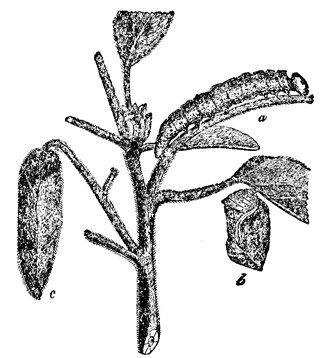 Goatweed Butterfly: a. larva; b. chrysalis; c. larval case. (After Riley) After some weeks of this sheltered existence the caterpillar is ready to change to a chrysalis. It leaves the tent and commonly attaches a bit of silken web to the under side of a leaf or branch of its food plant or some other kind of shelter. Here it changes to a chrysalis, to emerge a little later as the beautiful burnt-orange butterfly. There are said to be two broods each season, in some regions, although in others there seems to be but one. The butterflies hibernate in hollow trees or in such other shelters as they may find. The full-grown caterpillar (a) is an inch and a half long and of a general grayish color, dotted thickly with slightly elevated points. The chrysalis (b) is suggestive of that of the Monarch butterfly. It is light green covered with whitish granules. The adult butterfly is remarkable for the falcate shape of the outer margin of each front wing and the broad tail at the hind outer angle of each hind wing. In the male the upper surface of all the wings is of a dark orange tone, with a rather narrow brown marginal marking. In the female this marginal band is broader and is nearly paralleled by another narrower band a little nearer the body. In bright sunshine there is a distinct purplish red iridescence over practically the whole upper surface. The under side of both wings is of a color to suggest a dead brown leaf, with a purplish iridescence in certain angles of light. The Gray Emperor
Chlorippe celtis
This very distinctive medium-sized butterfly is found in the Southern states at least as far west as the Mississippi Valley. It extends north to Indiana and Ohio and probably occurs quite generally from Ohio eastward. This species is distinguished by the general gray-brown or olive-brown coloring of the wing surfaces, heavily marked with a much darker dusky brown and with many irregular white spots as well as one large eye-spot on each front wing near the border, and a row of seven more or less distinct eye-spots near the border of each hind wing. Like the Tawny Emperor this species feeds in the larval state upon the leaves of hackberry. In Missouri the butterflies appear in June. A little later they lay eggs upon the under side of the hackberry leaves, commonly one in a place but sometimes several side by side. A few days later these eggs hatch into little yellow caterpillars that feed upon the leaves for about a month when they become full grown. They are then a little more than an inch long, of a general light green color with yellow spots along the middle of the back and three yellow lines along each side. The head has a pair of curious antlers much like those of the caterpillar of the Tawny Emperor. These caterpillars now spin a bit of silken web on the under side of the leaf or twig. They attach their hind legs into this web and hang downward for a day or two, before casting the last larval skin and changing to chrysalids. They change again to butterflies which are seen upon the wing early in August. These butterflies lay eggs in turn on the hackberry leaves, the eggs soon hatching into small caterpillars which according to Riley's observations are less active than those of the earlier brood. These caterpillars feed for a few weeks until they become nearly half-grown and have passed their second or possibly their third moult. They now stop eating and get ready for a long fast through the winter. Apparently some of them at least attach themselves to the under side of the hackberry leaves and turn to a brownish color, remaining upon the leaves until the latter fall to the ground and presumably hibernating in the shelter thus provided. Whether or not all of the caterpillars have this rather curious habit seems to be doubtful. It has been suggested that some of them find shelter within the crevices in the rough bark of the tree. At any rate, the caterpillars remain in a sort of stupor until the following spring. Then they awaken, climb up the trees or bushes, and begin feeding upon the young leaves. They continue this until they become full grown in May when they change to chrysalids, to emerge as the first brood of butterflies the following month. Many of the caterpillars make a sort of nest for themselves by spinning a web of silk upon the under surface of the leaf and drawing together slightly the outer edges. As is the ease with so many other butterflies that hibernate as caterpillars, apparently the species is only partially double-brooded. Some of the earlier caterpillars become lethargic when half grown and remain in that condition throughout the later weeks of summer and all through the fall and winter. The Tawny Emperor
Chlorippe Clyton
This handsome butterfly is easily distinguished from the Gray Emperor by the general reddish color of the wings which are thickly marked with bands and eye-spots of darker brown or black. The eye-spots are especially marked on the hind wing, there being a row of five of these on each hind wing in both sexes. The females are decidedly larger than the male and generally of a distinctly lighter color. This butterfly is a southern species found more or less abundantly from southern New York to northern Florida and across the country to a line drawn from Iowa to Texas. It seems to be more common in the Mississippi Valley than in other regions and its life-history was first thoroughly worked out in Missouri and published in one of Riley's classic reports on the insects of that state. It has since been studied by Edwards and others, but even now there seems to be some uncertainty in regard to many points in its development, notably the number of broods in different localities and the habits of the larvae when preparing for hibernation. The principal points in the life-history of the species may be outlined as follows: some time in July the eggs are laid on the leaves of hackberry in dense clusters, each of which may contain from two hundred to five hundred eggs. These are usually deposited in two or more layers, one upon another. A little more than a week later these eggs hatch, each caterpillar eating through one end in a way to cut out the rim of a tiny cap which is pushed up as the larva escapes. The whole brood emerges at practically the same time and collects upon one or more leaves where they begin to feed upon the succulent green tissues. Like so many caterpillars that feed in companies each spins a silken thread wherever it goes. The little larvae remain together until after the third moult, at which time they are about half grown. In the more northern regions where they are found they are now likely to scatter about in search of quarters for hibernation. Having found suitable shelter, they remain through the winter to come forth early the following spring and feed upon the developing leaves of the hackberry trees. They continue to do this for a few weeks before they become full grown. They are then smooth-bodied, greenish worms about an inch and a half long, striped longitudinally in yellow and brown. The hind end of the body is forked in a curious fashion and the head is even more remarkable for the strange pair of tiny antlers projecting from it. These full-grown caterpillars soon change to pale green chrysalids, lightly striped with longitudinal lines of yellow, with a distinctly pointed head. From these chrysalids butterflies emerge early in summer. Evidently in the more Southern states there are two broods of these butterflies each year but there is great need of more precise knowledge in regard to them. As is the case with so many other butterflies there is a dimorphic form, called ocellata, in which the outer half of the hind wing is very dark brown, with the eye-spot showing as black with red-brown circles. Synopsis of the Emperors
Goatweed Emperor (Anoea andria or Pyrrhanea andria). Expanse 2 ½ inches. Front outer angle of each front wing projecting into a falcate tip. Rear outer angle of each hind wing projecting into a distinct tail. General color burnt-orange with darker marginal bands, and in the female on the upper surface other sub-marginal markings. Gray Emperor (Chlorippe celtis). Expanse 2 inches. General color grayish brown with numerous markings of white and blackish. A distinct brown eye-spot on the upper surface of each front wing near the outer hind angle. Tawny Emperor (Chlorippe clyton). Expanse 2 inches. General color tawny brown with markings of black and yellowish white. No distinct eye-spot on upper surface of front wings. THE MEADOW-BROWNS OR SATYRS
FAMILY Agapetidae
The Meadow-browns form one of the most distinctive family groups among all the butterfly tribes. They are characterized, at least so far as our eastern species are concerned, by their slender bodies and rather large wings, toned in various shades of brown, and marked chiefly with conspicuous and characteristic eye-spots. The larger veins of the front wings are swollen at the base. The caterpillars are rather slender and have a curious division of the last body segment into two parts, which gives them an appearance suggestive of the caterpillar of the Emperor butterflies, although the Meadow-brown caterpillars do not have, upon the head, the curious antlers borne by the Emperor larvae. The Common Wood-nymph or
Grayling
Cercyonis alope
In the development of our knowledge of both birds and mammals as found upon the American continent the experience in many eases has been essentially this: a bird or a mammal was first described from some well-known region of North America, commonly from specimens carried to Europe by early voyagers. Later other species of the same genus were brought to light by various explorers and given specific names. As each section was thus explored a new form differing markedly from the others was found and named. At a later period, when great collections were brought together so that one observer was able to make a careful survey of specimens from all parts of the continent, it was found that many of these species merged into each other through intergrading forms from regions between the localities of the original species. So it has come about that in the ease of a large number of our birds and mammals we have geographical races distinctly recognized instead of separate species. While the study of butterflies has by no means received the degree of attention which has been given the birds and mammals, it is already evident that a similar condition prevails with reference to many species. As the size of collections has increased and more careful studies have been made of the various forms from different regions it has been found in numerous cases that they intergraded to so great an extent that it is impossible to distinguish many species which were formerly considered entirely distinct. One of the most striking examples of this is found in the case of our common Wood-nymph, which is sometimes called the Blue-eyed Grayling. The form which is one of our most abundant butterflies in southern New England and many of the Eastern states was described as Satyrus alope by the French naturalist Fabricius, who also described another species from the Southern states as Satyrus pegala, and a form found in northern Canada was described by the English entomologist Kirby as Satyrus nephele. Various other forms from isolated regions have been given specific names by other authorities. (see plate.) During recent years many collectors have gathered these butterflies from all parts of North America and many specimens have been grouped together in the more important collections. When this occurred it became easy to see that this is essentially a variable species which under varying climatic conditions has assumed slightly different forms, so that we have a good illustration of well-developed geographical races. The more important of these are indicated in the synopsis of the Meadow-browns on page 227. The Similar Life-histories
One good indication that these varying forms all have a common origin is found in the remarkable unity of their life-histories. It is essentially the same in all. The mother butterflies lay eggs late in summer upon the leaves of grasses and perhaps other plants. About three weeks later these eggs hatch into small caterpillars that immediately become lethargic and begin their hibernating condition without eating any vegetation. They remain thus fasting until spring when, after the weather warms up sufficiently, they begin to feed upon grasses and perhaps other herbage. But they have lots of time in which to complete their growth and they are very moderate in their eating and their movements. They grow slowly so that they do not become mature as caterpillars until June. They then change to chrysalids to emerge as butterflies during July and August. The female butterflies remain upon the wing for some weeks before they begin to lay their eggs. We thus have in this case an adaptation to single-broodedness in practically all stages of the insect's life. The twelve months of the year must be passed and egg, larva, chrysalis, and butterfly each seems to try to do its part in prolonging its period of life. These butterflies are especially common along streams and near the borders of woods, as well as in upland pastures and meadows. They are interesting creatures with characteristic manner of flight. They are by no means so easy to capture as one might think who sees them apparently going with slow, erratic motions from flower to flower. Mr. S. F. Denton, a collector of long experience, has written this interesting paragraph upon this point: "As the flight of these insects is weak, they have been obliged to resort to a number of tricks to outwit their enemies. In capturing these butterflies the collector will very soon become acquainted with their modes of escape, which are very interesting and show no small amount of cunning, scarcely to be looked for in an innocent little butterfly. Their first plan of escape on being disturbed is to make directly for a clump of bushes into the thickest part of which they dive and there remain until the danger is past. If one is startled from the grass at some distance from a safe retreat and the collector overtakes him, he will immediately dodge backward and forward, at one time high in air and again low down near the grass tops, and in spite of his slow flight keeping well clear of the net. If the net is at last brought very close to him he will try his last desperate scheme to elude his pursuer and shutting his wings quickly together will drop into the grass, disappearing as if by magic. If it were not for the cunning of the frail little creatures they would doubtless have gone to the wall long ago in the struggle for existence." The Southern Wood-nymph
Cereyonis pegala
This large southern butterfly is sufficiently distinct from the other Wood-nymphs to rank as a separate species. The yellow blotch has expanded into a large band extending practically across the front wings. On its upper surface there is one eye-spot in the male and two in the female. It is abundant in the extreme Southern states and has occasionally been taken much farther north. The Pearly Eye
Enodia portlandia
Most butterflies are creatures of open country, basking freely in the sunshine and visiting flowers of many sorts for their nectar food. Some of them are found at times along the borders of woods and others seek the woods especially in autumn for the purpose of hibernation. This exquisite Pearly Eye, however, is distinctly a woodland species, being found only in little glades in the midst of woods and apparently seldom even seeking flowers for their nectar. It is commonly considered one of the rarest of American butterflies, but many collectors who have searched their regions carefully have been able to find small areas in which the butterfly is quite abundant. In such situations it may be looked for in all parts of the United States east of the western limits of the Mississippi Valley and south of Canada, except perhaps the lower part of Florida. In northern regions this butterfly is single-brooded, the adults appear shortly before midsummer and continue on the wing through July and at least part of August, The eggs are laid some weeks after the butterflies emerge, The caterpillars feed upon grasses and apparently hibernate after they become well grown, changing to chrysalids the following spring in time to emerge as butterflies in early summer. These Pearly Eyes have certain characteristics which are of especial interest. No other species presents such exquisite modulation of brown coloring arranged in beautiful circles upon both surfaces of the wings. The males possess, perhaps to a greater degree than any other of our native butterflies, the ability to give off a peculiar, pleasant aroma which is noticeable whenever the insects are collected and which at least one careful observer has been able to detect in the open air as the butterfly flew near. For many years Mr. W. F. Fiske made a special study of the butterflies prevailing in the region of Webster, New Hampshire. tits word picture of the haunts of the Pearly Eye is more adequate than any other which has been published and seems well worth quoting in this connection: "I have found them in several localities, always in some numbers, but nowhere more abundant than in a little wooded glen in Webster. Here a scattering group of tall pines, a few thick hemlocks, and a young growth of miscellaneous deciduous trees fill up the space between two rather steep banks. A small trout brook follows close by one of these banks, and near the lower end of the glen, in a space kept clear of underbrush by the overshadowing influence of the pines and hemlocks, is a little spring, the overflow from which keeps the ground moist for some space on each side of the channel which it follows to the brook. This is the great meeting place of these butterflies; here they may be seen at almost any time in the day except in the early morning--when they seek the outskirts of the woods--until the shades of evening render their flitting forms indistinguishable. Half-way up the bank on one side, half shrouded in the dense growth of underbrush which is springing up around it, is an old apple tree upon which the sapsuckers work yearly. The wounded limbs, dripping with sap, are frequented by many forms of insect life, most noticeable among them this butterfly, and such refreshment added to the moisture which they suck from the margin of the spring is all that I have ever seen them partake." The Eyed Brown
Satyrodes canthus
For delicacy of gray-brown color tones few butterflies can compare with this exquisite creature. It seems indeed to have succeeded in a modest attempt to obliterate itself, for even when the spread wings are placed against a clear white background they can scarcely be called conspicuous and it is very probable that when the butterfly is at rest in its native haunts, with wings closed together so that only the very delicate light brown color-tones of the under surface are revealed, it actually becomes invisible. The upper surface of the wings is broadly washed with a gray-brown color which runs into a suggestion of a lighter band near the outer margin of the front pair. The upper surface of the hind wings is almost uniformly washed with this same brown color which is interrupted only by very fine, double lines at the outer margin and a sub-marginal row of delicate ocelli which are larger than the somewhat similar sub-marginal row of eye-spots on the front wings. The under surface is much lighter in color, with distinct striations extending across the main surface of both wings from front to back and with some very attractive ocelli arranged as a sub-marginal series each with a central white eye. This is distinctly a northern species, having rather a limited range in Canada and New England. It extends south to Pennsylvania and Ohio and westward to Wisconsin and Iowa. It is more abundant in northern than in southern New England but it is often overlooked by collectors who are not familiar with its haunts. It is especially likely to be found among the tall grass of swamps and brooks running through lowlands. One of the best ways to discover it is to beat the grasses in such situations. The life-history of the Eyed Brown is fairly well known. The eggs are laid chiefly on grasses and probably at times upon the grass-like sedges. The larvae feed upon these plants and become nearly full grown before winter sets in. They then hibernate in this larval stage and the following spring complete their growth and change to chrysalids in time for the butterflies to emerge in June. There is but one brood a year. The White Mountain Butterfly
Oeneis norna semidea
To appreciate the extraordinary distribution of this notable species one must let his fancy carry him back a million years or so until he reaches that old time when the whole northern part of the American continent was covered with an icy coating. Then he must follow the gradual retreating of the ice northward, carrying with it wonderful changes in climate and along with these climatic changes taking northward many plants and animals which were adapted to the cool temperature along the borders of the glacier. As the ice cap retreated most of these arctic forms retreated with it, and all along the lower levels they were replaced by others migrating from the south so that gradually there came about the distribution of plants and animals as we find them to-day. When, however, the glaciers left the higher elevations of the White Mountains and the Rocky Mountains there were at the summits small areas in which the climatic conditions were of very much the same arctic character as prevailed along the margin of the ice cap. Consequently conditions were here favorable for the continuation of many of the arctic species which had disappeared from the warmer, lower levels. It was as if we had a great sea of air of a certain warmth and rising above this the islands of the mountain tops, these islands retaining the same arctic features as otherwise are found much farther northward. Among the animals thus left stranded by the retreating ice cap this White Mountain butterfly has perhaps attracted the most attention froth scientists. It is a butterfly of moderate size which shows in every phase of its structure and its life-history the results of the long process of adaptation to its unique environment. It has been carefully studied by many observers and has been considered one of the most desirable trophies by every collector of insects. As a result, notwithstanding its isolation and the difficulty of studying it, its life-history is better known than that of many a common and widely distributed species. To appreciate the facts in regard to the structure and life of this butterfly one must know that its habitat is confined to a thousand feet or so at the summits of the mountain, that in this area there are no trees or even shrubs worth mentioning, and that the surface of the mountain is covered with rocks between which grow a few stunted sedges and over which grows the ever-present reindeer moss. It is a bleak, bare, gray environment, constantly swept by terrific winds, where snow is seen in August and is likely to remain until June. So the summer season is of briefest duration and the climatic conditions are so severe that one can only wonder how a fragile creature like a butterfly is able to survive the twelve long months. Habits and Life-history
From a first glance at the mottled gray-brown wings of these insects one would guess that here was a distinctive example of obliterative coloring, and it is true as all observers testify that when the butterfly lights upon the stones and turns sideways, as apparently it does habitually in deference to the force of the wind, it becomes very difficult to see, for the wings are dosed and only the rounded, mottled under surface shows. It appears also to have the habit of some of the Graylings when hard pushed of simply closing its wings and dropping to the ground feigning death. In deference also to the wings its flight is just above the surface. Doubtless if it rose high in the air it would be swept away to lower regions where evidently it is unable to survive for long periods. These butterflies appear early in July and continue on the wing for several weeks. They lay their small eggs upon or near a species of sedge which is abundant on these alpine summits. About two weeks later the eggs hatch into sluggish little caterpillars which feed upon the sedge leaves, apparently eating only at night and hiding in crevices between stones by day. As one would expect from the prevailing low temperatures these caterpillars grow very slowly and apparently a large proportion of them require two years to complete their development. There seems to be some uncertainty in regard to this phase of the insect's life-history, but most entomologists are of the opinion that some of the butterflies mature in one year while others require two years: that is, the broods are both annual and biennial. There is no doubt that the insect hibernates as a caterpillar, and if this statement about the number of broods is correct some of the caterpillars hibernate when very small, and recently hatched from the egg, while others hibernate when nearly full grown. The full-grown caterpillars change to chrysalids beneath the shelter of the small stones in practically the same sorts of situation which they have chosen for hiding at night or for hibernation through the winter. Here without any button of silk or silken loop and with scarcely a suggestion of a silken cocoon they change to chrysalids, generally about the first of June. They remain in this condition for perhaps three or four weeks when they come forth as butterflies.
The Arctic Satyr
Oeneis norna jutta
This is another butterfly of decided interest because of its geographical distribution. It is normally an inhabitant of the Far North, extending around the North Pole over parts of three continents. Apparently, the only place in the United States where it occurs is a bog a little north of Bangor, Maine. This locality is called the Orono, Stillwater bog and is the only place where collectors have been able to find this species. An even more local insect is another of these mountain butterflies found by H. H. Newcomb on Mount Katahdin, Maine. So far as known this species is confined to the higher portion of this mountain and so is even more distinctly localized than the White Mountain butterfly. It is called the Katahdin butterfly (Oeneis riorna katahdin). The Little Wood Satyr
Cissia eurytus
This elfin creature has well been named the Little Wood Satyr, although under our modern conditions it is often found in fields and along hedge-roads rather than in the woods. It has, to a marked degree, the delicacy of structure of its allies and its small size serves to emphasize this appearance. It has also a rather general distribution west to the Mississippi Valley, extending from the corner of Dakota, south through Nebraska, Kansas, and central Texas, and north to Wisconsin, Michigan, and New England. It occupies the whole of the United States east and south of the lines thus indicated. The life-history of this species is very similar to the Common Grayling. The butterflies appear in early summer, deposit their eggs upon grasses, and the resulting larvae feed upon the grasses and grow slowly through the weeks of summer. They become nearly full grown by autumn and hibernate in this condition in such shelter as they can find at the soil surface. The following spring they come forth, probably feeding for a short time, and change to chrysalids in time to emerge as butterflies in May and early June. Practically all observers emphasize the fact that the butterflies are abundant only late in spring or early in summer, generally disappearing before the middle of July. There is thus but one brood a year. Other Meadow-browns
The Gemmed Brown (Neonympha gemma) is a small southern species remarkable for the plainness of its gray-brown wings which are marked on the upper surface only with two or three dark spots on the middle margin of each hind wing. There are two broods a year. The Georgia Satyr (Neonympha phocion) is another small southern form, remarkable for the four elongated eye-spots on the lower surface of each hind wing. The shape of these spots distinguishes it at once from the Carolina Satyr (Cissia sosybius) in which the eye-spots are rounded. Synopsis of Meadow-browns
Pearly Eye (Enodia portlandia or Debis portlandia). Expanse 2 ¼ inches. Eyes hairy. Outer margin of hind wings projecting in a noticeable angle. Brown with many distinct eye-spots on both surfaces of wings. Eyed Brown, (Satyrodes canthus or Neonympha canthus). Expanse 2 inches. Eyes hairy. Margin of hind wings rounded, without an angle. Both surfaces of wings pate brown with four distinct blackish eye-spots on each front wing near the margin. Five or six such spots on each hind wing. Common Wood-nymph or Grayling (Cercyonis alope). Expanse o inches. Eyes not hairy. Eye-spots on front wings, but not on upper surface of hind wings. The chief geographical races of this abundant species are indicated below, although in regions where the forms overlap many intermediate hybrids occur. Blue-eyed Grayling (Cercyonis alope alope). A large yellowish-brown blotch near outer margin of each front wing, above and below, with two distinct eye-spots in middle spaces of the blotch. A southern race extending north to central New Hampshire, Michigan, and Wisconsin. Dull-eyed Grayling (Cercyonis alope nephele). The yellowish brown blotch obsolete or nearly so, but eye-spots present. A northern race extending southward only to central New Hampshire, Michigan, and Wisconsin. Maritime Grayling (Cercyonis alope meritima). Similar to the type form, but with the yellowish blotch tinged with reddish. A race found only near the seacoast. Southern Wood-nymph (Cercyonis pegala). Expanse 3 inches. Eyes not hairy. General color brown with an orange-yellow blotch near outer margin of each front wing above and below with one eye-spot in middle space of the blotch on the male, and two on the female. Little Wood-satyr (Cissia eurytus or Neonympha eurytus). Expanse 1½ inches. Eyes not hairy. General color fawn-brown with two eye-spots on upper surface of each front wing and several on each hind wing. Gemmed Brown (Neonympha gemma). Expanse 1 ¼ inches. Eyes not hairy. General color mouse-brown with no markings on upper wing surface except a rather indistinct pair or more of spots next the margin of the middle of each hind wing. Under surface indistinctly striped with rusty lines and a few brown and silvery spots on the hind wings directly beneath the spots on the upper surfaces. Occurs in Southern states. Georgia Satyr (Neonympha phocion). Expanse 1 ¼ inches. Distinguished from the related species by the four distinct eye-spots on lower surface of each hind wing, these spots being transversely elongated rather than round. Occurs in Southern states. Carolina Satyr (Cissia sosybius). Expanse 1 ¼ inches. Distinguished by the row of round eye-spots near outer margins of lower wing surface. Occurs in Southern states. THE HELICONIANS
FAMILY Heliconidae
This is a tropical family with only a single species migrating northward to our Southern states. The butterflies of this group are characterized by having the wings so long and narrow that their length is usually twice as great as their width. The front legs in both sexes are so poorly developed that they are considered a modification approaching the complete dwarfing found in the Brushfooted butterflies. The Zebra Butterfly
Heliconius charitonius
While the butterflies of temperate North America show many examples of marvelous beauty and coloring, one must go to the tropics to see the culmination of what nature has done in painting the outstretched membranes of butterfly wings with gorgeous colors. The great butterfly tribes that swarm in tropical forests seldom reach our temperate clime, and even when they do they are likely to show only a suggestion of the splendid size and rich coloring to be seen farther south. The Zebra butterfly (Heliconius charitonius) belongs to one of these tropical tribes. It shows its affinities by its coloring and the curious shape of its wings. In most of our northern butterflies, the wings are about as long as they are wide, but in the tropical family, Heliconidae, they are very much longer than wide. This gives the insect an entirely different look from our common forms so that one recognizes it at once as a stranger within our gates. Indeed, it does not penetrate far into our region, being found commonly only in Florida and one or two other neighboring states, its principal home being in tropical America. The Zebra butterfly is well named, Across the brownish black wings there runs a series of yellow stripes, three on each front wing and one on each hind wing, with a submarginal row of white spots on each of the latter. The under surface is much like the upper, except that the coloring is distinctly paler. It is very variable in size: some specimens may be but two and a half inches across the expanded wings, while others are four inches. (See plate.) The Zebra caterpillars feed upon the leaves of the passion flower. When full grown they are about an inch and a half long, whitish, more or less marked with brownish black spots arranged in transverse rows, and partially covered with longitudinal rows of barbed black spines. They change to chrysalids which are remarkable for their irregular shape, with two leaf-like projections on the head which the insect can move in a most curious fashion. One of the most notable things about this insect is the fact that the male butterflies are attracted to the chrysalids of the females even before the latter emerge. Many observers have reported upon this curious phenomenon and have recorded experiments demonstrating that it is a general habit with the species. The Roosting Habits
The adult butterflies flock together at night and rest upon the Spanish moss which festoons so many of the trees in the Far South, or upon dead branches. They take positions with heads upward and wings closed, many of them often flocking together to roost, and wandering out to the near-by fields when the morning sun gives them renewed activity. But these butterflies are essentially forest insects. Reliable observers have noticed that when one emerges from a chrysalis it flies up in the air and makes straight for the nearest woods. Others have noticed that when a butterfly in a field is alarmed it also makes for the woods. And in the regions where the species is abundant the butterflies are most likely to be found in paths and glades in the forest. Thus they show the influence of their ancestral habitat in the tropical wilderness. There seems to be a certain amount of ceremony attending the flocking together at night for roosting purposes. A famous English naturalist, Philip Henry Gosse, saw the performance in the West Indies many years ago and described it in these words: "Passing along a rocky foot-path on a steep wooded mountain side, in the Parish of St. Elizabeth (Jamaica), about the end of August, 1845, my attention was attracted, just before sunset, by a swarm of these butterflies in a sort of rocky recess, overhung by trees and creepers. They were about twenty in number, and were dancing to and fro, exactly in the manner of gnats, or as Hepioli play at the side of a wood. After watching them awhile, I noticed that some of them were resting with closed wings at the extremities of one or two depending vines. One after another fluttered from the group of dancers to the reposing squadron, and alighted close to the others, so that at length, when only two or three of the fliers were left, the rest were collected in groups of half a dozen each, so close together that each group might have been grasped in the hand. When once one had alighted, it did not in general fly again, but a new-comer, fluttering at the group, seeking to find a place, sometimes disturbed one recently settled, when the wings were thrown open, and one or two flew up again. As there were no leaves on the hanging stalks, the appearance presented by these beautiful butterflies, so crowded together, their long, erect wings pointing in different directions, was not a little curious. I was told by persons residing near that every evening they thus assembled, and that I had not seen a third part of the numbers often collected in that spot." THE MIILKWEED
BUTTERFLIES
FAMILY Lymnadidae
So far as the great majority of readers of this book are concerned, this family includes but one species--the familiar Monarch or Milkweed butterfly. In the Southern states there is another--the Queen--and in Florida, still a third. The distinguishing characteristics are found in the dwarfed, useless front legs and the absence of scales upon the antennae. The Monarch
Aaosia plexippus
From June until October one may often see the stately Monarch flitting leisurely about over fields and meadows. It is one of the largest and most distinctive of these "frail children of the air" and may be easily recognized by its resemblance to the picture opposite page 241. The veins of the wings are heavily marked in black, with large white dots upon the black bands along the margin. The color of the rest of the wings both above and below is reddish brown. These butterflies come from the South in spring or early summer. They find milkweed plants and lay their eggs upon the leaves. These eggs soon hatch into small white and black caterpillars that feed upon the milkweed leaves and grow rapidly. One is likely to find them throughout most of the summer, wherever a milk-weed shows partially eaten leaves. Bring in the half-grown caterpillars, place them in an open vivarium, and furnish fresh leaves every day or two. The caterpillars will soon mature and change to beautiful green chrysalids with golden markings. This chrysalis has been called "the glass house with the gold nails." (See plates.) About two weeks later the glass house will burst open and the butterfly emerge. It will rest an hour or two while its wings and body harden and then it will want to fly away. It is not so anxious to do this, however, as most butterflies. If one is kept beneath a good-sized bell-glass, or in a glass-covered box, or even in a closed room, and fed with sweetened water it will soon become so tame that it will perch on one's finger and suck nectar from a flower held in one's hand. On this account it is a particularly desirable butterfly for the amateur photographer to cultivate, because he can easily get many interesting and beautiful pictures by posing the butterfly on different flowers. The Change from Caterpillar
to Butterfly
The change from the caterpillar to the butterfly is easier to watch in this species than in most others. The full-grown caterpillar spins--sometimes on the under surface of the milkweed leaf, sometimes elsewhere a little mat of silk in which it entangles the hooked claws of its hind feet. Then it lets go with its fore feet, and hangs downward with the front end of its body curled upward. In this position it remains for some hours--perhaps a day --the body juices gravitating downward and causing a swollen appearance on the lower segments. Then the skin splits apart and is wriggled off by the contortions of the body. When it finally drops away, there is left a strange-looking creature, broader below than above. This is a transition stage that lasts but a very short time: soon the form is entirely changed so that the broadest part is above instead of below. The definite outline of the chrysalis is soon taken on, the outer tissues hardening into a distinct covering. The insect is now a beautiful green with wonderful golden spots upon its surface and a few black spots just below the black "cremaster" by which the chrysalis is connected with the web of silk upon the leaf. In this quiet chrysalis the insect remains for nearly a fortnight. Then the structure of the forth-coming butterfly begins to show through the thin outer covering and you know that the period of the chrysalis is nearly ended. If you keep watch you will probably see the sudden bursting of the outer envelope and the quick grasping of its surface by the legs of the newly emerged butterfly. Its wings at first are short and crumpled, bearing little resemblance to those of the fully developed butterfly. But as it hangs there with one pair of legs holding to the empty chrysalis and the other to the leaf above, the wings rapidly lengthen, hanging limply downward, and the body juices penetrate the veins. A little later they expand in the other direction, the hind wings reaching full size before the front ones do. Finally both pairs of wings are fully expanded, and the butterfly is likely to walk to the top of the support, where it rests for an hour or two while its tissues harden, before it attempts to fly. In early autumn out of doors these butterflies stark southward on their long journey. They often gather in great flocks and roost at night on wayside shrubs and trees. At this season it is easy to catch them in an insect net and bring them indoors for pets. They live for a long while and lend interest and beauty to living room or window garden. To the photographer they offer opportunities for attractive indoor pictures. (See plates.) The Queen
Anosia berenice
The general form and color patterns of this fine butterfly show at once that it is related to the Monarch. Its general colors are chocolate-brown and black, dotted and spotted with white. The eggs are laid upon milkweed and the life-history is much like that of the Monarch. One of the most interesting facts in connection with this species is that it seems to be mimicked by the Vicereine butterfly in the same way that the Monarch is mimicked by the Viceroy. THE SNOUT
BUTTERFLIES OR LONG-BEAKS
FAMILY Libytheidae
One has a suggestion of Hobson's choice in the common names of this unique family. If Snout butterflies does not seem sufficiently elegant as a descriptive phrase for such delicate creatures, he can call them the Long-beaks, until he sees that this also is inadequate. As a matter of fact both are misnomers, for the projection from the head that gives them these names is neither a snout nor a beak. It is simply a pair of palpi unusually developed, which perhaps in an early stage of butterfly history served a useful purpose. At present, however, they serve chiefly to set the few owners apart from the other butterflies in the system of classification; although possibly they may also serve the butterfly by helping to give the impression of a leaf attached to a twig. (See plate.) The Snout Butterfly
Hypatus bachmani
There is a peculiar interest in any form of animal life which can be definitely traced far back through the geologic ages. In nearly every group of living creatures there are certain types which scientists have found were once abundant but which now are on the wane. As a rule these are better represented in the museums through fossil species than by those now living. To a considerable extent also such forms are likely to present various features which mark their primitive condition and the living allies have peculiarities which set them off as distinct from those of their own relations which have been modeled in a more modern fashion. Among the mammals the curious marsupials, of which our southern opossum is an example, furnish good illustrations of this general truth. Among the birds the curious little Least Bittern is an example. Among the butterflies the strange Snout butterfly is by far the best example. These Snout butterflies, of which only two species are now living in North America, are the sole representatives with us of the family Libytheidae or the Long-beaks, Only one of those species occurs to any extent at least north of Texas. It is the curious little creature called the Snout butterfly. It has a strange appearance due to the angular outline of both front and hind wings and the long palpi which project forward from the head in a way to attract attention. The common name is due to these projecting palpi. Even the coloring is primitive, the general tone of the wings being blackish brown, distinctly marked with white and orange spots. The under surface is less primitive in its coloring, being toned in iridescent grayish brown in a way to suggest protective coloring, except in that part of each front wing which is not hidden when the insect is at rest. This shows the white and orange-brown markings. Some years ago there were found in certain fossil deposits in the West about a dozen species of fossil butterflies. It is strange indeed that these ethereal creatures should be fossilized at all. One would think it scarcely possible that they could be so preserved that a million years after they had died man should be able to study them, determine to what families they belonged, and even guess with a high probability of accuracy upon what leaves their caterpillars fed. This little collection of fossil butterflies was studied by one of the great American authorities on living butterflies, the late Samuel H. Scudder, who mid of them: "They are generally preserved in such fair condition that the course of the nervures and the color patterns of the wings can be determined, and even, in one case, the scales may be studied. As a rule, they are so well preserved that we may feel nearly as confident concerning their affinities with those now living as if we had pinned specimens to examine; and, generally speaking, the older they are the better they are preserved." A curious fact is that out of the comparatively few species of these fossil butterflies two were easily recognized as members of this Long-beak family. They were given special scientific names and undoubtedly were closely related to the Snout butterfly which is still flying every year in various parks of the United States. Our modern species lays its eggs upon the leaves of hackberry and in these gee, logic deposits of that far-gone era there have been found well-preserved leaves of old hackberry trees, upon which it is extremely probable that the caterpillars of those ancient Long-beaks fed. What an opportunity for a modern collector of butterflies to work his fancy, as he thinks of those old times when these fossil creatures were flying in the sunshine, depositing their eggs upon the leaves of trees that made up landscape pictures probably very different from those of to-day! And how he wonders what flowers these butterflies visited for their nectar food, what birds chased them from tree to tree, and what mammals wandered through those ancient forests. What a suggestion also it gives of the continuity of life upon our old earth to realize that these butterflies of to-day are carrying on their brief existence in practically the seine way that these forbears of theirs did so many millions of years ago. Another way in which these butterflies are peculiar is the fact that the females have six well-developed legs while the males have only four. As already indicated the caterpillars feed upon hackberry. When full grown they are about an inch long, dark green, striped with yellow, with two blackish tubercules on the second ring behind the head. They apparently pass the winter in the chrysalis stage. The butterflies are likely to be found along the borders of brooks or streams running through woods, or along the margins of the forest. Occasionally they become abundant in certain localities, but on the whole they are rare and highly prized by collectors. THE METAL-MARKS
FAMILY Riodinidae
This small family of very small butterflies contains five genera and a dozen species found in the United States and Mexico. Only two, however, occur in the eastern region and only one extends much north of the Gulf states. Aside from certain peculiarities of the wing-venation (a costal and a humeral vein on the hind wings) these Metal-marks may be known by their minuteness and the bright metallic markings on the brown wings. Both our eastern species belong to the genus Calephelis. The Small Metal-mark (C. caenius) has been collected in Florida and Georgia. The wings are rusty red on both surfaces, brighter below than above, and marked with blackish spots that almost converge to form stripes; in addition to which there are, beyond the middle of each wing, two lines made by special scales that glisten with a steel glitter. The wings expand only about three quarters of an inch. So far as I can learn, the egg, larva, or pupa have never been described. The Large Metal-mark is called by science Calephelis borealis, but it deserves the latter name only in the sense that it is more northern than its allies. It has been collected as far north as New York and Michigan, but it seems to be very seldom found, at least in eastern regions. It expands a little more than an inch. The general color of the wings is yellowish brown, marked with blackish dots and lines, together with rows of steely spots on the under surface. In this case also the life-history is unknown.
THE GOSSAMER-WINGS
FAMILY Lycaenidae
The daintiest and most delicate of all our butterflies are included among the Gossamer-wings. Their bodies are small and slender, their antennae ringed with white and almost threadlike, their wings thin and of exquisite beauty. Many of them are marked with the slenderest of tailed projections from the hind wings. When the face is viewed from in front it is seen to be much narrower than its height. At the insertion of the antennae the eyes are notched, and they are also more or less surrounded with white scales. Most of the caterpillars have oval, slug-shaped, smooth bodies, with the under surface flattened, and very small heads, which in many species can be extended by means of an extensile neck. The chrysalids are held in place by silken threads both at the tail and over the middle. They are rounded, short, and stout. Notwithstanding their small size, the Gossamer-wings are among the most spritely of all our butterflies. They seem indeed winged sprites, playing everywhere, in fields and open woods, along roads, lanes, and brooks, in dooryards and gardens--wherever, in fact, a bit of open space invites their presence. Not alone upon the wing but even when at rest does their liveliness appear. For most of these butterflies have the curious habit of keeping the hind wings in motion after alighting, rubbing them against each other in a vertical plane or "moving them backward and forward when half expanded." These habits are so fixed that when one sees a butterfly thus engaged one can pretty certainly conclude it is a member of this family. The Gossamer-wings are commonly separated into three rather distinct tribes--the Hair-streaks, the Coppers, and the Blues. The characteristic features are these: Three branches arising from the radius of each front wing. Under surface of hind wing commonly marked with threadlike streaks: the Hair-streaks. Four branches arising from the radius of each front wing. Under surface of hind wing commonly marked with spots rather than lines. Colors
brownish red: The Coppers.
Colors blue: The Blues.
The Hair-streaks are small butterflies with the eyes notched to allow for the insertion of the bases of the antennae. The name is given on account of the fine, hair-like markings which extend across the under surface of the hind wings. In many species there is a tailed projection or two on the hind inner margin of the hind wing. The caterpillars are remarkable for the small head, so connected with the body that it can be pushed forward in a characteristic way. The Hair-streaks are among the most exquisite and delicate of all our butterflies. A large proportion of them have the upper surface of the wings toned in beautiful hues of grayish brown and the under surface lighter gray, marked with dots and stripes, some of which are brilliant in coloring. A few of the larger species are brilliantly iridescent in purples, blues, and greens, marked with black. The males have well-developed scent-pockets in many species, these being commonly along the front border of the front wing. A very interesting suggestion in regard to the possible function of the curious tail projections was made nearly a hundred years ago by some English entomologists and has since been discussed at considerable length in various publications. It is that the slender tails, together with the enlargement of the wing just back of them, give the impression of a false head. Along with this unusual development of the wing is to be considered the fact that these butterflies nearly always alight head downward so that the false head, furnished with what seem to be waving antennae, takes the place that would naturally be occupied by the true head. Instances have been reported in which this false head has apparently been nipped off by a lizard and much evidence has accumulated to indicate that this curious device may be a real protection in many cases. Of course, the loss of the tails and the part of the wings adjacent would be comparatively insignificant. In most cases, these projections on the wings are held at right angles to the plane of the wing. While nearly half a hundred species of Hair-streaks have been found in North America, only a few of these are sufficiently abundant to require discussion in this little book. The Great Purple Hair-streak
Atlides halesus
It seems something of a reflection on the activities of American entomologists to say that, after the lapse of more than a century since Abbott studied the insects of Georgia, our knowledge of the early stages of two of the largest Hair-streak butterflies is still confined to the observations he made. Yet this is true, and one of them-the Great Purple Hair-streak--is the largest species of the group that occurs in the eastern United States. The other is the White-M Hair-streak. The Great Purple Hair-streak is a beautiful, iridescent blue creature, as seen from above, with blackish borders around the blue. As seen from below, the wings are dark brown, with red spots near the body. The two tail-like projections are quite long. It is very large for the group to which it belongs, measuring nearly two inches across the expanded wings. It is a tropical form, extending into our southern borders from California to Florida and occasionally occurring north as far as southern Illinois. The larvae feed on oak. (See plate.) The White-M Hair-streak
Eupsyche M-album
The White-M Hair-streak is about two thirds the size of the Great Purple species with less blue and more black on the upper wing surface. The hind tail is slender and well developed, and the angle of the wing just back of it is rounded out in an unusual fashion. The lower surface of the wing is of a general grayish brown color, marked by a white stripe, which takes the form of the letter M: hence its name. This is also a southern species occurring at times as far north as Ohio and even Atlantic City, New Jersey. The caterpillars feed upon the leaves of oak and Askragalus or milk vetch. There is also a third species of this group of whose history, we are ignorant except for Abbot's observations. It, is an exquisite little butterfly called the Least Purple Hair-streak (Calycopis cecrops) and is apparently a tropical form which has spread into our Southern states. It is especially beautiful because of the brilliant red and white lines running across the under surface of both wings. It occurs as far north as West Virginia and Kentucky and ranges westward at least to the Mississippi Valley. The Gray Hair-streak
Uranotes melinus
This exquisite little creature is capable of surviving under a great variety of climatic conditions. It ranges from New Hampshire to Florida and Central America, but apparently occurs only rarely north of the United States. Perhaps the most distinctive feature in the female is the orange spot just in front of a pair of tiny tails on each hind wing, the rear one being curiously curved and about three times as long as the other. In the male the shorter tail is absent. The general color of the upper surface is a dark bluish gray, relieved on the margin of each hind wing by a few white dots and the orange spot already mentioned. The under surface is much lighter gray, distinctly marked with two dark brown lines near the margin, the outer line little more than a row of spots and the inner line with a white edge. (See plate, page 257.) These small butterflies lay tiny though beautiful eggs upon a variety of plants. The eggs hatch into curious little caterpillars that have the appearance of slugs with small heads which can be extended as if the little creature had really a rubber neck. The object of this extensile head is seen when one finds the larvae feeding upon the fruits or the seed-pods of its various food plants--hawthorn, hop, hound's-tongue, and St. John's-wort. The caterpillar is able to thrust its jaws into the interior of the seed-pods and devour their contents. There seem to be generally two broods in a season, even in the more northern parts of its range, while toward the south there are probably at least three broods. The butterflies are found upon the wing almost any time in summer, especially from early June until late in August. The Banded Hair-streak
Thecla calanus
This is one of the most familiar of the delicate little butterflies grouped in the genus Thecla. It occurs rather commonly in a great stretch of territory extending from Maine, west to Nebraska, south to New Mexico and Texas, and east to Alabama and Georgia. It also occurs in a limited area on the coast of California. The general color of the upper surface is a dark brown, which in the male is marked near the front edge of the fore wings with a distinct gray patch of scent scales. The under side is similar in color to the upper except that the outer half of the wing is marked by two series of broken lines in white, blue, and brown and a brilliant bit of coloring just in front of the tail projection of the hind wings; this coloring shows beautiful tones of red, blue, and black. These little butterflies may often be seen visiting the midsummer flowers but are fully as likely to be found along the sides of a shady road, where they rest upon the leaves of trees, shrubs, and herbaceous plants. When disturbed, they fly up in small companies but soon settle back again into their previous positions. They are lovers of sunshine and may often be seen upon a leaf, with fully expanded wings, taking a sun-bath. There is but one brood a year, butterflies appearing early in summer and remaining for several weeks. They lay their tiny pale green eggs upon the leaves of various trees, especially oaks and hickories, and probably hawthorns. It is not known whether these eggs remain unhatched as a rule until the following spring, or whether they soon hatch and the young caterpillars hibernate without feeding. It is probable that both conditions occur. In spring the larvae eat holes in the leaves of their food plant and grow rather slowly, gradually becoming brown or green slug-like caterpillars about half an inch long. They finally change into greenish brown chrysalids from which the butterflies emerge in early summer. The Striped Hair-streak
Thecla liparops
In the Eastern states the distribution of this species is almost the same as that of the Banded Hair-streak, but in the Central West the outline of its region moves northward extending into Canada, above North Dakota, and into Montana and Wyoming. It does not go so far south, however, extending practically only to the southern borders of Kansas and Missouri. The butterfly bears a striking general resemblance to the other species just named, differing chiefly in the fact that the under surface of the wings is much more thickly marked with broken lines that extend nearer to the body. As a rule, it is not common and consequently it is prized by collectors. Some good observers have noticed that it is more likely to be found only on flowers, instead of sunning itself on leaves. It is single-brooded, hibernating either in the egg state or in that of the young larvae. The food plants are varied, there being good evidence that the caterpillar feeds upon all of these: apple, plum, shadbush, blueberry, holly, chestnut, willow, thorn, and several kinds of oaks. Mr. W. F. Fiske found a chrysalis of this species in the deserted nest of a tent caterpillar in New Hampshire in early June, the butterfly emerging later in the month. The Acadian Hair-streak
Thecla acadica
This is one of the numerous butterflies that offers some young student an opportunity to make real contributions to science. It is a beautiful little creature, expanding scarcely an inch across its outstretched wings, found from New England west to Montana along a rather restricted area, which coincides pretty closely with the southern part of the Transition Zone. There is a form on the Pacific Coast which is commonly considered to be this same species. These butterflies appear during July and August. They visit various flowers but are especially likely to be found near willow thickets along the borders of brooks and swamps. It is supposed that the eggs are laid upon the willows and that they remain unhatched until the following spring. Then they develop into little caterpillars that feed upon the willow leaves and mature in time to form chrysalids early in June. These chrysalids in turn disclose the butterfly early in July. So far as I know the eggs themselves and the situation in which they are laid have never been described. The Olive Hair-streak
Mitoura damon
Very few butterflies have the distinction of showing a clear case of protective resemblance to one kind of plant in both the adult and the larval stages. This is the case, however, with this Olive Hair-streak which is so intimately associated with our common red cedar, that where one is found the other is likely to occur, although both caterpillars and butterflies are seldom seen because they resemble the twigs of the cedar so closely. Along the Atlantic Coast this little butterfly occurs from New Hampshire to Florida, and westward to a line drawn from Dakota to Texas. The upper surface of the wings is rather dark olive-brown and the under surface, so far as it is exposed when the butterfly is resting, is of a greenish hue that harmonizes with the green of the red cedar twigs. There are also, on the under surface, some irregular lines and dots of red, brown, and white which probably help in rendering the insect inconspicuous when it is resting among a cluster of twigs. The yearly history of this beautiful little butterfly differs from that of most of its relatives. The species winters in the chrysalis state, the first brood of butterflies bursting forth early in May. These lay their eggs upon or between the scales of the red cedar twigs, especially those which bear flowers. About a week later the eggs hatch into tiny caterpillars that feed upon the scale-like leaves, continuing to eat and grow for nearly six weeks before they reach their full size. These caterpillars are so similar in color that they are difficult to see, and they have a remarkable protective device in that the first ring behind the head is developed into a shield which covers the head, hiding it so completely that the movement of the jaws in feeding is effectively concealed. Late in June they change to chrysalids, part of which appear to remain in this condition until the following spring, while most of them give forth a second brood of butterflies in July. These butterflies lay eggs for a second brood of larvae that mature into chrysalids during September, and hibernate in this condition until the following spring. Consequently, in the Northern states, the collector should look for fresh specimens in May and early June and again in July and early August. These butterflies visit various flowers, apparently preferring rather small blossoms, such as those of the Mouse-ear Everlasting, which is in bloom when the first brood is flying, and the various members of the mint family, especially spearmint, as well as the sumacs, which are in bloom when the second brood is on the wing. The time between flower visits seems to be spent at rest upon the red cedar branches, and one of the surest ways to find the butterflies is to give these trees a sudden jar, which starts them into flight. In fact, they may often be seen flying around the tops of the cedars a score of feet from the ground. Synopsis of the Hair-streaks
Great Purple Hair-streak (Atlides halesus or Thecla halesus). Wing expanse 1 ¾ inches. Upper wing surface bright blue with blackish margins, the blackish coloring extending nearly to the middle in the female. Two distinct tails on each hind wing. Under surface sepia brown with blue and red spots. Abdomen orange below. White-M Hair-streak (Eupsyche m-album or Thecla m-album). Wing expanse 1½ inches. Upper wing surface blue with wide blackish margins in both sexes. Under surface marked with whitish lines suggesting the letter M, with a reddish spot near it. Each hind wing with two small tails. Least Purple Hair-streak (Calycopis cecrops or Thecla cecrops). Wing expanse 1 inch or less. Upper wing surface dark brown, more or less marked with blue, especially at base of front wings and inner half of hind wings. Under wing surface marked with a brilliant red line edged outside with white. Two very fine tails on kind wings with brightly colored spots near their base on lower surface. Gray Hair-streak (Uranotes melinus or Thecla melinus). Wing expanse 1 1/5 inches. Upper wing surface bluish gray with a brilliant red spot at base of tails on hind wing. Lower wing surface much lighter gray, each wing marked with a brown and white stripe and a row of dots nearer the margin. Banded Hair-streak (Thecla calanus). Wing expanse 1 1/5 inches. Upper wing surface dull dark brown, commonly without markings although sometimes there is an orange spot on each hind wing. Lower wing surface a little lighter than upper with bright red and blue spots at the base of the tiny tails, and with distinct narrow blue and white broken bands extending across the outer half of each wing. Striped Hair-streak (Thecla liparops). Wing expanse I inch. Very similar to the Banded Hair-streak, but having more white markings on the lower surface of the wings. Acadian Hair-streak (Thecla acadica). Wing expanse 1½ inches. Upper wing surface blackish brown with a slaty tinge, and red spots at base of the single short tail on each hind wing. Lower surface bluish gray with many small blackish spots edged with white arranged in two principal rows on the outer half of each wing. Larger orange-red spots on each side of base of the tail on each hind wing. Olive Hair-streak (Mitoura damon or Thecla damon). Wing expanse 1 inch or less. Upper wing surface olive-brown, more yellow in the male than the female. Tips of tiny tails on hind wing whitish. Lower surface green except where upper wing is covered by lower: this part is brown. The green is marked with a row of white spots on each front wing and two distinct rows of brown and white spots on each hind wing, with black spots between. THE TRIBE OF THE COPPERS
The members of this tribe are well characterized by their name, for most of them show on the upper wing surface tones of coppery brown, more or less marked around the margin with darker shades. On the under side of the tarsi there are numerous spines in irregular clusters. In the chrysalis there are curious hair-like projections on the skin, which are short and shaped like tiny toadstools or mushrooms. While some of the Coppers are very abundant, the majority are rather rare. Only a few species are sufficiently widely distributed to require description here. The Wanderer
Feniseca tarquinius
In many orders of insects there are whole families whose larvae are habitually carnivorous, feeding entirely upon other kinds of insects. This is especially so in case of the beetles, the flies, the true bugs, and the great order to which the bees and wasps belong. Among the scale-winged insects, however, carnivorous caterpillars are rare, seldom occurring among the moths and in hardly more than one species among the butterflies. This one exception is the modest-looking little butterfly fancifully called the Wanderer, perhaps because instead of frequenting the flowery fields where other butterflies congregate it wanders in and out among the alders by brooks and ponds, alighting oftener upon a leaf or twig than upon a flower -- the latter apparently lacking for it the attraction it has for other butterflies. If you watch one of these copper-hued creatures for awhile, however, you will soon see that its wandering is not aimless but has rather a method all its own. Perhaps you will see it alight upon an alder twig on or above which you are likely to notice curious woolly white excrescences. If you are close enough you will probably see the butterfly uncoil its tongue and sip up a liquid on twig or leaf--the exudations of the woolly aphids that make up the supposed excrescence and suck the sap from the bark. Much of this sap passes through the bodies of the aphids and collects in liquid globules on twigs and leaves, forming a sort of honey-dew which is much sought after by flies, wasps, and other insects. It seems to form the chief sustenance of these Wanderers. But many of these butterflies have another purpose besides that of sipping the honey-dew. Should you watch one of the mother butterflies carefully you would be likely to see her alight on or near a colony of woolly aphids and run rather rapidly over them in a wasp-like manner, finally stopping long enough to lay a tiny, roundish, slightly flattened egg upon the twig, generally on the under side, and only one in a place. Then she may continue her way, wandering lazily along the alder-bordered stream. Let us now centre our interest upon the egg. Three or four days later it hatches into a curious caterpillar. Instead of having mouth parts fitted for biting leaves as is the ease with most butterfly larvae, it has one fitted for grasping, piercing, and sucking the juices of the plump bodies of the aphids, which it finds hard by its place of birth. It also has silk spinnerets connected with its mouth, so it is able to spin a web to shelter it from being run over by its intended victims. The newly hatched larva is not slow to take advantage of the facilities with which it is provided. It at once begins to spin a web above and around itself, from the end of which it reaches out for the nearest aphids, sucking their life-blood and casting their empty skins to the discard of its protecting web. The skins thus serve as an additional shelter so that, as the caterpillar moves forward, increasing the number of its victims from day to day, it extends its web and the protection of the east skins intermingled with it, while through all--the east skins, the silken web, and even the hairs on the body of the caterpillar-there runs a woof of the woolly excretion--effectually concealing the larva from sight. The woolly aphids thus serve as the sole food of the caterpillar during its brief life as a larva. Perhaps because of the pre-digested nature of its food, it is able to mature much sooner than most butterfly larvae. In about eleven days after hatching it is ready to change to a chrysalis, having undergone during this period only three moults, instead of at least four as with other caterpillars. Each caterpillar then changes to a chrysalis which is remarkable because the form and color of its back bears a striking resemblance to the face of a miniature monkey. It remains in this condition nearly a fortnight and then emerges as a butterfly. In New England and the Northern states the short life of the larva enables this insect to mature three broods each season. Farther south there are probably more, for this species is widely distributed in eastern North America, occurring from Nova Scotia to Georgia and west to the Mississippi Valley. The American Copper
Heodes hypophlaeas
This little butterfly is one of the most generally abundant insects in the northern part of North America. It commonly occurs from ocean to ocean, from the Hudson Bay region to the latitude of Georgia, and it flies freely in city parks and village yards as well as in the more open spaces of field and forest. When seen through a lens it is very beautifully colored, the coppery red of the wings being overspread with conspicuous black dots and a touch of orange around the outer border. The expanded wings measure just about an inch, so that this is one of the smallest of our common butterflies. The caterpillars of the American Copper feed upon sorrel, one of the commonest weedy plants of waste places everywhere. The rusty red blossoms of the sorrel harmonize in color with the color of the butterfly, which is frequently to be seen flying slowly above the plants, stopping now and then to lay its eggs singly upon the leaves or stems. Each egg soon hatches into a curious caterpillar, which looks more like a slug than the usual type of butterfly larva. It feeds upon the succulent tissue of the sorrel leaf, at first biting small holes in the under surface. As it gets larger it feeds more freely and is likely to make channels instead of holes. It matures in about three weeks, changing into a chrysalis under the shelter of a stone or board. A little later it again changes to a butterfly. There is an interesting variation in the number of broods of this butterfly each season. In regions where it has been studied it has been found to be double-brooded in northern New England and triple-brooded in southern New England and the Atlantic states. It is probable that in its far northern home in the Hudson Bay territory it is only single-brooded. It is thought that the insect hibernates as a chrysalis. These little butterflies are so small and fly so near the ground that they are likely to be overlooked by the casual observer. They frequently alight to sun themselves or to sip nectar from many kinds of flowers. They begin their day's work early in the morning and continue well into the evening. Then they find a roosting-place, head downward upon a blade of grass, where they sleep until wakened by the morning sunshine.
The Bronze Copper
Chrysophanus thoe
This butterfly is nearly twice as large as the American Copper to which the female of the present species bears a, striking resemblance. The Bronze Copper is a rare species, occurring from New England nearly to the Rocky Mountains. The slug-shaped yellowish green caterpillar feeds upon dock and related plants. (See plate, page 256.) Synopsis of the Coppers The Wanderer (Feniseca tarquinius). Wing expanse l ¼ inches. Upper wing surface tawny brown, each wing more or less marked with dark brown spots, the distinction between the colors being clear-cut, and the lines between having an angular effect. Lower surface of front wings similar in colors to upper with dark spots rectangular. Under surface of hind wings mottled with irregular spots of pale brown. American Copper (Heodes hypophlaeas or Chrysophanus hypophlaeas). Wing expanse 1 inch. Upper surface of front wings tawny orange with margins and rectangular spots blackish. Upper surface of hind wings coppery red with a tawny orange band on outer margin. Lower surface of front wings much like upper surface; that of hind wings grayish marked with dark spots and an orange line near the margin. Bronze Copper (Chrysophanus thoe). Wing expanse 1 ½ inches. Male. Upper wing surface coppery brown marked with dark spots and a tawny orange sub-marginal band along outer margin of hind wings. Under surface of front wings lighter orange with blackish spots and of hind wings grayish with blackish spots and an orange submarginal band. Female. Upper surface of front wings tawny orange with blackish spots. THE TRIBE OF THE BLUES
These beautiful little butterflies are well named, for the majority of them are colored in exquisite tints of blue. They are distinguished from the Coppers by this blue coloring, as well as by the fact that the spines on the under side of the tarsi are arranged in rows rather than in clusters and are comparatively few in number. The body is rather slender and the under surfaces of the wings are generally dotted in a characteristic fashion. Most of the two score or more species found in North America occur on the Pacific Coast or in the Southwest, less than half a dozen being common in the eastern region. The Spring Azure
Cyaniris ladon
For a wee bit of a gossamer-winged creature that expands scarcely an inch across its outstretched wings, the Spring Azure has caused American scientists an immense amount of patient labor. Over the vast territory from Labrador across to Alaska and south to the Gulf of Mexico, this little blue butterfly exists in so many different forms that it requires special analytical keys to separate them. Not only does it vary geographically so that in one locality we find one form and in another a different form, but it also varies seasonally to a marked degree. As one would expect there is a striking difference in its annual cycle between Labrador and the Gulf Coast. In the far northern region there is but one brood a year, while in the southern region there are at least two and perhaps more. The variations in this butterfly are shown by the differences in the marking of both surfaces of the wings. These markings may run from a faint blackish border along the extreme margin and a few faint dots upon the under surface, to a wide black margin around the wings and a deep abundant spotting of the under surface. The markings of the various forms are so uniform that the varieties are easily distinguished. It is beyond the scope of this book to attempt to differentiate all these varieties but any reader interested will find an admirable summary of the conditions illustrated by an excellent plate in Cornstock's "How to Know the Butterflies." The species as a whole may be known from the fact that the upper surface is blue, the lower surface ash-gray, more or less spotted with dark brown, and the wings are without tails. (See plate.) The Strange Structures of the
Larvae
A remarkable variation of the adults is sufficient to give this species a special interest, but the larvae also have a unique attraction for the naturalist. The mother butterflies lay their eggs upon the flower buds of various plants, especially those which have clustered racemes of blossoms. These eggs hatch into minute slug-like larvae which feed upon the buds, commonly burrowing through the calyx lobes and devouring the undeveloped stamens and pistils inside. They finally change to chrysalids, which are more or less securely attached to a central flower stalk, from which in due time the butterflies emerge. So far there is nothing remarkable about this story of the life of the Spring Azure, but that is yet to come. These little caterpillars are subject to attack by tiny parasitic flies which lay eggs in their bodies. Each egg hatches into a still more tiny maggot that lives at the expense of the tissues of the caterpillar and finally kills it. When one of these little caterpillars has its head buried in the round ball of a flower bud, about half of its body is exposed defenseless, so that the little fly that lights upon it to lay her egg cannot even be dislodged by the head of the caterpillar, as is often the ease with other species. There is a very curious provision for defense, however. If you look carefully through a lens at the hind part of the body you will find a little opening on the back of the seventh abdominal ring. This opening leads to a sort of tiny pocket, a pocket which the caterpillar can turn inside out when it so desires. Now the curious thing about it is that the caterpillar, while this pocket is concealed in its body, is able to secrete in it a drop of liquid which we presume to be sweet to the taste. When the little pocket is partly filled with this drop of liquid the caterpillar turns it inside out in such a way that the liquid drop remains in position on top of the protruded pocket. Perhaps you ask what is the good of all this complicated arrangement? If you could see what happens when the little drop of what--for lack of a better name--we shall call honey-dew is exposed, you would begin to guess the reason. Wherever these larvae are found you will also find many ants wandering round among them, and the moment the honey-dew appears these ants begin to sip it up. When it is all gone the little caterpillar draws in its pocket again and presumably begins to store up another bit of liquid. It is certainly a curious example of what the naturalists call symbiosis, which simply means a living together of two animals, each helping the other in some way. In this case it is easy enough to see how the caterpillar helps the ant, but perhaps you are wondering in what possible way the ant may help the caterpillar. I hardly dare give the most plausible explanation for fear some one will cry out, "Nature-faker!" But fortunately the explanation is based upon at least one precise observation by W. H. Edwards, one of the most careful and reliable naturalists America has produced, who lived before the recent era of Nature-fakers and was never accused of sensationalism. Mr. Edwards saw an ant drive away from one of these caterpillars a little parasitic fly which apparently was searching for a victim. Consequently, it would appear that the ants helped the caterpillars by protecting them from these arch enemies. This is by no means an isolated example of the relations between ants and other insects. It has been known for hundreds of years that the ants use the aphids as a sort of domestic milk-producer, attending the aphids at all times and even caring for their eggs throughout the winter season. As the plant-lice live in colonies, sucking the sap of their host plant, they are attended by great numbers of ants that feed upon the honey-dew which passes through their bodies. In many cases the ants have been observed to stroke the aphids with their antennae in a way which seems to induce the aphid to give out a drop of the sweet liquid for the ant to lap up. In a similar way these ants seem sometimes to stroke these little caterpillars with their antennae and thus to induce them to turn their little pockets inside out with the drop of liquid at the tip. This is certainly an unusual and most interesting relation between two insects far separated by their structural characters. The little pocket that I have thus described is situated upon the seventh segment of the abdomen. Just back of it there are two other openings which are even more curious in their structure. These are provided with some slender tentacles on which there are circles of hairy spurs. These structures are a great puzzle to naturalists. It is difficult to explain what they are for unless we assume that they relate in some way to the honey-dew pocket on the seventh ring. The only plausible explanation is that these serve to advertise to the ants, by giving off a distinctive odor, that there is nectar near at hand to be had for the asking. They would thus be analogous in a way to the fragrant scent of flowers which is for the purpose of advertising to the bee the fact that nectar or pollen or both are near at hand and may be had for the asking. In the ease of these caterpillars, however, if this is the true explanation it is a most wonderful provision and one which would be likely to tax the ingenuity of man's mind for a long while before it was originated. So this little butterfly which greets us in every spring, like "a violet afloat," to quote Mr. Scudder's happy phrase, is full of interest at all stages of its existence. It should lead one to a new respect for the familiar things in the natural world when one learns how baffling to the wits of the wisest scientist is this little creature with its protean forms and the wonderful structure of its caterpillars. Scudder's Blue
Rusticus scudderi
This beautiful little butterfly is perhaps the most richly colored of all our northern Blues. The upper surface of the wings in the male is a nearly uniform hue, except for a narrow dark border around the margin. In the female there is, in addition, a series of black-centred orange spots inside of the black border, the series being more prominent on the hind wings than on the front ones. The under surface is very pale with distinct marks in black scattered over the basal two thirds, with a row of orange spots outside of these and another row of small blackish spots just inside of the blackish border stripe. This butterfly is a northern species. It occurs in New England, New York, and Michigan, and thence extends far north into Canada. The caterpillar feeds upon blue lupine and apparently the butterfly is likely to be found in most places where this plant grows. The eggs are laid upon the leaves or stems and the little caterpillars come out of the shells through small holes which they have gnawed. "The caterpillar," wrote Mr. Scudder, "has a very extensible head and flexible neck, and its manner of feeding immediately after birth is rather remarkable; it pierces the lower cuticle of the leaf, making a hole just large enough to introduce its minute head, and then devours all the interior of the leaf as far as it can reach--many times the diameter of the hole so that when the caterpillar goes elsewhere, the leaf looks as if marked with a circular blister, having a central nucleus; the nearly colorless membranes of the leaf being all that is left, and at the central entrance to the blister the upper membrane only." Later in its life it often modifies this feeding habit somewhat, and as it approaches full growth it is likely to devour the entire blade of the leaf. These larvae have the curious nectar-secreting glands on the seventh abdominal segment which are discussed in connection with the preceding species. Many ants are attracted by this secretion so that it often happens that the easiest way to find the caterpillars is to look for these attendants. In New England there are two broods of the butterfly, one appearing early in June and the other late in July. The Tailed Blue
Everes comyntas
The tiny, thread-like, white-tipped tail projecting from the hind angle of the hind wings distinguishes this species at sight from any other found in eastern North America. The species, however, occurs clear to the Pacific Coast and ranges north and south over most of the northern continent. The small slug-like caterpillar feeds upon the flowers of various clovers and other legumes. The Silvery Blue
Nomiades lygdamus
It would be a distinct privilege to work out the life-history of this exquisite little butterfly. Although the adult was described as long ago as 1842, the early stages seem to be still unknown. The species occurs in the South Atlantic states, extending west as far as Wisconsin. Synopsis of the Blues
Tailed Blue (Everes comyntas or Lycaena comyntas). Wing expanse 1 inch or less. A slender tail projecting from each hind wing. Upper wing surface of varying tones of blue, the males lighter than the females. Lower wing surface grayish white with scattered spots. Scudder's Blue (Rusticus scudderi or Lycaena scudderi). Wing expanse 1 inch or less. No tails on hind wings. Eyes without hairs. Upper wing surface blue; female has dusky margins on front wings and an orange border with blackish spots near outer margin of the hind wings. Lower wing surface bluish gray with many small spots. Silvery Blue (Nomiades lygdamus or Lycaena lygdamus). Wing expanse 1 inch. No tails on hind wings. Eyes hairy. Upper wing surface silvery blue with dusky margins which are broader in the female. Lower wing surface ashy gray with many darker spots. Spring Azure (Cyaniris ladon or Lycaena ladon). Wing expanse 1 inch. No tails on hind wings. Eyes hairy. Upper wing surface azure blue with black border markings varying greatly, more pronounced in the female. Lower wing surface slaty brown with many darker spots. ____________________(2) "Nature Sketches in Temperate America," p. 146. (3) "Nature Sketches in Temperate America", p. 88. |
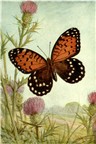 to continue to Part
III of Butterflies
to continue to Part
III of Butterflies