 Web
and Book design, Web
and Book design, Copyright, Kellscraft Studio 1999-2005 (Return to Web Text-ures) |
Click Here to return to Book of Boston Content Page Return to the Previous Chapter |
 (HOME) |
|
CHAPTER
XII FANEUIL
HALL AND THE
WATERSIDE  EAR the Old State House
and, like it, tucked in among big office buildings, you come
unexpectedly upon
a broad, plump, portly, comfortable, restful building, with an aspect
of age as
well as this aspect of ease, and you search elusively for words to
define its
impression, and you know that the right phrase has come when you hear
it called
the Cradle of Liberty; for it is a building that gives a comfortable
old-fashioned impression of a comfortable old-fashioned cradle –
although this
is not what gave it its cradle cognomen, but the fact that within its
walls the
fiery orators of pre-Revolutionary days made their most eloquent
appeals for liberty. EAR the Old State House
and, like it, tucked in among big office buildings, you come
unexpectedly upon
a broad, plump, portly, comfortable, restful building, with an aspect
of age as
well as this aspect of ease, and you search elusively for words to
define its
impression, and you know that the right phrase has come when you hear
it called
the Cradle of Liberty; for it is a building that gives a comfortable
old-fashioned impression of a comfortable old-fashioned cradle –
although this
is not what gave it its cradle cognomen, but the fact that within its
walls the
fiery orators of pre-Revolutionary days made their most eloquent
appeals for liberty.It is a distinguished
looking building, with its dignified regularity of windows, and the
good
old-fashioned dignity of its long sides, and its interesting
round-topped
tower. It is twice as large as it used to be – as Boston has grown so
this
cradle has naturally grown – but in doubling its length and increasing
its
height it lost none of its good old-fashioned symmetry, for the great
Bulfinch
undertook the work of enlargement and gave it his utmost care. The building was the
gift,
in 1742, of a public-spirited citizen named Peter Faneuil, who gave the
money
for it because he knew that Boston needed not only a good hall but a
market-place to take the place of the earlier market, at the Old State
House;
and a market-place was accordingly established in the lower floor. The
building
was burned a few years later, and promptly rebuilt, and the final
enlargement
that we now see was made a little more than a century ago. The hall itself,
above the
public market, is never rented, but is forever to be used freely by the
people
whenever they wish to meet together to discuss public affairs; and this
alone
would make the building proudly notable. And many a great man, and many
a man
who was deeply in earnest even if not great, has spoken in this hall.
And it is
still used freely for the public meetings of to-day. The meeting hall,
almost
square, has a right-angled arrangement of seats, and, with its rows of
Doric
columns, is quite distinguished. And one notices that a winding
stairway leads
down from the very floor of the speaker's platform and wonders if it is
to
facilitate the entrance of popular speakers in case of a great crowd,
or, on
the other hand, to facilitate the hasty exit of the unpopular! One
notices,
too, that the balcony has peculiar effectiveness of proportion, adding
much to
the effectiveness of the entire hall, and further notices, as an
additional
point on the part of Bulfinch, that this comes from his having made the
space
above the gallery a little higher than the space below, although the
first impression
is to the contrary. It is the same idea, carried out here in simple
wood, in
early America, on a small scale, that the great Giotto carried out so
splendidly on a large scale in his tower at Florence. The great painting
behind
the speaker's platform is fittingly a painting of a great American
oratorical
scene, for it represents Webster, in the United States Senate,
delivering his
celebrated reply to Hayne. Webster himself has spoken here in this hall
just as
all the famous orators of New England have spoken here, and here were
held some
most momentous early meetings, including that which, several years
before
Lexington and Bunker Hill, stated the rights of America so plainly and
imperatively as always to be held by the British to mark the real
beginning of
the Revolution. The paintings of
notables
that hang about the walls are to quite an extent copies, but what is
believed
to be an original Gilbert Stuart is the big painting of Washington, who
is
represented as about to mount his horse, at Dorchester Heights. This
painting,
however, would not have been made by Stuart had it not been for a
blacksmith!
For it seems that a wealthy citizen wished to pay for a painting of
Washington,
to be hung in this hall, and the town meeting was about to decide to
give the
commission to a certain Winstanley, when the blacksmith interposed his
objection. This Winstanley, a painter of no originality, had worked up
quite a
business in copying the Washingtons of Stuart, getting the idea of
doing so
from the fact that Stuart's Washingtons had frankly been copied and
adapted by
Stuart himself – which was a very different matter. Washington himself,
after
sitting to Stuart, had freely and knowingly accepted a copy, by Stuart,
of the
painting that had been made from the sittings, and the original itself
is now
in the Boston Museum of Fine Arts. The only other Washington that was
painted
by Stuart with his great subject personally before him was what is
known as the
Lansdowne portrait, which journeyed long ago to England. Whenever, for
years,
Stuart needed money – which was often! – he painted a Washington for
somebody,
by copying or adapting from his own work. Winstanley knew of this, for
there
was no secrecy about it, and those who got these Washingtons from
Stuart knew
that they were copies or replicas, but that they were Stuart's own
replicas;
they were the results of the great artist's personal study of his great
model;
whereas the copies of Stuart that Winstanley made and sold, one of
which made
its way as a veritable Stuart to the White House, and was picturesquely
taken
out of its frame by Dolly Madison to save it on the approach of the
British,
were in no proper sense Stuarts. Yet when Faneuil Hall was to have its
painting
of Washington it was about to be decided to buy a copy from the ready
Winstanley! And it was at this point that the blacksmith, who is
remembered
only as a man of the North End, arose and vehemently opposed the idea,
declaring that to procure a copy of Gilbert Stuart made by some one
else would
be a lasting disgrace when Gilbert Stuart himself was actually living
in the
city. At that, Stuart was promptly commissioned to paint a Washington
for
Faneuil Hall. And it is a pleasant recollection that Edward Everett, in
his
eulogy of Lafayette, delivered in this hall, electrified his hearers by
suddenly turning to this portrait of Washington and exclaiming: "Speak,
glorious Washington! Break the long silence of that votive canvas!" From time to time,
there
have been gatherings here not only for political objects or to record
grievances, but for social ends, and one such was a meeting at which
General
Gage, the royal governor, at a time when he knew that the Port Act was
about to
ruin the commerce and business of the town, rose and proposed a toast
"To
the prosperity of Boston"! And another was the ball given here, some
three-quarters of a century ago, in honor of the Prince de Joinville,
at which.
time Faneuil Hall and the adjoining Quincy Market, which was long ago
built to
meet the growing market needs of the city and whose gable faces the
gable of
Faneuil Hall, were connected by a temporary bridge and both buildings
were
aglow with light and thronged with guests. Quincy Market is itself 535
feet
long and covers 27,000 square feet of land. Another reminder of
Faneuil
Hall came to me in Windsor, England, recently, for in an out-of-the-way
corner
of that old town, near the foot of a picturesque and almost mysterious
stairway
which leads down from the huge castle on its height to a postern-door,
I
noticed a house with a tablet upon it. Something led me to cross the
street to
read, and I was interested to find that it was the home of Robert
Keayne, who
left old Windsor for Boston and founded in this new world the Ancient
and
Honorable Artillery Company, the oldest military organization in
America. And
how old it makes this country seem! For Keayne was born before the
settlement
of Boston, before even the settlement of Plymouth, and he founded the
artillery
company here in Boston in 1637, and the upper portion of Faneuil Hall
is used
as its armory. Keayne was only a
tailor
over in England, and it used to be an English saying that it takes
several
tailors to make a man, but Keayne, coming to America, showed that the
English
saying does not apply on this side of the ocean, for he certainly was a
man of
capacity and affairs, a man who did very much to establish the
foundations of
early Boston on a strong basis. That his will, written with his own
hand, and
disposing of some four thousand pounds – quite a fortune for those days
–
covered 158 folio pages, and that it is said to be the longest will on
record,
at least in New England, is but one of the side-lights on an
interesting
personality; but the most interesting thing he did was to found his
artillery
company, and he did this because he was a member of an old artillery
company in
London. Any man deserves to be remembered who puts in motion something
that
remains prominently in the public eye for almost three centuries; and
there
seems to be no reason why his organization should not continue for
centuries
more. Down by the big and
busy
South Station which, when it was opened in 1899, was said to be the
largest
railway terminal in the world and which still claims to be first in the
number
of persons using it daily, one does not expect to find anything
connected with
the Boston of the past; as you walk there, you think only of the rumble
and
thunder of present-day business, for the streets are thronged with
trolley cars
and heavy trucks and the sidewalks are crowded with busy business men,
and
elevated trains hurtle by on their spidery trestles. But you go on for a
little
beside the elevated, on Atlantic Avenue, and your attention is
attracted by a
bronze tablet, set into a building at one of the busiest corners, and
something
draws you to read it, and you find yourself deeply rewarded.
Ordinarily, in
these modern days, one does not stop to read tablets of the past on
buildings
of the present; one likes to look at buildings of the past and to read
of the
actions of the past, and it is likely to be rather uninteresting to
look at a
place which is merely the site of a happening and which is now covered
with
something which has no relation to that happening. But this tablet is
one of
the exceedingly worth while exceptions. At the top is the figure of a
full-rigged, old-time ship, and beneath the ship you read that this
tablet
marks the spot where formerly stood Griffin's Wharf; and lest you
forget what
Griffin's Wharf was, the tablet goes on to explain that here lay
moored, on
December 16, 1773, three British ships with cargoes of tea, and that
"to
defeat King George's trivial but tyrannical tax of three pence a
pound,"
about ninety citizens of Boston, partly disguised as Indians, boarded
the ships
and threw the cargoes – three hundred and forty-two chests in all –
into the
sea, "and made the world ring with the patriotic exploit of the Boston
Tea
Party." You cannot but feel
stirred
as you stand here, and the fact that where the wharf stood and ships
lay is now
all solid ground, built up with business blocks, does not take away
from the
sudden vision of the past which comes sweeping over you. For it was a
right
brave thing that those men did; it was an achievement of tremendous
daring in
the face of the power of England; and that the value of the tea was
great added
to the very real danger of most severe punishment: I have read, though
it seems
almost incredible, that the tea was valued at eighteen thousand pounds! One should not, however, enter this district except on a Sunday. On Sundays all is quiet and deserted; scarcely a single person is met; it is almost a solitude, and it is an excellent time to continue to some of the nearby, old-time wharves which do still represent the old-time Boston waterside. 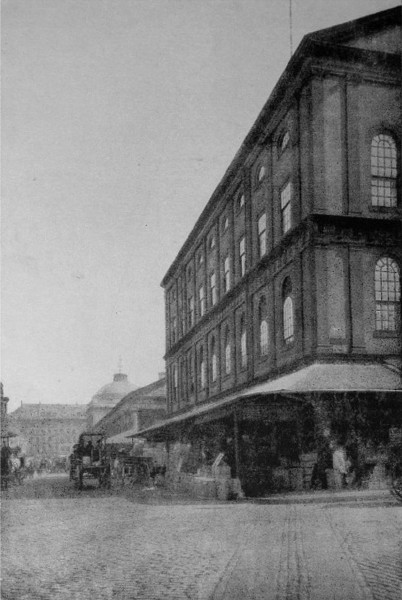 Faneuil Hall and Quincy Market It is but a short
walk,
continuing along Atlantic Avenue, to a big wharf which, although almost
covered
with modern cargo sheds, still retains its ancient name of India Wharf.
And the
wharf also retains the great old India Wharf building, standing
detached from
all the modern shipping sheds and towering up to its height of seven
stories –
really a towering height in early American days. A big, brick structure
it is,
built with a broad center and two broad wings, and giving a striking
effect of
isolation – an isolation that is at the same time both shabby and
proud. The
big building faces out toward the water and gives a fine air of
standing for
the old shipping prosperity that meant so much in the early days of
Boston; and
I cannot remember a more romantic looking business structure in America. The brick, laid in
English
bond, has mellowed to a weathered yellowness. The fifty windows of the
façade
were originally shuttered, but the shutters remain on only three, and
beside
the others the wrought-iron holders stick out like little black prongs.
Some of
the windows are arched with white stone; here and there across the
building's
front are remains of white marble lines; a monster chimney stands above
the
towering top of the middle gable; the two highest windows are fans, and
a shelf
between these two, now empty, up in the pediment, looks as though it
was
originally made to hold some figure, probably that of a ship; and the
lines of
the sash of these two lofty fans are like the longitude lines of a
globe. The pavement in front
of the
building is of enormous cobbles of granite, some of these blocks being
as large
as two feet by one, and they are just like ancient pavement blocks,
such as one
is accustomed to think of only in old Italian cities. India Wharf and the
wharves
adjoining are not parallel with the shore line but project in long
rectangles
right out into the water of the harbor. Long Wharf, near by, was given
its name
because at the time it was built it was the longest wharf in the
country; and
because it was so long, thus offering a point of military advantage, a
battery
used to stand out there on the very end of it. Central Wharf is also
interesting, with its long row of old-fashioned stone warehouses. In
fact, this
entire region tells vividly of the picturesque early business years
before the
great changes that came with railroads. T Wharf – which, when
you
see it on the street sign, "T Wf.," seems positively cryptic – is
picturesque in a high degree, for old-time-looking, full-rigged fishing
boats,
with rattling yards and ropes, are tied up alongside, and on Sundays
immense
nets are spread out on the wharf, at great length, with their rows of
cork
floats. Sea-gulls whirl over the wharves and the water, and dart
divingly for
their food, and cry their harshly wailing note; and on Sundays the
fishermen
and their friends, Americans and Italians, congregate about these boats
and the
wharf; and some of the fishermen – or perhaps they are dock hands or
market
porters – make their homes in the oddest of fleets, a covey of perhaps
a score
of little mastless boats, painted blue or green, and anchored close to
shore in
a space between two piers. And everywhere is the permeative smell of
fish. And
often the close-gathered fishing boats mass picturesquely against the
sky a
great tangle of masts and ropes and spars. Many of the buildings
among
these wharves stand on piling, and are partly over the water, and the
wharves
themselves are built of enormous blocks of stone, or of enormous
timbers. In
one place I noticed a long stretch of black beach beneath overhanging
flooring,
and it led back in strange, long, tunnel-like spaces among the wooden
supports,
into the distant darkness; and all seemed whispering of romance or
crime. Here one sees the
long-forgotten sign of "Wharfinger"; and there are little shops that
sell all sorts of sailors' supplies: ferocious knives with blades a
foot and a
half long, fish forks with handles as long as hay forks but with only a
single
prong, fog horns, anchors, hooks, woolen "wristers," oil skin
clothing, and "sou'westers" that have come straight out of Winslow
Homer's paintings. The sign, too, of
"hake
sounds" is remindful that this city of cod has also many another fish,
for
one finds there are the haddock, the mackerel and the herring; the
scrod –
which is really a little cod, although even Bostonians cannot always
tell when
the scrod becomes a cod or when a cod is still a scrod. There are the
swordfish
and spikefish; there are cusk and tinkers and eels; there are
butterfish,
flounders and perch; there are halibut and chicken-halibut; there are
bluefish,
sea-trout, bass and scup; there are oysters, lobsters, clams and the
giant
sea-clams so delectable in New England chowder; there are sculpin,
tautog and
quahog. On Commercial Wharf
is a row
of uniform old buildings of dignified solidity, all broad gabled and of
stone,
with rows of little dormers like hencoops on their high slate roofs.
When this
wharf was built, about a century ago, it was by far the finest of the
waterside
blocks of buildings, and men whose ships traded to the Cape of Good
Hope, the
Spanish Main, to India and China, to the North of Europe, flocked to it
to make
it their headquarters. And old-timers love to tell that, in their
boyhood,
old-timers of that period loved to tell them, that in those early days
of American
commerce the skillful captains of the ships would beat in under full
sail,
without assistance, up to these very wharves. The general district
adjacent to these old-time wharves is mostly given over to the modern,
but here
and there are still to be seen quaint roof lines, and old-fashioned
gables, and
odd street-corner lines, reminiscent of the days that have gone. There
is
considerable, in fact, to remind one of old-time business London,
including the
many narrow passages and alley-ways that go diving here and there among
the
buildings. Not far away, too, is Fort Hill Park, a level space, grassed
and
sparsely-treed, in the heart of modern business buildings, and
retaining the
circular shape remindful of its past: for here in early days rose a
hill a hundred
feet in height, and where it was cut partly down its slopes were
covered with
fashionable homes – Gilbert Stuart chose his residence here – and at
length it
was entirely leveled into its present simple form. Up a little distance
from
the waterside, on Custom House Street, is the old Custom House of
Boston, sadly
altered in looks from its early days, shorn of all distinction, and now
showing
a front of extraordinary plainness, with a sign denoting that it is a
"Boarding and Baiting Stable" – the "baiting" being itself
a queer reminder of a vanished time. The old Custom House
building is worth while making the few minutes' necessary pilgrimage to
see,
for here the collector of the port was Bancroft the historian, and one
of his
assistants was a certain young man of the name of Hawthorne! Bancroft
had been
attracted by some of Hawthorne's early short stories, and for that
reason had
offered him a position here. Hawthorne was rather
bored
by the work; he was gauger and weigher, but does not seem to have given
to the
duties of these humble offices the hard work that a certain other
writer, named
Robert Burns, devoted to similar duties. In fact, Hawthorne seems
always to
have considered public office a rather tiresome sort of thing to attend
to, in
spite of the fact that it gave certain financial advantages not to be
scorned
by novelists. I have somewhere read his own description of his work
here in
Boston, and he seemed to find the heat and the flies of the waterside
most
unpleasant; with nothing of offsetting pleasantness. Boston, at that
time, had
not discovered him – his recognition had been very slight. Somewhere I have read
a
brief description of him at this time, and it mentioned the delightful
fact,
which at once sets Hawthorne before us as a likable and very human man,
that he
loved to follow brass bands! Which amusing habit doubtless explains
why, over
in England, he notes in his journal that he had just seen march by the
regiment
of which George Washington was once enrolled as an officer! Close by this old
building-for one continually sees how near together are most of the
important
or interesting things in Boston – is the new Custom House, an extremely
notable
structure, towering up to the height of 498 feet above the sidewalk;
and the
building does literally tower, for it may be said to be all tower!
Years ago, a
dignified structure, with pillared fronts, was built, in the form of a
Greek
cross, to replace the old building of Bancroft and Hawthorne, but the
business
of the city gradually outgrew it, and an appropriation was made by
Congress for
larger quarters. Real estate, however, had so gone up in price in
Boston that
the appropriation was not sufficient to buy land as well as to put up a
building, and so the expedient was hit upon of running up the building
itself
into the air! The pillared fronts, with their thirty-two great Doric
columns,
still remain, but the entire center has risen, splendidly dominating in
its
immense height, making a tower which, though not quite beautiful, can
be seen
for miles in all directions. The city of Boston forbids the erection of
any
building within its limits higher than 125 feet, but the United States,
taking
advantage of the fact that it owns as a National Government the land
upon which
any of its public buildings stands, simply ignored the Boston
restriction and
went right ahead with this higher tower. And the people of Boston,
themselves,
are not displeased, although this was done in spite of them; in fact,
they say
that it gives a beacon-like effect to the city which rather matches the
generally desired tone. At the same time, it fits in with the beacon
idea of
the early days, and the fact that old Boston of England is also
dominated by a
tower which can be plainly seen for miles and miles across the fenland
does certainly
add to the sense of appropriateness. And that the Custom House stands
so
supreme over everything else in Boston, that it so dominates, is but
natural
after all – for in Boston it is natural for Custom to dominate! 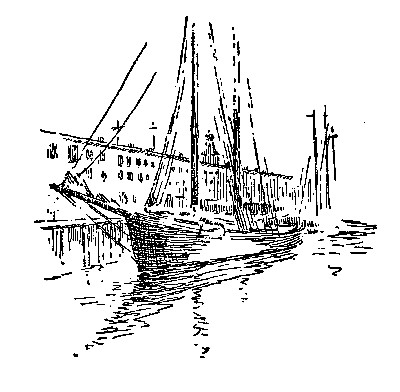 |
 Click the book image to turn to the next Chapter.