|
BLACKBOARD
SKETCHING
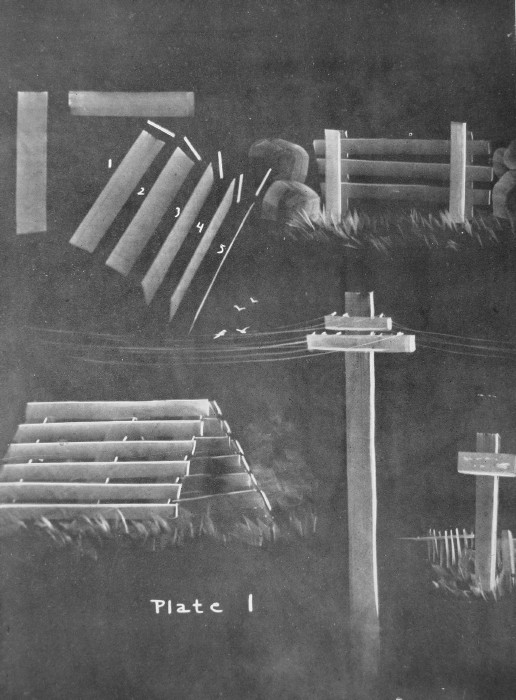
PLATE 1
For the
first
lesson I advise trying the simplest possible stroke, and its
application in the
sketching of very simple things. The stroke is a straight mark with the
side of
the chalk.
Take
half or two-thirds of a stick of chalk, discard the small end, and use
such a
piece in nearly all the lessons given. In this case place the chalk
horizontally upon the board, and drag it gradually downward, keeping an
even
pressure upon the chalk. Try this in various directions.
The
oblique lines
show what a variety of width may be obtained by changing the angle of
the
chalk. At 1, the full length of the chalk is required to give the broad
stroke
desired. At Nos. 2, 3, 4 and 5, the line above the stroke indicates the
angle
at which the chalk is placed in order to give the width of the strokes
below.
The use of the chalk in this manner enables one to obtain any desired
width of
line, without constantly changing the piece of chalk. A light or dark
tone is
produced by varying the pressure upon the chalk.
In drawing
the
telegraph pole, draw first a delicate vertical stroke, then add the
horizontal
cross pieces with a stronger accent, and last the white strokes
indicating
thickness.
In the
case of the
chicken coop, draw first the oblique slats, then with a stronger
pressure upon
the chalk, add the horizontal slats, and lastly, with the point of the
chalk
add the accented bits of detail.
Almost any
simple
object composed of straight lines may be drawn in this manner.
|


 Click the book image to turn to the next Chapter.