THE LITTLE JACKALS AND THE
LION Once there was a great big
jungle; and in the jungle there was a great big Lion; and the Lion was
king of
the jungle. Whenever he wanted anything to eat, all he had to do was to
come up
out of his cave in the stones and earth, and roar. When he had roared a
few
times all the little people of the jungle were so frightened that they
came
out of their holes and hiding-places and ran, this way and that, to
get away.
Then, of course, the Lion could see where they were. And he pounced on
them,
killed them, and gobbled them up.
He did this so often that at
last there was not a single thing left alive in the jungle besides the
Lion,
except two little Jackals, -- a little father Jackal and a little
mother
Jackal.
They had run away so many
times that they were quite thin and very tired, and they could not run
so fast
any more. And one day the Lion was so near that the little mother
Jackal grew
frightened; she said, --
"Oh, Father Jackal,
Father Jackal! I b'lieve our time has come! the Lion will surely catch
us this
time!"
"Pooh, nonsense,
mother! " said the little father Jackal. "Come, we'll run on a
bit!"
And they ran, ran, ran very
fast, and the Lion did not catch them that time.
But at last a day came when
the Lion was nearer still and the little mother Jackal was frightened
about to
death.
"Oh, Father Jackal,
Father Jackal!" she cried; " I'm sure our time has come! The Lion 's
going to eat us this time!"
"Now, mother, don't you
fret," said the little father Jackal; "you do just as I tell you, and
it will be all right."
Then what did those cunning
little Jackals do but take hold of hands and run up towards the Lion,
as if
they had meant to come all the time. When he saw them coming he stood
up, and
roared in a terrible voice, --
"You miserable little
wretches, come here and be eaten, at once! Why didn’t you come before?"
The father Jackal bowed very
low.
"Indeed, Father
Lion," he said, "we meant to come before; we knew we ought to come
before; and we wanted to come before; but every time we started to
come, a
dreadful great lion came out of the woods and roared at us, and
frightened us
so that we ran away."
"What do you
mean?" roared the Lion. "There 's no other lion in this jungle, and
you know it!"
"Indeed, indeed, Father
Lion," said the little Jackal, "I know that is what everybody thinks;
but indeed and indeed there is another lion! And he is as much bigger
than you
as you are bigger than I! His face is much more terrible, and his roar
far, far
more dreadful. Oh, he is far more fearful than you!"
At that the Lion stood up
and roared so that the jungle shook.
"Take me to this
lion," said he; "I'll eat him up and then I'll eat you up."
The little Jackals danced on
ahead, and the Lion stalked behind. They led him to a place where there
was a
round, deep well of clear water. They went round on one side of it, and
the
Lion stalked up to the other.
"He lives down there,
Father Lion!" said the little Jackal. "He lives down there!"
The Lion came close and looked
down into the water -- and a lion's face looked back at him out of the
water!
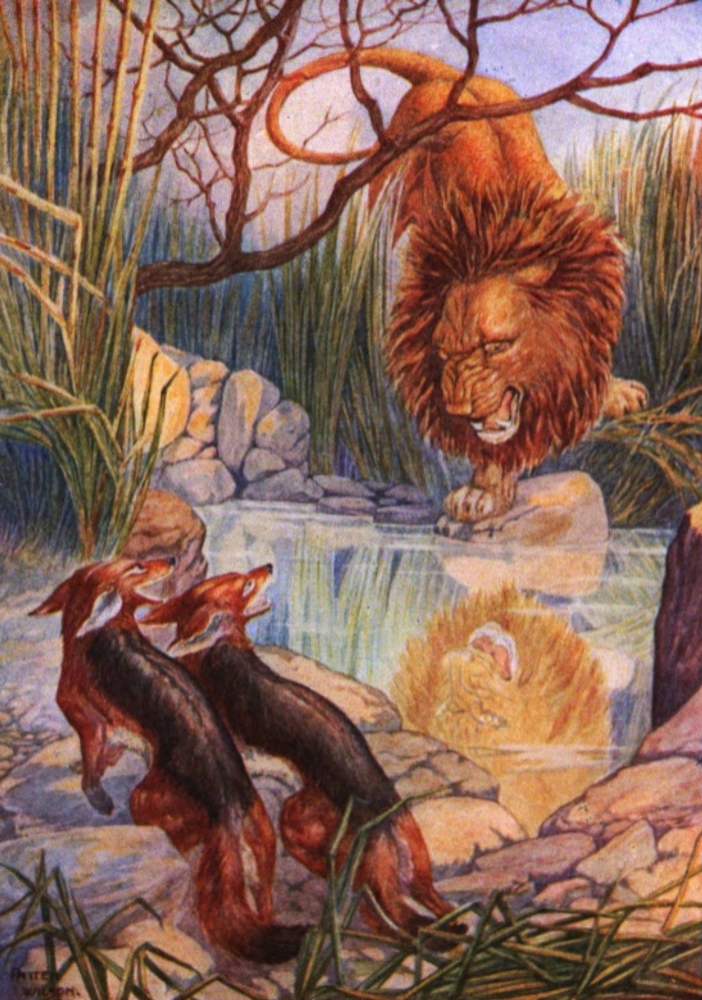 THE
LION IN THE WATER SHOOK HIS MANE AND SHOWED HIS TEETH
THE
LION IN THE WATER SHOOK HIS MANE AND SHOWED HIS TEETH
When he saw that, the Lion
roared and shook his mane and showed his teeth. And the lion in the
water shook
his mane and showed his teeth. The Lion above shook his mane again and
growled
again, and made a terrible face. But the lion in the water made just as
terrible a one, back. The Lion above couldn’t stand that. He leaped
down into
the well after the other lion.
But, of course, as you know
very well, there wasn’t any other lion! It was only the reflection in
the
water. So the poor old Lion floundered about and floundered about, and
as he
couldn't get up the steep sides of the well, he was drowned dead. And
when he
was drowned the little Jackals took hold of hands and danced round the
well,
and sang, --
"The Lion is dead! The
Lion is dead!
"We have killed the
great Lion who would have killed us!
"The Lion is dead! The
Lion is dead!
"Ao! Ao! Ao!"
LITTLE JACK
ROLLAROUND
Once upon a time there was a
wee little boy who slept in a tiny trundle-bed near his mother's great
bed. The
trundle-bed had castors on it so that it could be rolled about, and
there was
nothing in the world the little boy liked so much as to have it rolled.
When
his mother came to bed he would cry, "Roll me around! roll me
around!" And his mother would put out her hand from the big bed and
push
the little bed back and forth till she was tired. The little boy could
never
get enough; so for this he was called "Little Jack Rollaround."
One night he had made his
mother roll him about, till she fell asleep, and even then he kept
crying,
"Roll me around! roll me around!"' His mother pushed him about in her
sleep, until she fell too soundly aslumbering; then she stopped. But
Little
Jack Rollaround kept on crying, "Roll around! roll around!"
By and by the Moon peeped in
at the window. He saw a funny sight: Little Jack Rollaround was lying
in his
trundle-bed, and he had put up one little fat leg for a mast, and
fastened the
corner of his wee shirt to it for a sail; and he was blowing at it with
all his
might, and saying, "Roll around! roll around!"
Slowly, slowly, the little
trundle-bed boat began to move; it
sailed along the floor and up the wall and across the ceiling and down
again!
"More! more!"
cried Little Jack Rollaround; and the little boat sailed faster up the
wall,
across the ceiling, down the wall, and over the floor. The Moon
laughed at the
sight; but when Little Jack Rollaround saw the Moon, he called out,
"Open
the door, old Moon! I want to roll through the town, so that the people
can see
me!"
The Moon could not open the
door, but he shone in through the keyhole, in a broad band. And Little
Jack
Rollaround sailed his trundle-bed boat up the beam, through the
keyhole, and
into the street. "Make a light, old Moon," he said; "I want the
people to see me!"
So the good Moon made a
light and went along with him, and the little trundle-bed boat went
sailing
down the streets into the main street of the village. They rolled past
the town
hall and the schoolhouse and the church; but nobody saw Little Jack
Rollaround,
because everybody was in bed, asleep.
"Why don't the people
come to see me?" he shouted.
High up on the church
steeple, the Weather-vane answered, "It is no time for people to be in
the
streets; decent folk are in their beds."
"Then I'll go to the
woods, so that the animals may see me," said Little Jack. "Come
along, old Moon, and make a light!"
The good Moon went along and
made a light, and they came to the forest. "Roll! roll!" cried the
little boy; and the trundle-bed went trundling among the trees in the
great
wood, scaring up the chipmunks and startling the little leaves on the
trees.
The poor old Moon began to have a bad time of it, for the tree-trunks
got in
his way so that he could not go so fast as the bed, and every time he
got
behind, the little boy called, "Hurry up, old Moon, I want the beasts
to
see me!"
But all the animals were
asleep, and nobody at all looked at Little Jack Rollaround except an
old White
Owl; and all she said was, "Who are you?"
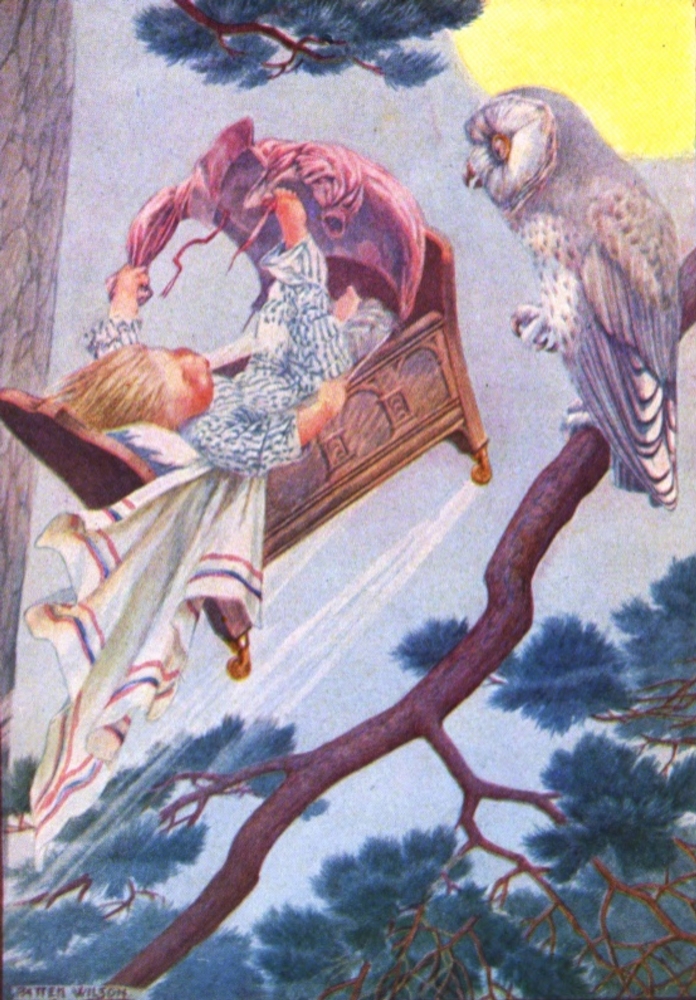 ALL
SHE SAID WAS, 'WHO ARE YOU?'
ALL
SHE SAID WAS, 'WHO ARE YOU?'
The little boy did not like
her, so he blew harder, and the trundle-bed boat went sailing through
the
forest till it came to the end of the world.
"I must go home now; it
is late," said the Moon.
"I will go with you;
make a path! " said Little Jack Rollaround.
The kind Moon made a path up
to the sky, and up sailed the little bed into the midst of the sky. All
the
little bright Stars were there with their nice little lamps. And when
he saw
them, that naughty Little Jack Rollaround began to tease.
"Out of the way, there!
I am coming! " he shouted, and sailed the trundle-bed boat straight at
them. He bumped the little Stars right and left, all over the sky,
until every
one of them put his little lamp out and left it dark.
" Do not treat the
little Stars so," said the good Moon.
But Jack Rollaround only
behaved the worse: "Get out of the way, old Moon!" he shouted,
"I am coming!"
And he steered the little
trundle-bed straight into the old Moon's face, and bumped his nose!
This was too much for the
good Moon; he put out his big light, all at once, and left the sky
pitch-black.
"Make a light, old Moon! Make a light!" shouted the little boy. But
the Moon answered never a word, and Jack Rollaround could not see where
to
steer. He went rolling criss-cross, up and down, all over the sky,
knocking
into the planets and stumbling into the clouds, till he did not know
where he
was.
Suddenly he saw a big yellow
light at the very edge of the sky. He thought it was the Moon. "Look
out,
I am coming!" he cried, and steered for the light.
But it was not the kind old
Moon at all; it was the great mother Sun, just coming up out of her
home in the
sea, to begin her day's work.
"Aha, youngster, what
are you doing in my sky?" she said. And she picked Little Jack
Rollaround
up and threw him, trundle-bed boat and all, into the middle of the sea!
And I suppose he is there
yet, unless somebody picked him out again.
HOW BROTHER RABBIT FOOLED
THE WHALE AND THE ELEPHANT
One day little Brother
Rabbit was running along on the sand, lippety, lippety, when he saw the
Whale
and the Elephant talking together. Little Brother Rabbit crouched down
and
listened to what they were saying. This was what they were saying: --
"You are the biggest
thing on the land, Brother Elephant," said the Whale, "and I am the
biggest thing in the sea; if we join together we can rule all the
animals in
the world, and have our way about everything."
"Very good, very
good," trumpeted the Elephant; "that suits me; we will do it."
Little Brother Rabbit
snickered to himself. "They won't rule me," he said. He ran away and
got a very long, very strong rope, and he got his big drum, and hid the
drum a
long way off in the bushes. Then he went along the beach till he came
to the
Whale.
"Oh, please, dear,
strong Mr. Whale," he said, "will you have the great kindness to do
me a favour? My cow is stuck in the mud, a quarter of a mile from here.
And I
can't pull her out. But you are so strong and so obliging, that I
venture to
trust you will help me out."
The Whale was so pleased with
the compliment that he said, "Yes," at once.
"Then," said the
Rabbit, "I will tie this end of my long rope to you, and I will run
away
and tie the other end round my cow, and when I am ready I will beat my
big
drum. When you hear that, pull very, very hard, for the cow is stuck
very deep
in the mud."
"Huh! " grunted
the Whale, "I'll pull her out, if she is stuck to the horns."
Little Brother Rabbit tied
the rope-end to the Whale, and ran off, lippety, lippety, till he came
to the
place where the Elephant was.
"Oh, please, mighty and
kindly Elephant," he said, making a very low bow, "will you do me a
favor?"
"What is it? "
asked the Elephant.
"My cow is stuck in the mud, about a quarter of
a mile from here," said little Brother Rabbit, "and I cannot pull her
out. Of course you could. If you will be so very obliging as to help me
-"
"Certainly," said
the Elephant grandly, " certainly."
"Then," said
little Brother Rabbit, "I will tie one end of this long rope to your
trunk, and the other to my cow, and as soon as I have tied her tightly
I will
beat my big drum. When you hear
that, pull; pull as hard as you can, for my
cow is very heavy."
"Never fear," said
the Elephant, " I could pull twenty cows."
"I am sure you
could," said the Rabbit, politely, "only be sure to begin gently, and
pull harder and harder till you get her."
Then he tied the end of the
rope tightly round the Elephant's trunk, and ran away into the bushes.
There he
sat down and beat the big drum.
The Whale began to pull and
the Elephant began to pull, and in a jiffy the rope tightened till it
was
stretched as hard as could be.
"This is a remarkably
heavy cow," said the Elephant; "but I'll fetch her!" And he
braced his forefeet in the earth, and gave a tremendous pull.
"Dear me!" said
the Whale. "That cow must be stuck mighty tight;" and he drove his
tail deep in the water, and gave a marvelous pull.
He pulled harder; the
Elephant pulled harder. Pretty soon the Whale found himself sliding
toward the
land. The reason was, of course, that the Elephant had something solid
to
brace against, and, too, as fast as he pulled the rope in a little, he
took a
turn with it round his trunk!
But when the Whale found
himself sliding toward the land he was so provoked with the cow that he
dove
head first, down to the bottom of the sea. That was a pull! The
Elephant was
jerked off his feet, and came slipping and sliding to the beach, and
into the
surf. He was terribly angry. He braced himself with all his might, and
pulled
his best. At the jerk, up came the Whale out of the water.
"Who is pulling
me?" spouted the Whale.
"Who is pulling
me?" trumpeted the Elephant. And then each saw the rope in the other's
hold.
"I'll teach you to play
cow!" roared the Elephant.
"I'll show you how to
fool me!" fumed the Whale. And they began to pull again. But this time
the
rope broke, the Whale turned a somersault, and the Elephant fell over
backwards.
At that, they were both so
ashamed that neither would speak to the other. So that broke up the
bargain
between them.
And little Brother Rabbit
sat in the bushes and laughed, and laughed, and laughed.
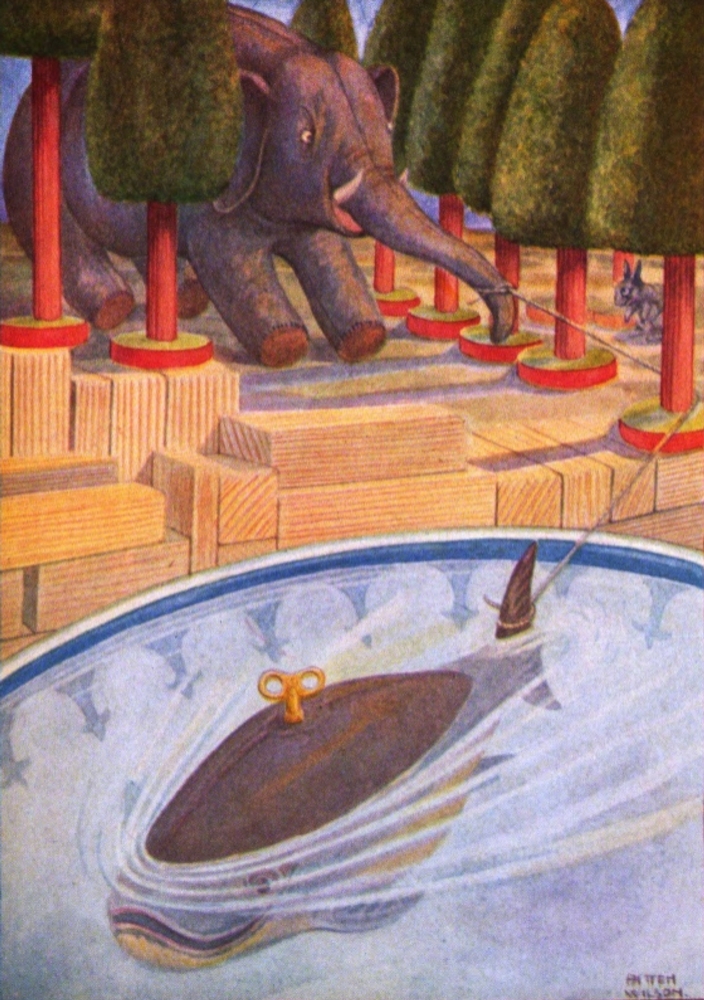 THE
ELEPHANT . . . BRACED HIMSELF WITH ALL HIS MIGHT, AND PULLED HIS BEST
THE
ELEPHANT . . . BRACED HIMSELF WITH ALL HIS MIGHT, AND PULLED HIS BEST
THE LITTLE
HALF-CHICK
There was once upon a time a
Spanish Hen, who hatched out some nice little chickens. She was much
pleased
with their looks as they came from the shell. One, two, three, came out
plump
and fluffy; but when the fourth shell broke, out came a little
half-chick! It
had only one leg and one wing and one eye! It was just half a chicken.
The Hen-mother did not know
what in the world to do with the queer little Half-Chick. She was
afraid
something would happen to it, and she tried hard to protect it and keep
it from
harm. But as soon as it could walk the little Half-Chick showed a most
headstrong
spirit, worse than any of its brothers. It would not mind, and it would
go wherever
it wanted to; it walked with a funny little hoppity-kick,
hoppity-kick, and
got along pretty fast.
One day the little
Half-Chick said, "Mother, I am off to Madrid, to see the King!
Good-by."
The poor Hen-mother did
everything she could think of to keep
him from doing so foolish a thing, but the little Half-Chick laughed at
her
naughtily.
' "I'm for seeing the
King," he said; "this life is too quiet for me." And away he
went, hoppity-kick, hoppity-kick, over
the fields.
When he had gone some distance
the little Half-Chick came to a little brook that was caught in the
weeds and
in much trouble.
"Little
Half-Chick," whispered the Water, "I am so choked with these weeds
that I cannot move; I am almost lost, for want of room; please push the
sticks and
weeds away with your bill and help me."
"The idea!" said
the little Half-Chick. "I cannot be bothered with you; I am off for
Madrid, to see the King!" And in spite of the brook's begging he went
away, hoppity-kick, hoppity-kick.
A bit farther on, the Half-Chick
came to a Fire, which was smothered in
damp sticks and in great distress.
"Oh, little
Half-Chick," said the Fire, "you are just in time to save me. I am
almost dead for want of air. Fan me a little with your wing, I beg."
"The idea!" said
the little Half-Chick. "I cannot be bothered with you; I am off to
Madrid,
to see the King!" And he went laughing off, hoppity-kick, hoppity-kick.
When he had hoppity-kicked a
good way, and was near Madrid, he came to a clump of bushes, where the
Wind was
caught fast. The Wind was whimpering, and begging to be set free.
"Little
Half-Chick," said the Wind, "you are just in time to help me; if you
will brush aside these twigs and leaves, I can get my breath; help me,
quickly!
"
"Ho! the idea!"
said the little Half-Chick. "I have no time to bother with you. I am
going
to Madrid to see the King." And he went off, hoppity-kick,
hoppity-kick,
leaving the Wind to smother.
After a while he came to
Madrid and to the palace of the King. Hoppity-kick, hoppity-kick, the
little
Half-Chick skipped past the sentry at the gate, and hoppity-kick,
hoppity-kick,
he crossed the court. But as he was passing the windows of the kitchen
the Cook
looked out and saw him.
"The very thing for the
King's dinner!" she said. "I was needing a chicken!" And she
seized the little Half-Chick by his one wing and threw him into a
kettle of
water on the fire.
The Water came over the
little Half-Chick's feathers, over his head, into his eye. It was
terribly uncomfortable.
The little Half-Chick cried out, --
"Water, don't drown me!
Stay down, don't come so high!"
But the Water said,
"Little Half-Chick, little Half-Chick, when I was in trouble you would
not help me," and came higher than ever.
Now the Water grew warm,
hot, hotter, frightfully hot; the little Half-Chick cried out, "Do not
burn so hot, Fire! You are burning me to death! Stop! "
But the Fire said,
"Little Half-Chick, little Half-Chick, when I was in trouble you would
not help me," and burned hotter than ever.
Just as the little Half-Chick
thought he must suffocate, the Cook took the cover off, to look at the
dinner.
"Dear me," she said, "this chicken is no good; it is burned to a
cinder." And she picked the little Half-Chick up by one leg and threw
him
out of the window.
In the air he was caught by
a breeze and taken up higher than the trees. Round and round he was
twirled
till he was so dizzy he thought he must perish. "Don't blow me so,
Wind," he cried, "let me down!"
"Little Half-Chick,
little Half-Chick," said the Wind, " when I was in trouble you would
not help me!" And the Wind blew him straight up to the top of the
church
steeple, and stuck him there, fast!
There he stands to this day,
with his one eye, his
one wing, and his one leg.
He cannot hoppity-kick any more, but he turns slowly round when the
wind blows,
and keeps his head toward it, to hear what it says.
|


 Click the book image to turn to the next Chapter.